
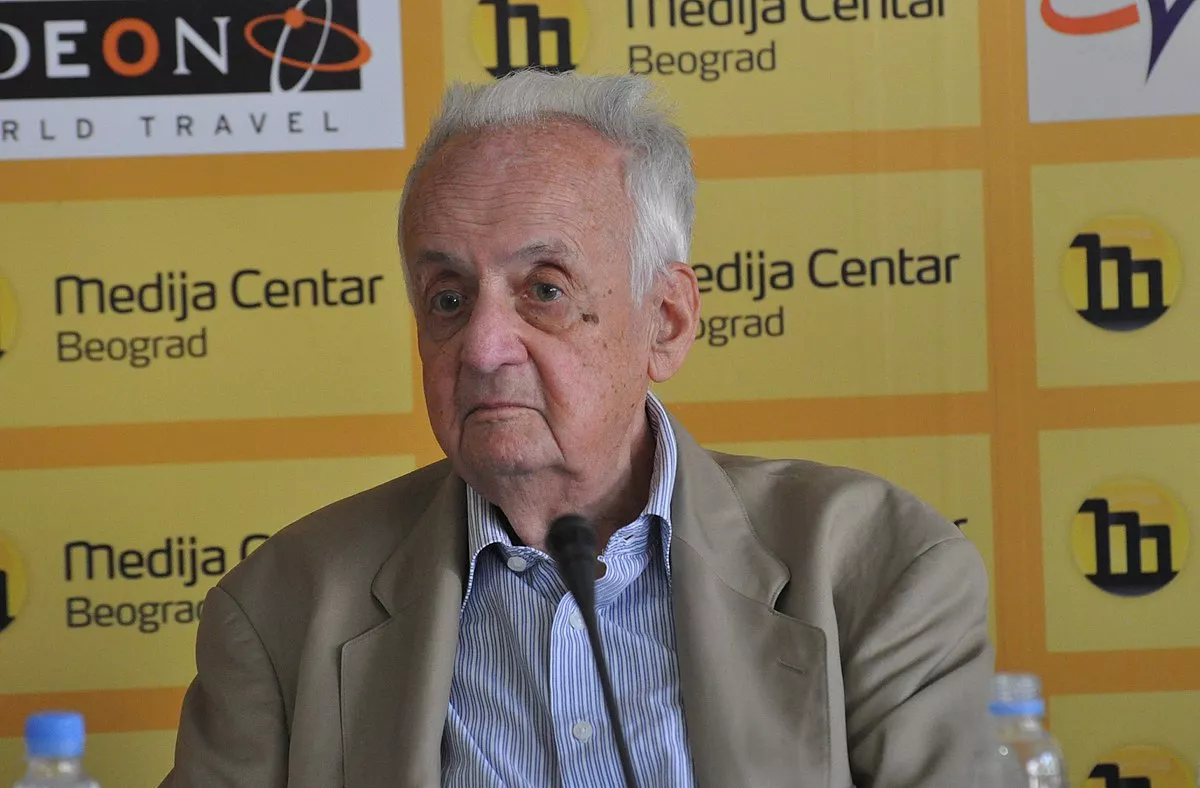
Recorded by: Sead Omeragić
Ivan Ivanji (90), a great literary and translation name, yesterday, January 24, turned 90 years old. In parallel with his career as an educator, diplomat, and journalist, he translated the most beautiful European literature. He translated Danilo Kiš, David Albahari, Vidosav Stevanović into German, and Günter Grass, Rosa Luxemburg, Karl Jaspers from German, and Sándor Petőfi, Endre Ady, János Herceg from Hungarian... He wrote fairy tales for children, stories, essays, and numerous extremely popular historical novels. He openly warned against historical revisionism in Serbia. He summarizes this in the sentence: "Emperor Trajan did not have goat ears, but he built a bridge across the Danube."
On his birthday, always an interesting interlocutor, Ivan Ivanji recalled some life details for the Patria news agency. He shared his views on people and homeland from the perspective of a translator:
Ivanji: Weak people, who do not find solid ground within themselves, seek community in religion or nation. Brecht once said that he would never use the word "people" because in German it sounds Nazi; if necessary, he would say "population." Try to translate the word, or rather, the concept, "narod" (people/nation), as it sounds in our common language, into English. Impossible. You can say "Nation," but that is a nation, not a people; "People," but that is people in the sense of "come on, people, let's drink," or "Folks," which sounds folkloristic or like "humans." I also have a problem with the concepts "otadžbina" (fatherland), "domovina" (homeland), because in our language they have such a strange nationalistic connotation. However, I deeply love my homeland in the narrow and broad sense. I could live, for example, in Austria; I have Austrian citizenship, I speak German with an Austrian accent, not like a foreigner, but for me, something like a fatherland-homeland is Voždovac in Belgrade, then Banat in Vojvodina, Vojvodina in Serbia, Serbia in the former Yugoslavia... I cannot reconcile myself with the fact that Bled and Bohinj, Rovinj and Zagreb, Sarajevo and Mostar, Budva and Lovćen, Ohrid and Skopje are not mine. Gustav Heinemann, who was the President of the Federal Republic of Germany from 1969-1974, answered a journalist's question that he was not a patriot. The journalist asked in amazement: "Mr. President, don't you love Germany?" The answer was: "No, I don't love states, I love my wife."
He was Tito's translator, but he admits he was not very close to him...
Ivanji: Let's calm things down, yes, I translated for Tito, yes, I claimed that a translator sees his client "intellectually in their underwear," but unfortunately, I cannot boast of being very close to him. I only had the opportunity to exchange a few private sentences with him on two or three occasions. The most striking? His calmness, phenomenal memory into deep old age, and sense of humor. As for the various stupidities written about him? A living person must endure stupidities. Emperor Trajan did not have goat ears, but he built a bridge across the Danube. At a historical distance, the facts will emerge, and it will be understood which books are true and that on a global scale, Tito was one of the most impressive figures of the twentieth century.
He had friendships and closeness with world literary giants, Nobel laureates, such as Günter Grass, with whom he was in contact until his death...
Ivanji: Yes, Grass also died. Coincidentally, we corresponded just before his death after a long time. I knew he was ill, but not that his departure was so close. By chance, he gave his last interview in his life to my son, Andrej. When you get old like me, the air around you thins. More than these distant friends, I miss Ivan V. Lalić, Predrag Palavestra, Branimir Živojinović, and many others who were not from literary-artistic circles; there are few contemporaries. When it comes to literature, there are new giants. I don't want to single out anyone from our post-Yugoslavian area; here are a few from further away, and they are indeed giants. The other day, Amos Oz from Israel died; for me, alongside him at the very top of world literature is Mo Yan from China, but I point to Arundhati Roy from India, Chigozie Obioma from Nigeria, Gaël Faye from Burundi – and that's without even starting with the more famous writers from America, England, France, and Latin America; there is plenty to read.
In recent years, he created and wrote three historical novels about Roman emperors...
Ivanji: I truly believe that my novels about Roman emperors are the best and most important things I have published, but at the beginning of the work on that trilogy was an accident. Oto Bihalji Merin, as the editor of the publishing house "Jugoslavija," planned a picture book about Diocletian's Palace and commissioned me to write a twenty-page introduction. I started reading about this great man, returned the task to Bihalji, and wrote a novel. Since the young Constantine plays an important role in Diocletian's life, as the son of his close friend and co-emperor Constantius, the story of Constantine begins in the novel about Diocletian, so it was logical that I had to write a separate novel about him later. At the end of the book about Constantine, I mention what will happen after his death, and thus we come to Julian. After the first printing of Diocletian, I published several editions of all three books, always correcting something; the definitive edition is only the one from "Laguna" after more than forty years of work. I tried to make the stories about these emperors a reflection of contemporary events. For example, the model for the character of Blasius in the novel about Diocletian is Tito's long-time media advisor, Blažo Mandić. Blažo and Tito knew and approved of this.
Will we hope for peace and good times after the terrible years of conflict...
Ivanji: It would be terrible if there were no hope. I don't expect us to be normal soon, especially since the whole world is moving in a direction that is unpleasant for me, an old man; perhaps this abnormality is something normal. However, even though I have no hope, I offer comfort. When I think about the time of the great Roman Empire and how people lived then, I don't see much difference in culture and politics, but huge differences in civilization. We in the northern part of Europe and America have – if we have it – electricity, water supply, and sewage systems, and – as during this correspondence – we don't stick stamps on envelopes, we don't have to go to the post office, or wait for the postman, but we click and we are connected. Isn't that progress?!
Komentari (0)
Prijavite se za komentiranje
PrijavaJos nema komentara. Budite prvi!
Minuta
Sve →Iz drugih kategorija

High Representative Not Elected: Germans, French and British Sabotaged Americans, New Attempt at End of June

ČOVIĆ WITHOUT MERCY: How Those Who Brought Ademović to Office Created a Political Hell for Him



Sunny Saturday, quite warm



Tragedy in Albanian resort: Two minors drown












