
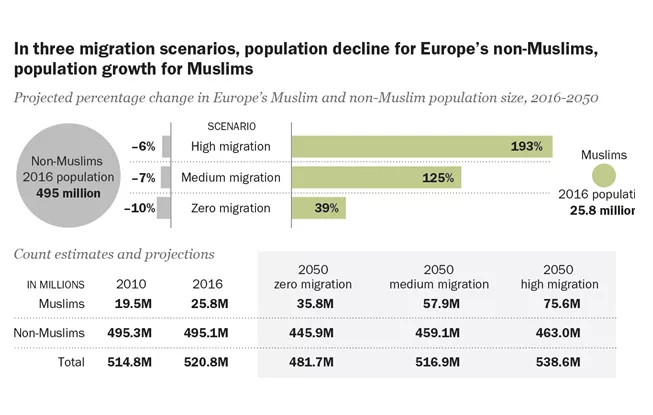
WASHINGTON, (Patria) - Although every second migrant is not Muslim, Europe is exclusively dealing with Muslim refugees. A study by "Pew Research Center", published in November 2017, shows predictions of a potential increase in Muslims under three scenarios, reports Patria agency.
This study presents possible percentages of the increase of Muslims on European soil.
In recent years, Europe has experienced a record influx of asylum seekers who fled conflicts in Syria and other Muslim-majority countries. The wave of Muslim migrants has sparked debate about immigration and security policies in many countries and raises questions about the current and future number of Muslims in Europe.
To see how the size of Europe's Muslim population may change over the coming decades, the "Pew Research Center" has modeled three scenarios that differ depending on future migration levels.
The baseline for all three scenarios is the Muslim population in Europe (defined as the 28 countries currently in the European Union, plus Norway and Switzerland). As of mid-2016, the Muslim population in Europe was estimated at 25.8 million (4.9% of the total population) - up from 19.5 million (3.8%) in 2010. (France currently has 5.72 million Muslims, Germany 4.95 million, the UK 4.13 million, Italy 2.87 million, the Netherlands 1.21 million, Spain 1.18 million, etc. - according to Pew Research Center tables).
Even if all migration to Europe stops immediately and permanently - a zero-migration scenario - Europe's Muslim population is expected to grow from the current level of 4.9% to 7.4% by 2050. This is because Muslims are younger (average age 13) and have higher fertility (an average of one more child per family) than other Europeans, reflecting a global pattern.
A second, "medium" migration scenario assumed that all large refugee flows would cease by mid-2016, but that "regular" migration to Europe would continue. Under such conditions, by 2050, Muslims could reach 11.2% of the European population.
Finally, a "high" migration scenario predicts a record wave of refugees in Europe... In this scenario, Muslims will constitute 14% of Europe's population by 2050 – nearly triple the current share, but still significantly lower than the population of Christians and religiously unaffiliated people in Europe.
However, refugee flows in recent years have been exceptionally high compared to historical averages over the past few decades. The influx has already begun to decline as many of the European Union member states have made policy changes to limit the arrival of refugees.
Predictions of future migration levels are impossible, as migration rates will depend not only on political and economic conditions outside Europe, but also on the changing situation and government economic policies within Europe... For example, if there is regular migration... but not like during the historically exceptional refugee wave from 2014 to 2016 - then the share of Muslims in the European population by 2050 is expected to be between 11.2 and 14 percent.
While the number of Muslims in Europe is expected to increase in all three scenarios - more than doubling in the medium and high migration scenarios - on the other hand, the number of European non-Muslims is projected to decline in every scenario. However, migration somewhat mitigates the effects of this decline. Nearly half of all recent migrants to Europe (47%) were not Muslim, with Christians making up the next largest group of migrants.
Overall, the population of Europe (including both Muslims and non-Muslims) is expected to decline significantly (from about 521 million to about 482 million) without future migration. In the medium migration scenario, the population will remain roughly stable, and the high migration scenario should see a slight increase.
The impact of these scenarios is uneven across different European countries; largely due to government policies, some countries are much more affected by migration than others.
Countries that have received a relatively large number of Muslim refugees in recent years are projected to experience the greatest changes in the high migration scenario... For example, Germany's population (6% Muslim in 2016) would be projected to be about 20% Muslim by 2050 in the high scenario - a reflection of Germany having accepted many Muslim refugees in recent years - compared to 11% in the medium scenario and 9% in the zero-migration scenario...
Sweden's population (8% Muslim in 2016) could rise to 31% Muslim in the high scenario by 2050, compared to 21% in the medium scenario and 11% without further Muslim migration.
In contrast, countries projected to experience the greatest changes in the medium scenario (such as the UK) are typically destinations for the largest number of regular Muslim migrants.
"Countries with a Muslim population that is particularly young, or have a relatively large number of children, will see the most significant change in the zero-migration scenario; this includes France, Italy, and Belgium," states the Pew Research Center study.
Komentari (0)
Prijavite se za komentiranje
PrijavaJos nema komentara. Budite prvi!
Minuta
Sve →Iz drugih kategorija

High Representative Not Elected: Germans, French and British Sabotaged Americans, New Attempt at End of June

ČOVIĆ WITHOUT MERCY: How Those Who Brought Ademović to Office Created a Political Hell for Him



Sunny Saturday, quite warm



Tragedy in Albanian resort: Two minors drown












