
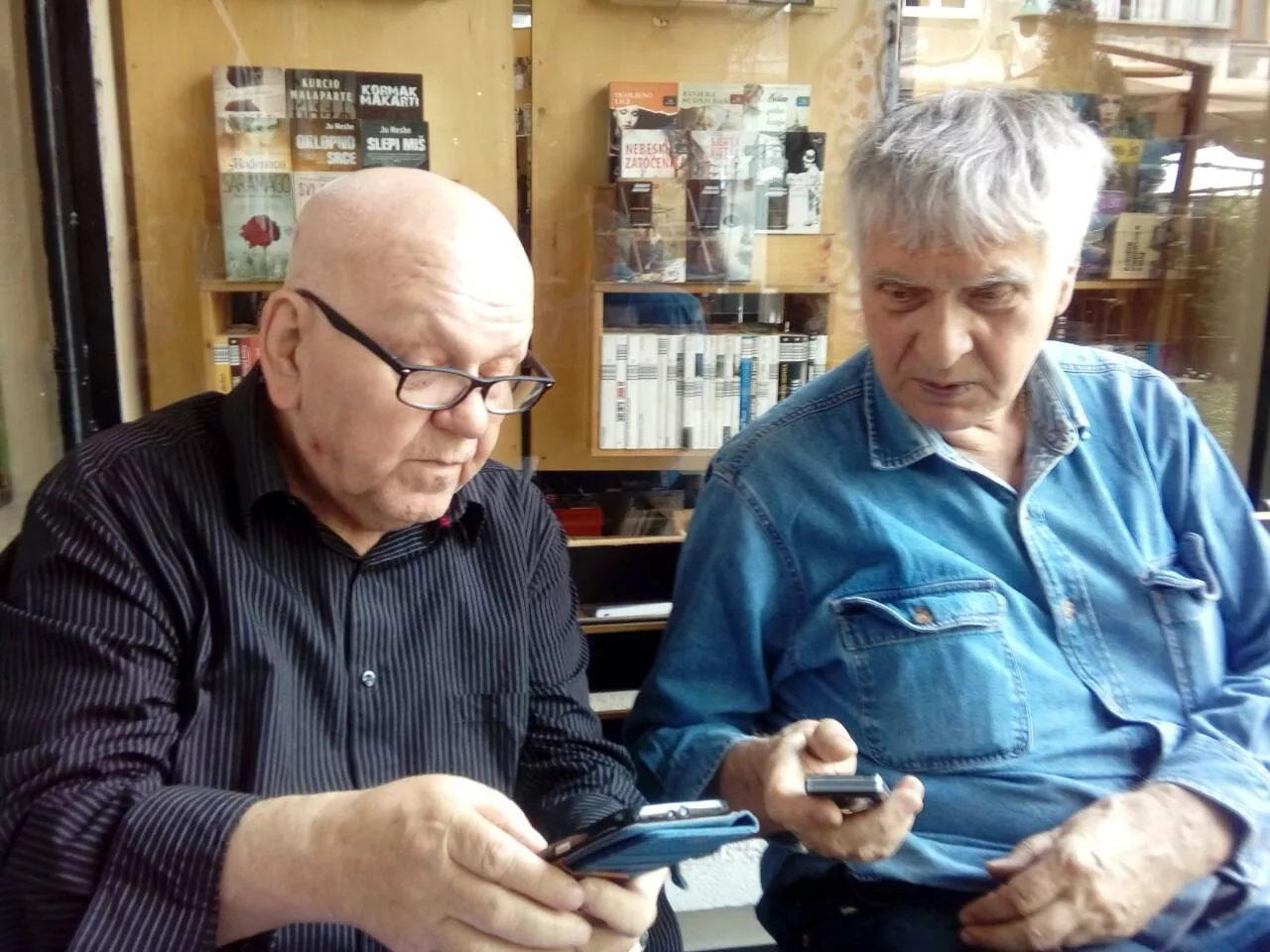
Interview by Sead Omeragić
Ismar Mujezinović is a world-renowned painter. He has won more than twenty significant regional and international painting awards. He presents himself as a Bosnian artist everywhere, even though Bosnia is not a promotional environment for him. Mujezinović now writes novels and short stories, composes music for his films and chansons. This June, he stayed in Sarajevo and socialized with the great writer Abdulah Sidran on several occasions. For the Patria agency, he talks about his art, analyzes the cultural reality in BiH. He reveals what has so far been unsaid about his life and his family's past.
PATRIA: You were born in Osijek, lived in Tuzla, Zagreb, Sarajevo, Ljubljana, and Lovrečica in Istria. You belong everywhere, but where do you truly belong the most?
MUJEZINOVIĆ: I am Slavonian by birth, Dalmatian by my mother, and Bosnian by my father. When I am in Osijek, I feel good, but nobody needs me there. I lived in Tuzla for five effective years and was mostly involved in sports. Tennis, basketball, without any significant success. I had two forays into acting, on the radio in a children's play, directed by Lorenco Perić, and in the theater as a high school student in Nušić's "The Deceased" I played Ljubomir Protić. In that period around 1953 and 1955, I was also an illustrator, as well as a photographer for "Front slobode." I was already earning money at twelve or thirteen. I continued this in my third year of high school in Sarajevo by drawing comics for "Zadrugar." I finished elementary school, the first classical year, as well as the sixth, seventh, and eighth grades later in Sarajevo. Thus, I was formed in Sarajevo and became a Sarajevan by feeling, where I was 'de facto' from the age of four until my studies, excluding those five years spent in Tuzla. I was at the academy in Zagreb and later for postgraduate studies with Krsto Hegedušić, a total of almost nine years. That was a successful period for me, and I gained most of my recognition there, directly and indirectly. After completing my 'military service,' I returned to Sarajevo and worked at the Academy of Fine Arts for about five years, then I resigned and returned to freelancing. In Istria, I am a homeowner and I paint there because I built a studio for myself, but I don't exhibit much. I only had exhibitions in Poreč and Rovinj. I had one solo exhibition in Ljubljana. I am not visually active, but I write, make films, and compose music. As you can see, I belong everywhere, but each environment doesn't really care about me, and I am not used to imposing myself. My theory is that the environment determines the quality of work and the author's phase through its influence. In my case, and the medium. Whether it's the working conditions, the interaction of the cultural milieu, or conflict with that environment, it's a question of analyzing the pros and cons of the quality and type of creativity of each environment. Since I decide everything, I am uncompromising in art, I have decided to be a Bosnian artist and I am treated as such, although Bosnia has not been a promotional environment for me. As I said, I gained most of my promotion in Zagreb, and later in Norway and the USA. I am only emotionally attached to Sarajevo.
PATRIA: Your father Ismet was a world-famous painter. He graduated in Zagreb. It is less known that he had his first solo exhibition in Sarajevo in 1926. He attended art history courses at the Sorbonne. You were a proud son, and your memories of seeing him for the first time when he returned from the partisans are interesting.
MUJEZINOVIĆ: Ismet graduated from the Academy of Fine Arts in Zagreb and specialized in frescoes under Jozo Kljaković. He enrolled at the Sorbonne in Paris, got his student ID, completed two semesters of art history, and went to the French Riviera, where he painted portraits of diplomats. He was an exceptional portraitist. I witnessed him paint a life-size portrait with hands in about 25 minutes. That's exactly how long it took me to pack my suitcases and luggage into the car trunk. Since portrait painting was profitable, he always had work, although he didn't exploit it. He was inclined to social life.
I saw him for the first time in Osijek in uniform. As a child of three and a half or four years old, he impressed me immensely, especially since I also loved to draw even then. To be clear, he went to the partisans while my mother was pregnant. When this became known in Sarajevo, she had to flee from Luburić to Osijek, to her parents. They looked at her suspiciously in Osijek, but she didn't have any major problems, while her sister's husband was killed in Jasenovac, just because he was rich. He was Czech and politically inactive. Fates are often inexplicable by simple conclusions.
PATRIA: You spent your childhood in Tuzla. In Sarajevo, Meša Selimović lived near you. Meša and your father were true friends. Do you remember their meetings?
MUJEZINOVIĆ: Ismet and Mladen Čaldarević invited Meša to Sarajevo from Belgrade after he was expelled from the party there. He got an apartment in the Vakuf skyscraper, one floor below us, and they readmitted him to the party. I know that initially, he wrote art reviews for the exhibitions of ULUBiH. In those reviews, he was quite firm in his stance on the then socialist realist orientation, that art must serve the purpose of building the country. He soon got more concrete jobs and, as far as I remember, he was a dramaturge at the Theater, worked at Bosna film, was a professor at the Faculty of Philosophy, and was an editor at "Svjetlost" and "Oslobođenje." I know that he discovered Nedžad Ibrišimović based on a story he published in the cultural section of the weekly edition of "Oslobođenje." He wrote screenplays, and I knew him then as a writer from stories about the National Liberation War (NOB). A film was also made based on those stories. It was played by the Sarajevo actor Mišo Margetić. My father and Meša were friends, but with different views on art, politics, as well as in cards, which they used to play all night with much outsmarting. It was a trio: Mladen, Meša, and Ismet. Mladen was later replaced by Branko Subotić for a while. Meša loved Hollywood films, while Ismet, like me, preferred European ones. I know he didn't like Eisenstein's "Ivan the Terrible," which we watched at a midnight screening at the Radnik cinema, while I was thrilled. Tastes differ, right? Meša liked Elizabeth Taylor, probably because his wife Darka resembled her. I remember he particularly liked Elizabeth's role in the film "BUtterfield 8."
PATRIA: You followed in your father's footsteps, as is the fate of many of us. You graduated in Zagreb from the Academy of Fine Arts under Krsto Hegedušić. Just like your father, also a Zagreb student, long before. Then you turned to filmmaking. Your father also acted in Parisian theaters, wrote a play (in the NOB), and before World War II, he made a film in Belgrade. Only later did he turn to painting, unlike you...
MUJEZINOVIĆ: Ismet advised me to study architecture, but I was interested in film. I already had a camera in 1957 and shot amateur films. We sent films to Austria for developing, which took almost a whole month. At that time, I lacked editing to shape what I was doing. Since I couldn't write more than two pages of text back then, and it was required for the entrance exam, I decided at the last minute and went to the Academy of Fine Arts. I had a backup plan: if I wasn't accepted, I would board a ship to Japan as a kitchen hand. But I passed the entrance exam and painted and drew instead of peeling potatoes in the kitchen on the ship. In my second year, I led the student film section at the Workers' University with Zoran Tadić, and our mentor was Krsto Papić. I left that job in my third year, and they called me back to film for my master's studies. First, Ivan Šibl offered me a role in a series, which Zvonimir Črnko later played, and then Tonči Vrdoljak in his film "Kad čuješ zvona." Vodopivec did a test screening for me, and I took acting classes with Krešo Golik. In the end, we mutually abandoned that experiment because I had some exhibitions planned, and learning the lines was also strenuous for me. The following year, I worked for six months as a set designer's assistant on Veljko Bulajić's film "The Battle of Neretva." After the army, I worked on two more films as a set designer and costume designer, and later I only designed posters for films: for Nikoli Stojanović, Bora Drašković, Vlatko Filipović, Hajrudin Šiba Krvavac, Puriša Đorđević, and Emir Kusturica for "Do not forget me, Dolly Bell."
PATRIA: You take care of your father's legacy. You preserve his works, which is a difficult task. Last year, you marked the 110th anniversary of his birth. You made a documentary-biographical film about your father: "Ismet Mujezinović – Atelje." You donated what Ismet bequeathed, the house with the studio and a thousand drawings. The rest is on loan to galleries, such as the famous portrait with the red scarf...
MUJEZINOVIĆ: As much as I can with my sister Ozrenka and cousin Enes, we maintain some memory of Ismet. We published a monograph of drawings for the centenary of his birth. Now I have made a second documentary film about Ismet. The Tuzla Portrait Gallery is also doing this with commemorative exhibitions, while Sarajevo has no interest in Ismet. There was no desire from any institution, not even a thought, to mark his centenary or 110th birthday. This is not my or our family's problem, but a problem of the newly composed cultural and visual art public, where professionalism has been replaced by the logic of survival and organizing exhibitions that bring any profit. I understand their problem, but I cannot help them? I fear that such a policy implies the demise of Sarajevo as an art center... I once said that contemporaneity is a bridge between the past and the future. If there is no bridge, there is no progress, except for those individuals who achieve it through their own persistence. The problem is that very often the most talented are promotional bunglers or hidden artists who stick to their work corner. Self-praise is not a characteristic of all successful people. In the end, they must know that a plant is planted where the climate suits it. There are no tomatoes or bananas in Greenland! Whether we become Greenland or the Sahara depends on "cultural climate change"?
PATRIA: You became a master painter with hundreds of solo and group exhibitions in the most famous galleries in the world. People in BiH remember you precisely for your painting. In Sarajevo, you were the head of the Painting Department at the Academy of Fine Arts and then you suddenly left the city. What was the deciding factor?
MUJEZINOVIĆ: I gained recognition very early, thanks to the Master Workshop which gave me good support in practical terms, as well as in contacts with important critics. At twenty-seven, our commissioner for the Paris Biennale of Young Artists, Boris Vižentin, director of the Modern Gallery in Rijeka and the Biennale of Young Artists, chose me to represent Yugoslavia. But in Belgrade, a commission concluded that I was too young, while my colleague from Belgrade, Peđa Nešković, was 34 and it was his last chance to exhibit. They said I had two more chances, so they left me for the next biennale. Vižentin then organized a parallel exhibition "Group Work," where we were supposed to exhibit together: Nives Kavurić, Zlatko Šimunović, Nikola Koydl, Zdravko Tišljar, and I, with critical support from young critics Darko Schneider and Josip Stošić. That would have been compensation for the missed main exhibition, but as it was my deadline, at the age of 28, I went to Bileća to the School of Reserve Officers, and they went to Paris for the biennale in a slightly different composition. It is interesting that Nikola Stojanović's film "In the Kitchen," produced by Sutjeska Film, was shown at that biennale. "In the Kitchen" is an exceptional cinematic achievement, now almost forgotten! The next biennale in 1971 was thematic – Ecology. Since I am not inclined towards themes, I politely declined the Biennale's invitation, which does not significantly change my artistic development, which depends on my desire and changing circumstances, as with everyone else. In Yugoslavia, I received the most important professional awards such as the "Josip Račić" award and the "Nadežda Petrović Memorial," as well as an award in Italy. I was invited to Sweden, to Lund, for a solo exhibition. However, the BiH Gallery conditioned my solo exhibition in Sweden on accepting ten colleagues as guest exhibitors. This exhibition was stalled for two years, and I didn't know why. I collegially agreed to this condition when they finally openly proposed it to me. I wanted to avoid unpleasantness because Sweden had broken off cultural cooperation with Yugoslavia precisely because they did not allow my solo exhibition. Thus, everything was smoothed over, and cultural exchange continued.
Regarding leaving Sarajevo, it was caused by the events that followed the breakup of Yugoslavia. My wife Špela (Rozin, a European successful actress - editor's note) was building a house in Istria, and we were in Ljubljana during the independence and the ten to fifteen days of the Slovenian war. Later, we finished the house in Istria for some time. But then the road to Bosnia was closed, and after that, she did not want to return to Sarajevo with our son. I was in Slovenia for five years as a refugee because I couldn't get a visa as a freelance painter, and I didn't want to get a job because I don't know where or what I would do? During that period, I mostly earned money in Switzerland, Austria, and Croatia as a painter, and as a designer in Slovenia.
PATRIA: Sarajevo promised to become the center of the Balkans in film, visual arts, literature, and music, as it once was one of the cities that dominated in all these arts. Today, very little money is allocated for film, galleries are falling apart, publishing is in trouble...
MUJEZINOVIĆ: We must know that even in Yugoslavia, BiH allocated the least for art. For example, Belgrade had a budget of 50 million, Zagreb 40, and Ljubljana around 35, while the whole of BiH had about 12 million, of which theaters, ballet, and opera spent 7-8 million. Film began to develop around the seventies, reaching its peak in the eighties, while immediately after the war, it was painting, then theater for a period with Gligorijević and Drašković around 1955, and so on. From the seventies, graphics and music were powerful. Now, officially, film is the most important art, along with a few conceptual artists who have gained recognition abroad. For the first time, one could say that the "Sarajevo Film Festival," as a domestic event, has opened doors for filmmakers. Visual arts should have a similar international event because our official institutions do not have the strength or reputation to promote younger artists. There are plenty of young artists, but their promotion outside BiH is non-existent. It is easier for conceptual artists, as it was for graphic artists before, while it is almost impossible for painters and sculptors without state support. These exhibitions are simply too expensive for a non-commercial artist. It is sheer stupidity that galleries can sustain themselves without state support. We do not have cultural tourism like Paris, Rome, or Florence, where people would come to see Michelangelo, Rembrandt, or Rubens. We don't even promote what we have, so galleries can only survive with state help. Everything else is an illusion. We have neither an art market nor potential patrons or buyers, and even if someone decides to buy, they lack the criteria to choose a valuable artwork, but only one that suits their taste. This does not change anything in the valorization of authorship or mean anything for the country's culture. The simplest thing is to designate, for example, three important institutions in each region at the state level and give them state significance so they can act in a coordinated manner to promote BiH. If this is not done, the probability is that it will become even more provincial. Banja Luka once had a large Yugoslav exhibition, Tuzla still has the international exhibition INTERBIFEP, while Sarajevo, as the capital city, has no significant visual art event. They were not even able to organize BiH's participation in the Venice Biennale. However, the direct producers, the artist authors, are to blame because they are passive and wait for recognition to fall from the sky or to win the lottery. They have met the fate of workers. They don't even have a union. Total apathy? Galleries, museums, ministries of culture exist for artists, authors, while based on practice, it seems that artists exist because of these institutions! If there is no art, they must understand that there is no them either!
PATRIA: Through our conversation, we remembered that you designed the cover for one of my books, which was published in Ljubljana in 1994. I was proud that such a true great artist designed the cover for my book, and then you told me that you had designed about a hundred covers for significant authors. That is a special kind of art in the world.
MUJEZINOVIĆ: Well, painters mostly engaged in design as an additional discipline. In the Master Workshop, I created covers for Andrija Kačić Miošić and for "Tonka's Only Love" by August Cesarec. I remember how Ismet, right after the war, designed a cover for Ivo Andrić and wrote the letters with a brush, freehand, as they used to say. I used Letraset, and today you have thousands of different fonts on the computer, so you choose. Computers have simplified the realization, while the idea is still a gift from God. It depends on whether it "falls" to you as a thought, or "doesn't come to mind." In Ljubljana, I did an average of three covers per month, so they accumulated. In art, as everywhere else, specializations are introduced, which I am not sure is a good thing? An excursion into another medium is inspiring and, in my opinion, a better option than creative block, which can last for several years for an artist.
PATRIA: You make films, you write books. This June in Sarajevo, you promoted the novel "Nasljeđe" (Legacy). After all this, you started composing. What kind of music do you compose? Where will these interests of yours end?
MUJEZINOVIĆ: I started writing as a bet: Who will write a novel first!? It took me 25 days for 200 pages. Then I sent it to my writer cousin, and he told me it wasn't bad and that I could publish it. I wrote the second novel by continuing to write a screenplay for video art. That novel of 260 pages is entirely in dialogue. I managed to convince the bureaucracy that there was nothing on the cover. White paper, tabula rasa. Then I liked it, so whenever I'm sick or don't feel like going out, I write. That's how I wrote five novels, two collections of short stories, one biography of Ismet, and a book of unfilmed screenplays. As for music, there are two reasons. One is emotional, and the other is practical, because I use that music in my films. I don't pay royalties! I have about thirty compositions. They are mostly chansons. I like melancholic music. How long will it last? I plan to make one more feature-length fictional film to complete my opus with one long, more experimental film. I currently have seven short fictional films, two feature-length films, and one long documentary about Ismet, as well as about twenty music videos and documentary segments from various exhibitions. My favorite films are from the Second Koševsko High School, shot around 1958 and 1959, when I joined the Sarajevo film club, but I wasn't active. At that time, I was at the Academy of Fine Arts in Zagreb. I had the idea to create music and choreograph a ballet, but that's a lot of work for my age, although you never know. Maybe I'll finally start painting again?
Komentari (0)
Prijavite se za komentiranje
PrijavaJos nema komentara. Budite prvi!
Minuta
Sve →Iz drugih kategorija

High Representative Not Elected: Germans, French and British Sabotaged Americans, New Attempt at End of June

ČOVIĆ WITHOUT MERCY: How Those Who Brought Ademović to Office Created a Political Hell for Him



Sunny Saturday, quite warm



Tragedy in Albanian resort: Two minors drown












