
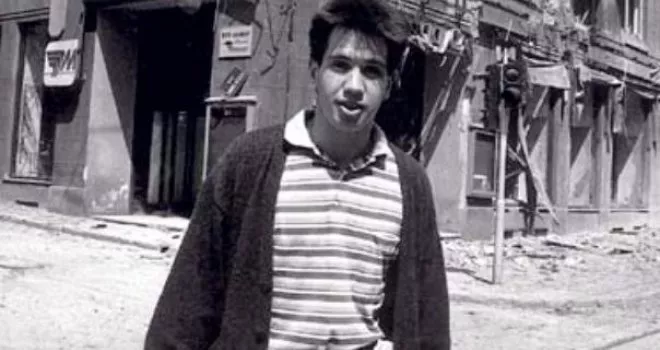
Karim Zaimović (Sarajevo, May 6, 1971 - Sarajevo, August 13, 1995) was a Bosnian journalist and writer. After graduating from the First Gymnasium in Sarajevo in 1989 and completing his military service, he enrolled in the Academy of Fine Arts, from which he transferred after a few months to study comparative literature at the Faculty of Philosophy in Sarajevo. From his earliest youth, he was intensely involved in drawing and read tirelessly, especially literary works.
Even in those years, he developed a great love for comics, thanks to which he grew into a versatile connoisseur of domestic and world comics, writing several valuable articles, critiques, reviews, and assessments in this field. He began his journalism career very early (collaborating with Radio Sarajevo at the age of 15). He wrote about film, comics, fine arts, and culture in general, in numerous magazines, weekly and daily newspapers (Naši dani, Lica, Vidici, Quorum, Kvadrat, Patak, Slobodna Dalmacija, Nedjeljna Dalmacija, Književna revija, Mladina, Start, Erasmus, Oslobođenje, Večernje novine, Avaz, Ven, Sineast, Fantom slobode, Dani). He was a regular contributor to Nezavisni radio Zid, and in the pre-war period, he occasionally collaborated with the Third Program of TV Sarajevo and the programs of Radio Sarajevo. He spent the entire war in Sarajevo.
After being demobilized from the Army of BiH, he edited the culture section of the magazine Dani. Together with Semezdin Mehmedinović, he launched the cultural magazine Fantom slobode, where he served as deputy editor-in-chief. He wrote short stories and screenplays. Two novels remained unfinished in manuscript form. He died on August 13, 1995, from wounds sustained as a civilian victim of one of the many shellings of Sarajevo.
Tajna džema od malina (The Secret of Raspberry Jam) is the only posthumously published book of prose by Karim Zaimović. The eleven stories share the same poetic, postmodern orientation, a qualification that has been repeatedly applied, more or less, in all reviews of this book, without deeper analyses of the genealogy of that postmodernism. The distinctiveness of Karim's prose stems from intermediality, which manifests on multiple levels and two dominant ones: the first, less present in practice, in the form of intermedial shifts from literature to radio and from radio to literature; and the second, general, in the form of interpolations of dramatic, narratological, and thematic-motivational elements of comics into literature.
According to the general definition, "intermediality is the process by which structures and materials characteristic of one medium are transferred to another; one of these media is usually art." On the first intermedial level of Karim's prose, in the relationship between radio and literature, we have the influence of a non-artistic medium on artistic expression, and vice versa, while on the second level, we have a postmodern, non-transparent relationship between two artistic media, comics and literature.
Most of the eleven stories from Tajna džema od malina were created as part of the program Josif i njegova braća (Joseph and His Brothers), which Karim Zaimović edited for Radio Zid. At least, that's what Karim's stories say, and we are not authorized to disbelieve it. For the world of the story, it is irrelevant whether its radio life happened actually or literarily.
For illustration, here's how the radio context of a story appears in Karim's works:
"In tonight's episode of the series 'Joseph and His Brothers,' we will try to answer that. (...) In tonight's episode of the cycle 'Joseph and His Brothers' on Radio Zid Sarajevo... (...) The fact that the container, or rather a modified chest, in which the paintings were hidden, bore the mark of the Third Reich reminded me of a situation I found myself in during a previous investigation conducted for the program 'Joseph and His Brothers.' (...) We are reconstructing that story in tonight's edition of the program 'Joseph and His Brothers.' (...) Tonight, in the eighteenth episode of the cycle 'Joseph and His Brothers'"
(...) All of Karim's stories are told in the first person; the authorial narrator is the one who initiates and unravels the story, enigmas and mysteries attach to him, he follows or resolves them, just like Dylan Dog, from whom he differs only in professional position: the former is a former policeman, and Karim is a journalist, an investigator, a writer who informs the public about the results of his supposed investigations through a radio program. Karim's stories intertwine motifs and thematic interests of the scriptwriters for the comics Marti Misterija and Dylan Dog, which are fundamentally postmodern, cultural, and interdisciplinary, with a tendency to spill over into literature. For example, two years after Karim's death, Carlo Abrosini publishes the comic Napoleone, which delves even deeper into occult and paranormal realms. "Napoleone has the ability to access places through his power of dreams and thus arrives at conclusions and discoveries that he could not otherwise attain. In everyday life, he lives with his dreams and gives them the same importance as events and things in real life."
(...) For the purpose of our research, defined by modest ambitions, we bought three issues of Marti Misterija and four issues of Dylan Dog at a flea market, hoping to satisfy our investigative intuition and find correspondences with Karim's prose in them, at least in hints. And we were not disappointed. Who knows where more extensive research would have led us?! But here are a few significant situations from Karim's stories whose parallels we found in the comics.
In the story Čovjek sa Šiljinim licem (The Man with the Shaved Face), as we have already noted, there are hints of the poetics of cultural comics. The story of Jakob Esalović, a painter who predicted events on his canvases, is perhaps the most obvious example of the poetics of intertwining pseudo-factual and real elements. In the issue of Marti Misterija, titled Kuća na granici sveta (The House on the Edge of the World), the main characters encounter a terrifying artistic vision.
On the other hand, Jakob Esalović's paintings evoke a similar effect, predicting bloody historical events, on the Parisian Boulevard De Capucines in the basement
"For the doctors of that time, the incoherent story of the mad hotelier about the terrifying paintings, which, when he entered the room, 'assaulted' him from all sides, showering him with their eerie predictions, meant little."
In the story Čudo neviđeno (An Unseen Miracle), the writer follows the trail of a small booklet with a strange title, which reveals the existence of a Sarajevo vampire.
"The writer begins the book with a report on how a series of unexplained murders occurred in Sarajevo at the end of 1913, which the police tried to keep out of the public eye."
(...)
The last story in the collection is unfinished, and the editors titled it (Untitled), indicating with parentheses that all other stories were titled by the author. However, even though the story ends with an unfinished sentence, it feels complete because its narrative arc has reached its conclusion. In terms of intermediality, the radio context is not as functional in any story as it is in this one. In the previous ones, radio was merely a medium through which the writer communicated the results of his "investigative work." Here, however, radio is an agent of action, a kind of stage for investigating the life paths of two Sarajevans, Aleksandar Antonijević and Karim Zaimović, selected by a computer drawing system, whose only similarity is that they were born in the same year. The radio investigation triggers a whole chain of coincidental events:
"But, by chance, it so happened that Aleksandar Antonijević existed and that at the very moment of the broadcast, he was listening to his life story on the program 'Joseph and His Brothers.' (...) And so, everything was ready for the final act of the game of chance, a chance that loosened one thread in the fabric of fate to tighten another."
(The entire essay "Intermediality in Karim Zaimović's Prose" by M.Sc. Fatmir Alispahić can be read at https://www.youtube.com/user/TvTuzland)
Komentari (0)
Prijavite se za komentiranje
PrijavaJos nema komentara. Budite prvi!
Minuta
Sve →Iz drugih kategorija

High Representative Not Elected: Germans, French and British Sabotaged Americans, New Attempt at End of June

ČOVIĆ WITHOUT MERCY: How Those Who Brought Ademović to Office Created a Political Hell for Him



Sunny Saturday, quite warm



Tragedy in Albanian resort: Two minors drown












