
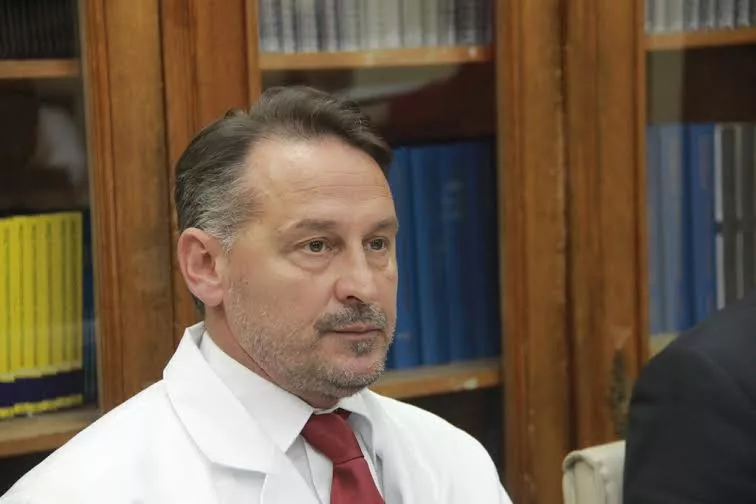
Prof. dr. Damir Aganović in an interview for the BH news agency Patria talks about the condition of the University Clinical Center Sarajevo when he took over the management of this health institution, and about financing problems. He also talks about his new book which has not yet been promoted, as well as about prof. dr. Kemal Dizdarević.
PATRIA: In what condition did you find KCUS when you took over the management of this health institution?
AGANOVIĆ: I took over the duty of the general director of the largest health institution in the country on July 2, 2012. At the time of taking over, together with my associates, I found obligations to suppliers amounting to 49.5 million KM as of June 30, 2012, and immediate obligations to suppliers amounted to 17.5 million KM. Obligations as of December 31, 2012, amounted to 56.8 million KM and relate only to supplier claims. Obligations that KCUS was obliged to settle by then were 26 million KM and are the result of increased costs of medicines and energy, previously signed full contracts for the maintenance of medical equipment, and an increase in salary costs due to the application of the Collective Agreement from March 1, 2012, which were not financed by the Sarajevo Canton Health Insurance Fund (ZZO KS) and with which funds for paying obligations were reduced.
A total of 81 lawsuits were found where KCUS was sued on various grounds (labor disputes with employees, compensation for damages in providing health services), with an estimated value of these lawsuits of 1.8 million KM.
In 2010, a new Law on Health Protection was passed (Official Gazette of FBiH 46/10), which declared University Clinical Centers as public health institutions co-founded by one or more cantons and the Federation together, in accordance with Article 53, Paragraph 3 of the same Law. The same Law gave health institutions a deadline of 36 months to align their organization and operations with its provisions. Since the entry into force of this Law, the former management of the institution did not take any action to align the organization of KCUS with the Law on Health Protection. The Statute, in accordance with the new Law, was adopted by the Management Board on August 10, 2012, i.e., after my appointment.
Regarding personnel recruitment, 157 employees signed employment contracts without the consent of the Ministry of Health of Sarajevo Canton, which is contrary to the conclusion of the Government of Sarajevo Canton from 2011 on hiring new employees. They were hired without a public advertisement procedure.
PATRIA: You opened a new operating block, which according to some estimates is the best in the region. Is that true, Prof. Dr. Aganović?
AGANOVIĆ: The new Operating Block (OP) was planned and built according to all the most modern technical and technological standards and as such certainly deserves a high position in the near and wider surroundings. The total area is 5,000 square meters and, together with accompanying facilities, is spread over two floors. In the New OP block, all surgical procedures that were performed before are now performed in better conditions for both patients and staff, but an additional specificity compared to the old premises is that the new OP rooms of all clinics are equipped with equipment for minimally invasive surgical procedures, which is a trend in all world surgical centers. All costs of the OP block have also been reduced since all rooms are concentrated in one place near the Intensive Care Unit. This modern OP block enables the performance of all the most demanding surgical procedures, especially in the field of tertiary healthcare. In addition to the above, as it is equipped with a modern integrated system for operating rooms, the New OP block also allows for complete control of the utilization of operating rooms, material consumption, and all other important parameters relevant for the control and improvement of the work of such a modern OP block. The design and construction of the NOB were done in accordance with currently valid international standards, which increased the utilization of installed medical equipment, as well as patient safety. The JINJ KAR with 19 beds is fully equipped in accordance with international standards and enables top care for the most critically ill patients of UKC, as well as patients from all over BIH. The new operating block has 11 OP rooms (2 OP rooms for urology, 2 OP rooms for abdominal surgery, and 1 OP room each for glandular and oncological, thoracic, ENT, maxillofacial surgery, vascular and orthopedic surgery, plus an 11th OP room which is multipurpose and can be used for surgical procedures of all specialties participating in the New OP Block as needed, and its additional specificity is that it is also equipped and prepared for transplant surgery. From March 5, 2014 (when it officially started operating) until today, a total of 3214 complex surgeries have been performed.
PATRIA: What else does KCUS plan to build in the future?
AGANOVIĆ: The construction plans of KCUS are defined through two segments: the completion of initiated investments through precise dynamic implementation plans, at this moment it is the completion of construction and equipping of the space for inpatient accommodation of the Clinics for ENT and Maxillofacial Surgery).
Also, there is the submission of proposals for future investments to all competent institutions with precise priorities, which is primarily the strategic goal of completing the CMB, where the bedridden patients of most clinics will be accommodated, then the reconstruction of destroyed buildings at the Jezero site, and the construction of a hospice in Ilidža.
PATRIA: Are there any specific problems in financing KCUS?
AGANOVIĆ: The price list that KCUS uses when invoicing provided health services is the prescribed Tariff of Health Services from 1986 with minor changes in 2008 by the Federal Health Insurance and Reinsurance Fund, which indicates the fact that the services prescribed by the Tariff of Health Services of FBiH from 1986 are outdated, underestimated, unrealistic, and therefore do not correspond to the actual costs, and on that basis KCUS incurs losses, which we constantly point out to our founders.
This is supported by the fact that health insurance funds do not allocate funds for medicines not on the essential list of FBiH, which KCUS uses in the treatment of insured patients of these cantonal funds; on the contrary, they dispute the issuance of approvals for treatment, even when it comes to life-saving medications that must be administered at the critical moment of the so-called "golden hour." Furthermore, ZZO disputes approvals for implantable and consumable materials that are not included in the Ordinance on orthopedic and other aids, endoprostheses, and other materials of the Fund, which are not harmonized with the prescribed Federal Decision on determining the basic package of health rights (Official Gazette of FBiH No. 21/09), primarily when it comes to staplers as materials used in surgical procedures. It should also be noted here that no Fund finances implantable and consumable materials that are not within the scope of mandatory health insurance, and therefore all these costs are borne by KCUS, all for the purpose of patient treatment. However, the burden that KCUS carries due to such an unregulated healthcare system leads our institution into increasing losses.
KCUS also introduced a second shift for diagnostic services to reduce waiting lists, and due to the high workload of diagnostic equipment, especially MRI and CT, frequent breakdowns occur, which entails significant servicing costs. When repairing equipment failures, we face a major problem because the equipment is from different manufacturers and requires the engagement of service technicians from the representatives of those manufacturers, thus allowing a monopolistic approach, high prices for spare parts and service technician services, who often demand an advance payment of 70-100 percent to address the fault. Last year alone, we allocated 3.1 million KM for the maintenance of medical equipment.
Also, it should be mentioned that insured patients of other cantonal funds do not wait for services, and their admission is processed through the VIP outpatient clinic.
Regarding cooperation with ZZO KS, we also had problems, some of which have been overcome, but unresolved issues remain: financing of 91 employees for whom the Ministry of Health of KS and the Public Health Institute of Sarajevo Canton gave consent, financing of 33 residents, although there are solutions for them, non-acceptance of any request for an increase in the tranche for which we have sent numerous letters with arguments requesting an increase, ZZO KS participates with 56.2% in the total revenue of KCUS for 2013, and with 76.82% in the number of treated patients. We have pointed out this disproportion on several occasions.
NEW BOOK IS INTENDED FOR STUDENTS, BUT ALSO FOR DOCTORS
PATRIA: You recently published the book "Fundamentals of Urodynamic Measurement and Analysis." When is the promotion planned?
AGANOVIĆ: The book was completed and printed in April of this year. Unfortunately, due to daily obligations that I recognize as more important, I haven't had time to promote it. This will certainly happen in the near future within the Institute for Scientific Research and Development of KCUS. The book is the result of years of work by my colleagues and me in the field of urodynamic diagnostics. The moment I decided to transfer my own knowledge and experience from this field was chosen only after over 2000 complex multi-channel studies were performed. I believe that this is an extremely important field of urology, an underutilized method, not only here but also in the world, probably due to its complexity. Therefore, I had a great responsibility in writing this book.
The book is intended for medical students, as well as doctors of various specialties, namely urologists, pediatricians, pediatric surgeons, neurologists, and physiatrists. Urodynamics is one of the few multidisciplinary fields in medicine.
PROF. DR. DIZDAREVIĆ ALSO ACCUSED MY PREDECESSORS
PATRIA: In the past period, Prof. Dr. Kemal Dizdarević has made a series of accusations against KCUS in public, how do you comment on that?
AGANOVIĆ: It is true that Prof. Dr. sci. Kemal Dizdarević has made and continues to make accusations against KCUS in the media and in many other ways, as well as personally against me as the general director. I would not comment on these accusations, I would only point out that this has been going on for many years, even from the period of my predecessors. Decisions on these accusations will be made by the competent courts and competent prosecutor's offices. Anything I say about it would be prejudging and obstructing ongoing court proceedings. I can only say that the public statements of Prof. Dr. sci. Kemal Dizdarević and the disclosure of data related to KCUS constitute serious violations of labor discipline, and his statements themselves contain elements of defamation. That is all I can say.
Komentari (0)
Prijavite se za komentiranje
PrijavaJos nema komentara. Budite prvi!
Minuta
Sve →Iz drugih kategorija

High Representative Not Elected: Germans, French and British Sabotaged Americans, New Attempt at End of June

ČOVIĆ WITHOUT MERCY: How Those Who Brought Ademović to Office Created a Political Hell for Him



Sunny Saturday, quite warm



Tragedy in Albanian resort: Two minors drown












