
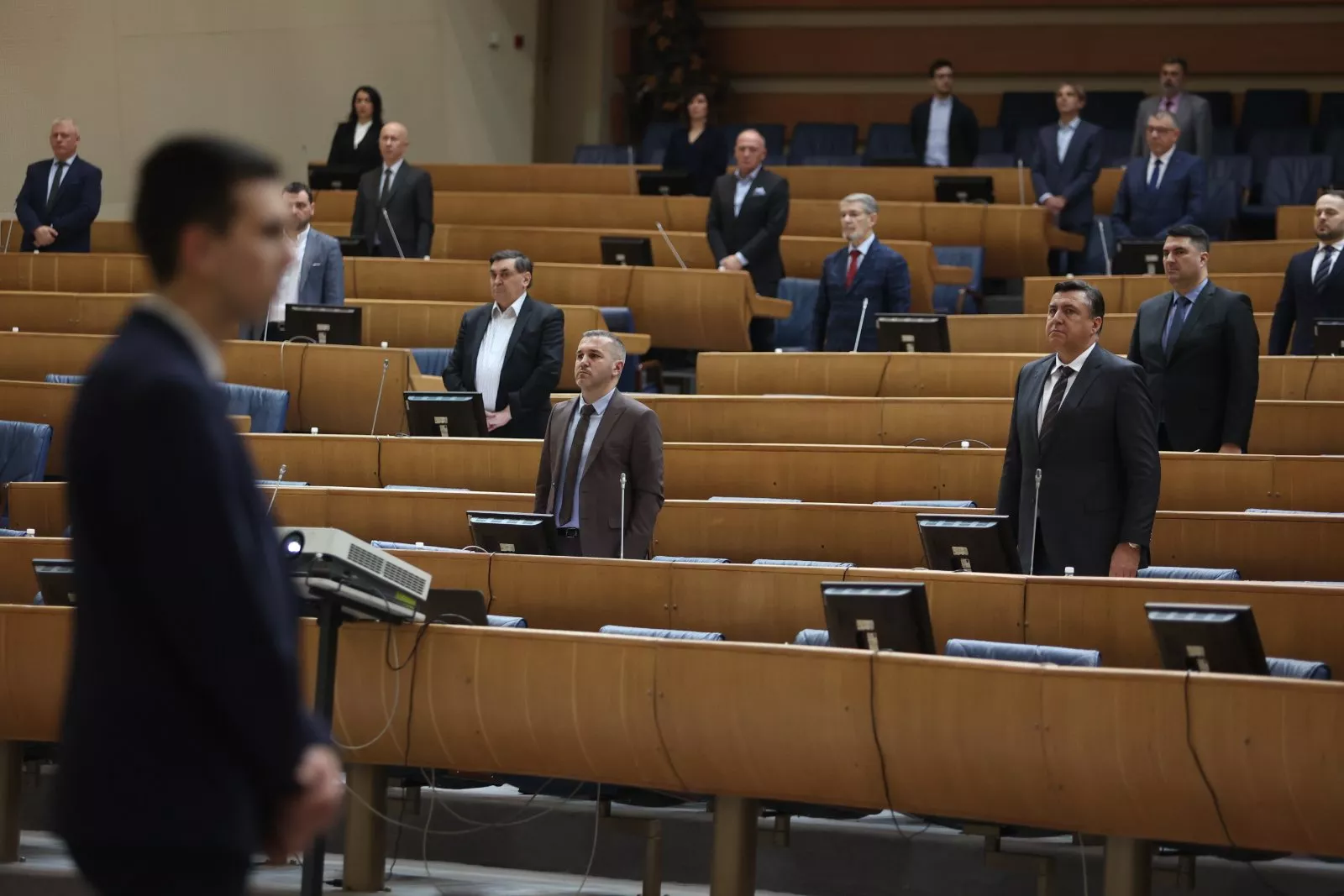
(Patria) - At the last session of the House of Representatives of the BiH Parliament held on June 12, MP Jasmin Emrić (NES) warned the Speaker of the House, Denis Zvizdić, that he had not convened an urgent session requested by five state MPs on May 8, and expressed hope that it would be convened as soon as possible. Zvizdić only thanked Emrić but did not comment on his address. The session has not been convened even ten days later.
Emrić received a response from the Ministry of Foreign Trade and Economic Relations regarding the national structure in that Ministry, headed by SNSD cadre Staša Košarac, only after four months. Although the minister claimed that civil servants do not have to declare their nationality, Emrić clarified that this is not true and that there are far more Serbs in the Ministry than they are entitled to according to the Constitution and the last census, while Bosniaks are lacking. The Ministry of Transport and Communications, headed by Edin Forto, also lacks Bosniaks, with Minister Forto admitting in his response that he prioritizes expertise and competence, which would translate to a lack of expert and capable Bosniaks, which is hard to believe.
We remind you that five state MPs requested a session on the topic "Consideration of data on ethnic representation of employees in the institutions of Bosnia and Herzegovina - causes and consequences of non-implementation of the Constitution and laws of Bosnia and Herzegovina which establish proportional representation of constituent peoples and Others in the institutions of Bosnia and Herzegovina", and the analysis of data from over 70 state institutions showed a lack of Bosniaks, with a particular problem in leadership positions.
The request was signed by MPs Jasmin Emrić, Elvisa Hodžić, Šemsudin Mehmedović, Aida Baručija, and Ermina Salkičević-Dizdarević.
Out of 74 analyzed institutions, Bosniaks are in imbalance in 62 institutions, considering the number they are entitled to according to the laws of Bosnia and Herzegovina. It is particularly concerning that Bosniaks are significantly fewer in higher-ranking positions, which are leadership and better-paid, but more numerous in positions of employees with secondary vocational education, which obscures the total number of employees and the actual situation.
In the last two years, there has been a significant imbalance to the detriment of Bosniaks in terms of employment and internal advancement in institutions. This is particularly evident in nine state ministries, as well as in some institutions with several hundred employees.
As for employees from the category of Others, it is concerning that the number of leading state and police officials who declare themselves as Others is not even close to the legally determined number, and that in many institutions there are no employees from the category of Others.
In the Ministry of Security of BiH, headed by Nenad Nešić until December 2024 when he was arrested, and then the leadership was taken over by Deputy Minister Ivica Bošnjak, out of 32 people who started employment during that period, 28 are Serbs. A similar situation exists in the Ministry of Foreign Trade and Economic Relations and the Ministry of Finance and Treasury, headed by SNSD cadres.
In the Ministry of Justice of BiH, led by Davor Bunoza (HDZ), the number of Croats and Bosniaks is almost equal.
The only example where national balance is respected is the Central Bank of BiH, where 50 percent are Bosniaks, 31 percent Serbs, 16 percent Croats, and 3 percent Others.
In the Ministry of Transport and Communications, headed by Edin Forto, out of six leading officials, only one is a Bosniak.
Out of a total of 4,081 employees in 28 institutions for whose appointments the Council of Ministers of BiH is responsible, Bosniaks lead institutions with 339 employees, or 8%. Serbs and Croats lead institutions with 3,742 employees, or 92%. The budget of these 28 institutions for 2024 amounted to 330 million KM. Bosniaks lead six institutions with a budget of 51 million KM, while Serbs and Croats lead 22 institutions with a budget of 279 million KM.
In 13 state institutions located in the BiH entity of Republika Srpska, out of a total of 3,045 employees, only 1,165 are of Bosniak nationality. There are fewer Bosniaks in 361 positions, while there are more Serbs in 296 positions and Croats in 109, and a certain number of employees from the category of Others are also missing.
A particular problem are police agencies that are staffed according to the 1991 Census, which should be changed given that we have a valid Census from 2013. However, regardless of this, in SIPA, for example, there have been more Serb employees than Bosniaks for a year. All three state police agencies lack employees from the category of Others.
Due to this situation, MPs requested the introduction of a moratorium on employment and appointments in institutions in order to determine the state of national representation and proceed with respecting the BiH Constitution and laws on proportional representation.
However, it is clear that neither Zvizdić nor the parties of the 'trojka' are discussing this issue, raising the question of who is supposed to protect the interests of Bosniaks in state institutions. The opposition, or those who did everything to be in power with SNSD and HDZ?
Komentari (0)
Prijavite se za komentiranje
PrijavaJos nema komentara. Budite prvi!
Minuta
Sve →Iz drugih kategorija

High Representative Not Elected: Germans, French and British Sabotaged Americans, New Attempt at End of June

ČOVIĆ WITHOUT MERCY: How Those Who Brought Ademović to Office Created a Political Hell for Him



Sunny Saturday, quite warm



Tragedy in Albanian resort: Two minors drown












