
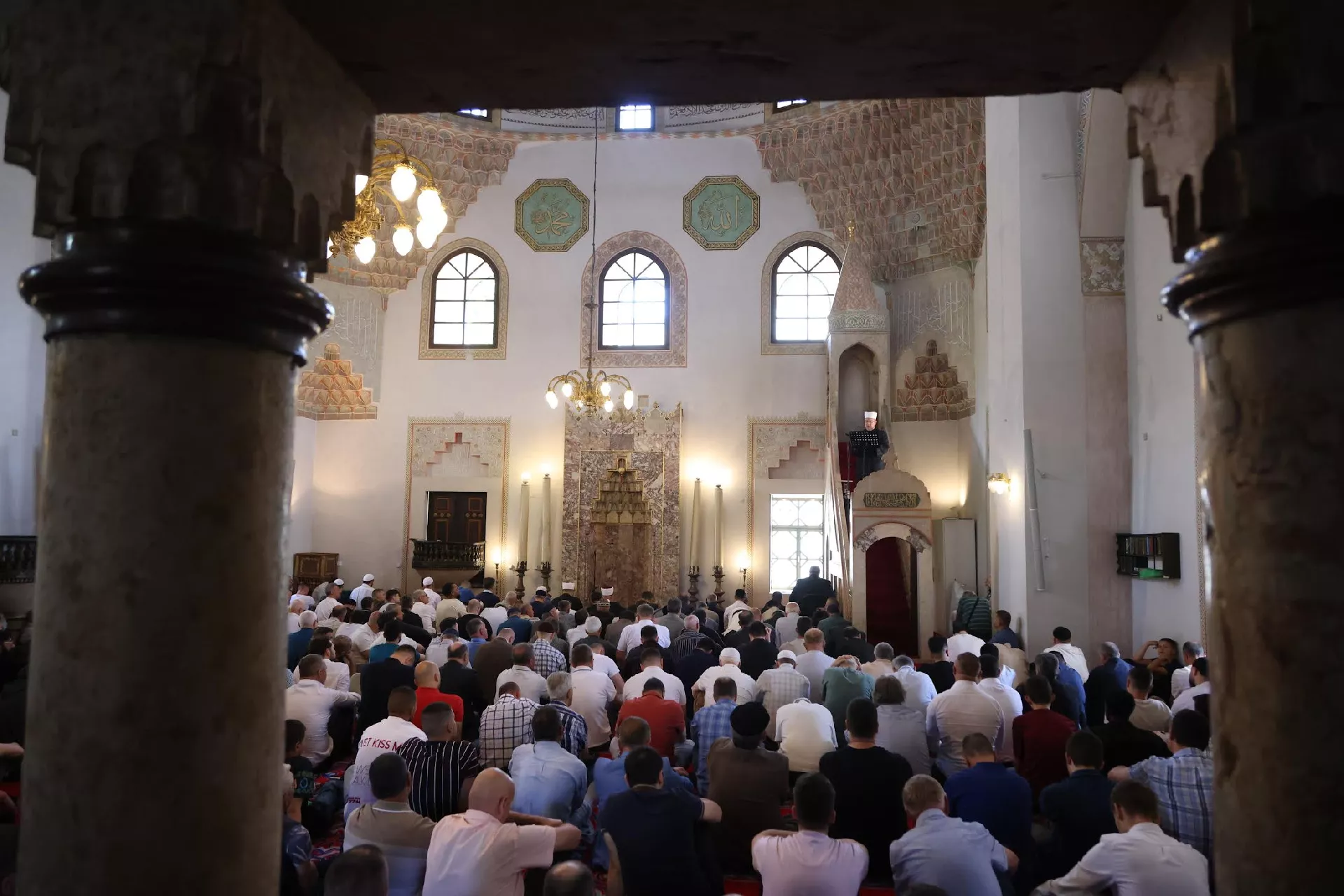
(Patria) - Hajj and sacrifice are indicators of physical and material worship, and the pilgrimage to Hajj, its rituals, and the sacrifice are manifestations of that worship, it was stated in today's sermon on sacrifice, authored by Zehrudin-ef.
Hadžić, chief imam of the Islamic Community Council of Jajce.
According to the Calendar of the Islamic Community in Bosnia and Herzegovina, the first day of Eid al-Adha is June 16. In order to remind people of the proper performance of Islamic duties, this thematic sermon was read in all mosques today.
"Every action of a true believer in this world is in the name of Allah, may He be glorified, and according to Islamic teachings, every deed is judged by intention. Closeness to God is achieved through a pure heart and piety, and the symbolism of sacrifice is based on sacrifice and piety, just like in the example of the two sons of Adam, Cain and Abel," the sermon stated.
A verse from the Quran, Surah Al-Ma'idah, was recalled: "And recite to them the story of Adam's two sons, in truth - when they both offered a sacrifice - and it was accepted from one of them but was not accepted from the other. He said to the other, 'I will surely kill you.' He said, 'Indeed, Allah only accepts from the righteous.'" As stated, "out of obvious jealousy and envy, Cain killed his sincere brother Abel, who was devoted to obedience to God, because Allah bestowed His grace upon him and accepted his sacrifice, which he sincerely offered in His name."
"Through this example, sacrifice is mentioned as Abel's sincere obedience to Almighty Allah, may He be glorified, and the resolution of a family dispute between brothers," the sermon stated.
The word 'qurban' itself comes from the verb 'qarraba-yuqarribu', which means to draw near, and implies movement - action, constant drawing near to Allah, may He be glorified, which defines the meaning and purpose of sacrifice.
"There is another Arabic term used for sacrifice, 'udhiyah', which means sacrifice, a sacrifice in the name of Allah, may He be glorified. The issue of sacrifice in Islam is always linked to a person's personal relationship with their Lord. Without sacrifice, there are no good deeds, no Straight Path (Sirat al-Mustaqim), just as our Prophet Muhammad, peace be upon him, teaches us, who
said: 'Sacrifice (qurban), it is the Sunnah of your father Abraham,'" the sermon emphasized.
Another mention of sacrifice is in the case of Prophet Abraham, peace be upon him. Sacrifice as an expression of obedience to parents is mentioned in the Quranic account of Abraham, peace be upon him, and his son Ishmael, peace be upon him, where Almighty Allah says: "And when he reached with him the age to work with him, he said, 'O my son, indeed I have seen in a dream that I must sacrifice you, so see what you think.' He said, 'O my father, do as you are commanded; you will find me, if Allah wills, among the patient.'"
"Determined in his sincere intention, with a heart torn and a soul full of sorrow, Abraham, peace be upon him, resolved to make a sacrifice to his Lord. And at that very moment, he heard a voice: 'O Abraham, you have fulfilled the vision.' Indeed, thus do We reward the doers of good.' When Abraham, peace be upon him, looked in the direction from which the voice came, he saw the angel Gabriel carrying a large, white, horned ram from Paradise as a substitute and ransom for his son Ishmael.
The example of Abraham, peace be upon him, and Ishmael, peace be upon him, teaches us that the purpose of this sacrifice was the father's ransom for his son's life," the sermon stated.
As added, "in the case of Abraham, peace be upon him, and his son Ishmael, peace be upon him, the lesson is that Abraham, peace be upon him, belonging to the outgoing generation, is ready to sacrifice the most precious thing he has, his son. And Ishmael, peace be upon him, belonging to the incoming generation, is ready to give - sacrifice the most precious thing he has, his life."
"Father and son, the outgoing and incoming generation, show their readiness for sacrifice for God, for Islam, and the idea of Tawhid. Allah, may He be glorified, said in Surah Al-Kawthar: 'Indeed, We have granted you, [O Muhammad], abundant good. So pray to your Lord and sacrifice [to Him alone]. Indeed, your enemy is the one cut off.' Let us ask ourselves now, sincerely, how ready are our current outgoing and incoming generations for sacrifice, and how ready are we ourselves for sacrifice, not only in terms of the actual slaughter of the sacrifice?!" the sermon emphasized.
The Prophet Muhammad, peace be upon him, said in a hadith: "Man can do no better deed on Eid al-Adha than shedding blood. The sacrifice will come on the Day of Resurrection with its horns, wool, and hooves. Its blood will be accepted by Allah before it falls to the ground (during slaughter), so offer it willingly."
"Sacrifice is an individual act of worship - in the case of Abel, but also a 'family act of worship' - in the case of Abraham, peace be upon him. One sacrifice is sufficient for the worship of the entire family. Sacrifice is also an act of worship for generations," it was stated.
It was emphasized that "ultimately, sacrifice is an act of worship for the Community, and our Islamic Community distributes sacrifices to those in need throughout the year."
"Responsible individuals from the Islamic Community said about sacrifice: 'Just as the first sacrifice in the courtyard of Gazi Husrev-beg Madrasah was a challenge of its time and an adequate response to improving several meals for the madrasah students, ten years later, the campaign managed to cover the total needs of the students with meat and meat products. Today, through the campaign, we are trying to respond to the challenges of our time: to support domestic breeders, increase the domestic livestock population, support domestic slaughterhouses and meat industries, domestic labor, employment, and the overall economic development of the homeland. Sacrifice on our own soil, in our homeland, with our Islamic Community. The social aspect of the campaign is reflected in the fact that there is organized halal processing and support for various institutions and individuals in need throughout the year in Bosnia and Herzegovina.' The Islamic Community in Bosnia and Herzegovina, through the Caliphate and madrasahs, also provides services for slaughtering sacrifices for those who do not have the means to do it themselves, to facilitate their fulfillment of the obligation and worship," the thematic sermon stated.
The principle of sacrifice is individual, it was added, however, sacrifice should be understood as a family act of worship, and the peculiarity of sacrifice is its social dimension, where the division of sacrifice into three parts points to the importance of caring for the community.
"After all that has been said, we can conclude that offering a sacrifice in the name of Allah, may He be glorified, because sacrifice nurtures generations that are obedient to Allah, may He be glorified, obedient to parents, and ready to make sacrifices for the community in His name," concluded the sermon by Zehrudin-ef. Hadžić.
Komentari (0)
Prijavite se za komentiranje
PrijavaJos nema komentara. Budite prvi!
Minuta
Sve →Iz drugih kategorija

High Representative Not Elected: Germans, French and British Sabotaged Americans, New Attempt at End of June

ČOVIĆ WITHOUT MERCY: How Those Who Brought Ademović to Office Created a Political Hell for Him



Sunny Saturday, quite warm



Tragedy in Albanian resort: Two minors drown












