
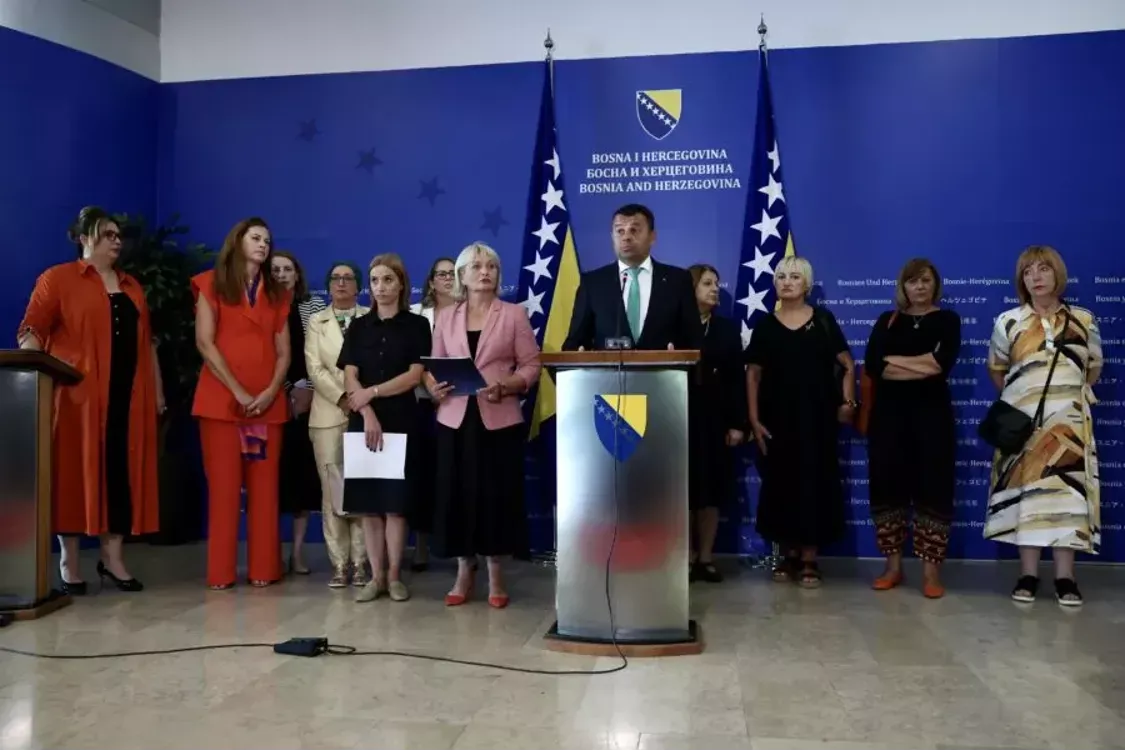
(Patria) - Minister of Human Rights and Refugees of Bosnia and Herzegovina Sevlid Hurtić held a meeting with representatives of the Steering Board of the Safe Network of non-governmental organizations.
A series of conclusions were adopted in line with the recommendations for Bosnia and Herzegovina from the GREVIO Committee of the Council of Europe as an urgent response to cases of gender-based violence and femicide.
Tolerance towards gender-based violence against women in Bosnian society, both in the family, at the workplace, and in public spaces, and especially cases of femicide (the latest brutal case in Gradačac), require urgent adoption of new and implementation of existing legal regulations, in accordance with the Recommendations of the Council of Europe Committee for monitoring the implementation of the Istanbul Convention.
The recommendations of the Council of Europe were adopted in June 2022, based on a comprehensive insight and analysis by Council of Europe experts into the degree of implementation of the Istanbul Convention in Bosnia and Herzegovina. In accordance with the recommendations, Bosnia and Herzegovina is obliged to improve the implementation of the Istanbul Convention standards in order to reach the necessary level of compliance with the provisions of the Istanbul Convention.
At this moment, there is an urgent need to focus on improving prevention and protection from the most severe forms of gender discrimination and violations of the Istanbul Convention, which have unforeseeable and tragic consequences, namely violence against women and girls and femicide.
The conclusions call for urgent and coordinated action by all levels of government in Bosnia and Herzegovina, in accordance with their constitutional and legal responsibilities:
1. Urgently adopt regulations and bylaws that will ensure effective protection of victims of violence in accordance with the standards of the Istanbul Convention, especially regarding criminal policy, so that the sentences and measures imposed for domestic violence and other forms of violence against women are effective, proportionate, and deter from committing offenses.
2. Police, judiciary, and social work centers must take all necessary measures to ensure the physical safety and psychological well-being of victims of gender-based violence and children, and to break the cycle of power and abuse by perpetrators. It is necessary to strengthen professionalism and objectivity in handling cases, and to capacitate social work centers and the police for more effective monitoring of the situation and action in communities, in close cooperation with citizens and the non-governmental sector.
3. Police and social work centers, with the support of the judiciary and other protection entities, are obliged to professionally, thoroughly, and consistently conduct risk assessments and risk management of gender-based violence, taking into account all risk factors (such as previous reports of violence, filing for divorce, etc.).
It is necessary to ensure that risk assessments:
a) are systematically conducted for child victims and witnesses of violence, taking into account any threat directed at them or related to their removal from a violent environment;
b) are conducted continuously and repeated at all relevant stages of the procedure;
c) include all actors in the protection circle from violence (police, social work, education, healthcare, safe houses, and other specialized non-governmental organizations, etc.) and represent the central element of a coordinated "intersectoral" response to prevention and protection;
d) result in a safety plan for victims that is comprehensive and implementable.
4. Ensure the legal status, as well as sufficient and continuous funding from public budgets for all forms of specialized support and assistance for victims of violence, including safe houses, legal and psychological counseling centers, and SOS hotlines.
5. Ensure standards for handling and funding programs for working with perpetrators of violence.
6. In order to overcome gender stereotypes and strengthen professional skills, introduce systematic and mandatory training on all forms of violence against women for relevant professionals working with victims or perpetrators, especially for police officers, prosecutors or judges, as well as for social work center staff and medical personnel, in accordance with the standards of the Istanbul Convention. To ensure continuity and sustainability, training must be funded from the budget and not depend on donor funds.
7. All protection entities (especially social work centers, healthcare, police, and judiciary) should regularly and systematically collect administrative data for all forms of violence against women at all stages of proceedings, classified by gender and age of the victim and perpetrator, type of violence, and the relationship between the perpetrator and the victim, for the entire territory of Bosnia and Herzegovina. This is the only way to conduct an analysis and clearly articulate the shortcomings in the institutions' response to violence, which are continuously repeated as the biggest deficiency in exercising victims' rights.
8. Instead of gender-based violence being a subject of media interest only after a serious case occurs, the media, especially public broadcasters, should implement long-term and continuous program content to raise awareness among professionals and the general public about the prevention and protection of victims from all forms of gender-based violence. In addition to spreading knowledge and overcoming stereotypes, the goal of program content and campaigns must necessarily be to promote the issue of personal and social responsibility in cases of violence against women. Equally important, campaigns and awareness-raising must also be directed at women at risk of discrimination, so that they receive information about their rights and the support services available to them.
9. Improve the system of functioning and coordination of existing coordination bodies for monitoring the implementation of the Istanbul Convention at various levels of government in BiH, in order to ensure overall coordination, standards of procedure, and exchange of information between these bodies, so that the standards of the Istanbul Convention are respected in all parts of Bosnia and Herzegovina, in close consultation with specialized non-governmental organizations and civil society.
10. The composition of the Committee for Monitoring and Reporting on the Istanbul Convention and Femicide, formed by the Council of Ministers of Bosnia and Herzegovina in 2019, is still incomplete, as it does not include representatives from Republika Srpska. It is necessary for representatives from Republika Srpska to be included in the work of this committee, which should, among other things, ensure overall coordination and exchange of information between bodies at different levels of government in Bosnia and Herzegovina.
11. It is high time for Bosnia and Herzegovina, in order to comprehensively and coordinatedly implement the Recommendations of the Council of Europe Committee for monitoring the implementation of the Istanbul Convention (GREVIO Committee), to adopt an Action Plan for the implementation of the recommendations, which will be implemented by all levels of government in accordance with their constitutional and legal responsibilities. In the implementation of the Action Plan, specialized non-governmental organizations are key partners to government bodies, and various international assistance projects are important support for its realization.
Komentari (0)
Prijavite se za komentiranje
PrijavaJos nema komentara. Budite prvi!
Minuta
Sve →Iz drugih kategorija

High Representative Not Elected: Germans, French and British Sabotaged Americans, New Attempt at End of June

ČOVIĆ WITHOUT MERCY: How Those Who Brought Ademović to Office Created a Political Hell for Him



Sunny Saturday, quite warm



Tragedy in Albanian resort: Two minors drown












