
By: Rasim Belko @rasimbelko
I was surprised by some actors in our suffering political life who, lately, often use the term "Sarajevo HNS" in public. Only recently did I realize that this term does not refer to the Trojka coalition, but to its socio-liberal wing known as Naša stranka (Our Party).
This is a project created within circles that could not implement the projects of the fine city elite (FGR) within the Social Democratic Party (SDP) to prove that parades and care for dogs, cats, and parrots are more important than the interests and care for the state. Naša stranka began to operate from such a project, with abundant help from the international community and lobbying circles, a project that until 2022 was limited to the route of Gras's trolleybus line, with a certain presence in the Parliament of the Federation.
Today, that Naša stranka is the connective tissue of the Trojka project, which was created by the same circles that created Naša stranka. And the figurehead of Naša stranka is Sabina Ćudić, who has established a reign of terror within the party structures, positioning the president Edin Forto as a decoy to absorb public criticism.
Naša stranka, starting from the constitution of the current City Administration in Mostar to the present day, has truly proven to be the Sarajevo political branch of HDZ BiH, which could be clearly seen not only in the federal Parliament but also at the state level.
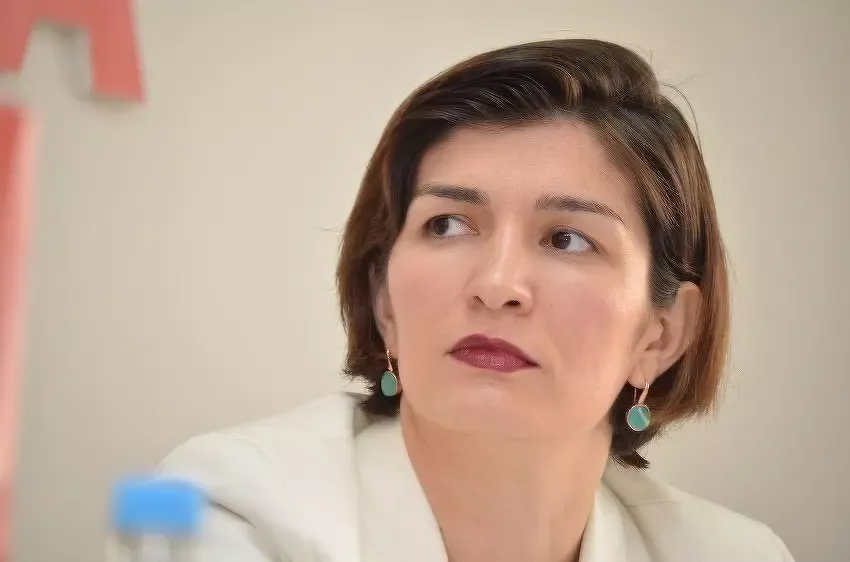
This is the reason why they are called the Sarajevo HNS. And that this is more than arguable was shown by last week's "Sarajevo Plenum: Quo vadis Balkan?". Sabina Ćudić, the figurehead of the Sarajevo HNS, participated in one of the panel sessions and showed the entire public in Bosnia and Herzegovina that Naša stranka has completely adopted the narrative of their apparent mentor, Dragan Čović.
The panel session in which Ćudić participated was titled "On the Constitution and the Need for Constitutional Change in BiH".
Ćudić, to everyone's surprise, said: "Regarding consociation, I will say that we have roughly divided types - corporate and liberal. We live in a very rigid consociation where the defined rights of all ethnic groups are literally secured. My question as a politician and political scientist is whether we can move from rigid to liberal consociation within the existing Constitution. I think it is wrong to advocate for democracy in the way of majority rule. I would like us to move towards liberal democracy and distance ourselves from our divisions, and to feel a sense of belonging to a system that guarantees rights to everyone".
In conclusion, she stated that "Bosnia and Herzegovina is undoubtedly a rigid consociation and that a biodegradation of the constitutional system is needed".
The president of HDZ BiH, Dragan Čović, wrote to international officials in October 2020, stating that BiH is a "post-conflict and deeply divided society", and therefore BiH is "organized as a consociational democracy".
– The Constitutional Court of BiH, in its decision on legitimate representation, could not ignore this fact, but it is consciously ignored in public discourse, thereby deceiving and dividing the public. Consociation does not perpetuate conflicts and divisions, but addresses and resolves them. It prevents the hegemony, repression, and majorization of one nation over others. Therefore, we have a system that is established with very clear purposes and goals," stated Čović, as if Ćudić were prompting him.
It is therefore obvious that the president of the Sarajevo HNS from the shadows is trying to impose in Sarajevo the narrative that Dragan Čović has promoted and advocates as a model that should enable the division of the country into three parts and introduce governance based on the principle of parallelism.
More concerning than the fact that Sabina Ćudić is pushing Dragan Čović's views is that, apart from Slaven Kovačević, no one present at the panel even attempted to respond to the discussion about consociation.
If we know that consociational democracy has its four fundamental principles, the first of which is the existence of a Grand Coalition in whose creation political parties with opposing ideological views participate, and ethnic communities or constituent peoples, as we call them here, do not participate at all.
The distribution of political power within consociation is carried out between the actors in the political system, and not between ethnic communities. Kovačević asked if the proponents of consociation know that it is based on the proportional distribution of political power, meaning that the number of mandates and positions is derived proportionally, not through parity as is the case in Bosnia and Herzegovina.
It is quite clear that consociation is not possible in Bosnia and Herzegovina, but political projects that follow the path and war goals of Boban's, Kordić's, and later Jelavić's and Čović's HDZ are.
Consociation is the opposite of our European path, so it is high time for Naša stranka, the Sarajevo HNS, or FGR politics to answer whether we have received a branch in Sarajevo for the implementation of Tuđman's original policy.
The author of these lines does not need an answer, but the citizens of Sarajevo, primarily Bosniaks, who saw a change in Sabina Ćudić and her Naša stranka. Only no one drew their attention to the fact that it is a change tailored to the measure and goals of Čović and HDZ!
Komentari (0)
Prijavite se za komentiranje
PrijavaJos nema komentara. Budite prvi!
Minuta
Sve →Iz drugih kategorija

High Representative Not Elected: Germans, French and British Sabotaged Americans, New Attempt at End of June

ČOVIĆ WITHOUT MERCY: How Those Who Brought Ademović to Office Created a Political Hell for Him



Sunny Saturday, quite warm



Tragedy in Albanian resort: Two minors drown












