
Written by: Avdo Avdić/Istraga.ba
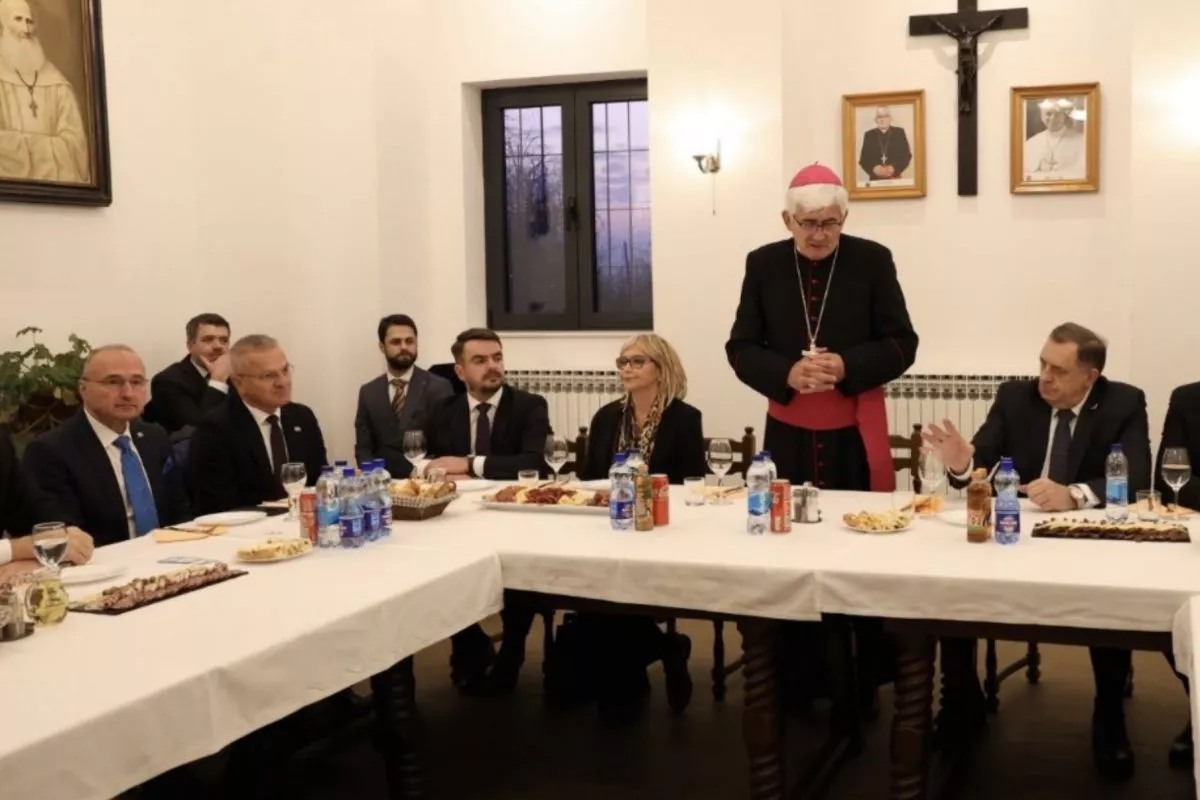
While visiting Catholic churches and monasteries in Banja Luka, Andrej Plenković, Dragan Čović, and their priest hosts did not, with a single word or gesture, remember Filip Lukenda and Cecilija Grgić. Does the Croatian Prime Minister even know who Filip and Cecilija are? Did his host and Čović's "President Dodik" tell him that in the Catholic Church of Presnače near Banja Luka, on the night of May 12, 1995, between 2 and 4 a.m., parish priest Filip Lukenda and nun Cecilija Grgić were burned alive? The church was then mined and razed to the ground, and Filip and Cecilija were granted the status of martyrs.
These two clergy were not killed by members of the Army of the Republic of Bosnia and Herzegovina. They were killed by members of the Army of Republika Srpska, whose criminal legacy is today glorified by Milorad Dodik and the acolytes of his political company. Yet, Andrej Plenković has no problem cordially shaking hands with Milorad Dodik and entering the Palace of the President of Republika Srpska.
Željko Komšić, on the other hand, is unacceptable to Plenković. Because he was in the Army of the Republic of Bosnia and Herzegovina, he wears a decoration of the Army of RBiH, and he does not make his decisions in accordance with the instructions of official Zagreb and unofficial western Herzegovina.
When he was on an official visit to Sarajevo in January 2024, Andrej Plenković avoided visiting the Presidency of Bosnia and Herzegovina. The prime minister of supposedly friendly Croatia chose to ignore the institution of the state of Bosnia and Herzegovina. He reduced Bosniaks to a religious group when, during the visit, he went to the Rijaset where he met with Reis Husein Kavazović and his associates, who form their foreign policy views in accordance with payments from the Budget of the Republic of Croatia for meaningless exhibitions "under the sky of clear faith".
Is there any reason why Andrej Plenković can be considered a friend of Bosnia and Herzegovina? Let us exclude all clichés about Croatia's commitment to a "European BiH" and face the truth.
Act one – Maka Radić.
A final verdict of the Court of BiH established that HVO fighter Maka Radić, from July 1993 to March 1994, participated in the formation of a prison, ordered the illegal arrest and imprisonment of several dozen Bosniak civilians, women, children, and the elderly, and participated in crimes in the camp. He was sentenced to 27 years in prison. He was supposed to be released only in 2027. But at the beginning of October 2018, the HDZ Minister of Justice of BiH, Josip Grubeša, approved Radić's request to serve his sentence in Croatia. In Plenković's Croatia. As soon as he was transferred to Zagreb, the "independent judiciary" of the state of Croatia commuted the sentence to 12 years. Exactly as long as Radić had spent in prison in BiH. "Friendly" Croatia released Radić in the same year, 2018. Nine years before he was supposed to be freed.
Act two – Zlatan Mijo Jelić
"The County State Attorney's Office in Zagreb today published a brief statement on its official website stating that on July 17 it issued a decision to discontinue the investigation against a Croatian citizen born in 1970, initiated due to reasonable suspicion that he committed criminal acts against humanity and international law, specifically war crimes against civilians and prisoners of war, due to lack of evidence," Croatian media reported this year.
It concerned Zlatan Mijo Jelić, a fugitive HVO general. Previously, the Prosecutor's Office of BiH, following the proven recipe of Maka Radić, handed over the criminal proceedings against Zlatan Mijo Jelić to the DORH in October 2020. And the "independent" DORH of the state of Croatia decided to discontinue the proceedings. And so, another case related to crimes against "friends" Bosniaks was concluded by Croatia with an acquittal.
Act three – releasing gas from the state of Croatia
On Thursday, March 15, 2021, the job was completed. Gas pipelines, about 450 meters long, were laid under the cover of night under the Sava River, which separates Bosnia and Herzegovina from Croatia. They were laid by the company Crodux, based on an agreement between the Government of the Republic of Croatia and the Government of Republika Srpska on the "gasification" of the Oil Refinery in Brod, whose majority owner is the Russian Zarubezhneft. The state authorities of Bosnia and Herzegovina never gave consent for the construction of this gas pipeline. This act of disrespect for the borders of BiH, which in international law is called aggression, was reported with all praises by HRT in its program. And, again, nothing happened. Plenković is a friend of BiH.
Act four – migrants
That Plenković's Croatia does not respect the borders of Bosnia and Herzegovina was also established by the international organization Human Rights Watch. In their annual report on the state of human rights for 2020, they stated that "Croatia, despite illegally and violently returning migrants to BiH and Serbia, thereby violating EU laws on refugees and human rights, did not suffer consequences from European institutions."
"Despite credible reports throughout the year of illegal and violent returns of migrants to Bosnia and Serbia, violating EU law on refugees and human rights, Croatia did not suffer consequences from EU institutions," HRW writes in its report on human rights in Croatia.
If you think I am stopping the list because there are no more "acts", you are wrong. All the "friendly" moves of Plenković's Croatia could not fit into a double-digit number of acts. But, you know, Plenković was in Srebrenica. He acknowledged Serbian crimes against Bosniaks. Because the graves of Bosniaks in Potočari have long served only as a bulwark for Greater Croatian politics to settle scores with living "political" Bosniaks. Does anyone remember Andrej Plenković uttering a word of criticism about the glorification of two convicted UZPs with Franjo Tuđman at the helm? No. Because you cannot remember something that never happened.
Did Andrej Plenković impose sanctions on Milorad Dodik? Did he ban him from passing through Croatia, while the latter was still formally a "fugitive" from BiH justice? No, he did not. Because that, Plenković himself would admit, "was not in the interest of the Republic of Croatia." Which, by analogy, should mean that such a policy of Milorad Dodik is "in the interest of the Republic of Croatia."
"President Dodik, through you I want to greet all friends from Republika Srpska at every level of government, because just as we try to create a network of joint action, I am sure we cannot do that if we are not all together. This togetherness can work wonders," Dragan Čović said on Thursday, while Croatian Prime Minister Andrej Plenković stood beside him.
The "togetherness" of Dodik, Čović, and Plenković can indeed work wonders. But none of those wonders will be called the Election Law. Because every hand raised from Sarajevo, Tuzla, Zenica, Bihać, and Travnik for the Election Law proposed by Plenković and Čović will be equal to the hand of Fikret Abdić. And in achieving that wonder, neither the mufti's prayers from the Zagreb Mosque nor all the exhibitions of Dževad Hodžić can help him.
And, therefore, Mr. Plenković, protect the Republika Srpska. That is what Dragan Čović told you!
Komentari (0)
Prijavite se za komentiranje
PrijavaJos nema komentara. Budite prvi!
Minuta
Sve →Iz drugih kategorija

High Representative Not Elected: Germans, French and British Sabotaged Americans, New Attempt at End of June

ČOVIĆ WITHOUT MERCY: How Those Who Brought Ademović to Office Created a Political Hell for Him



Sunny Saturday, quite warm



Tragedy in Albanian resort: Two minors drown












