
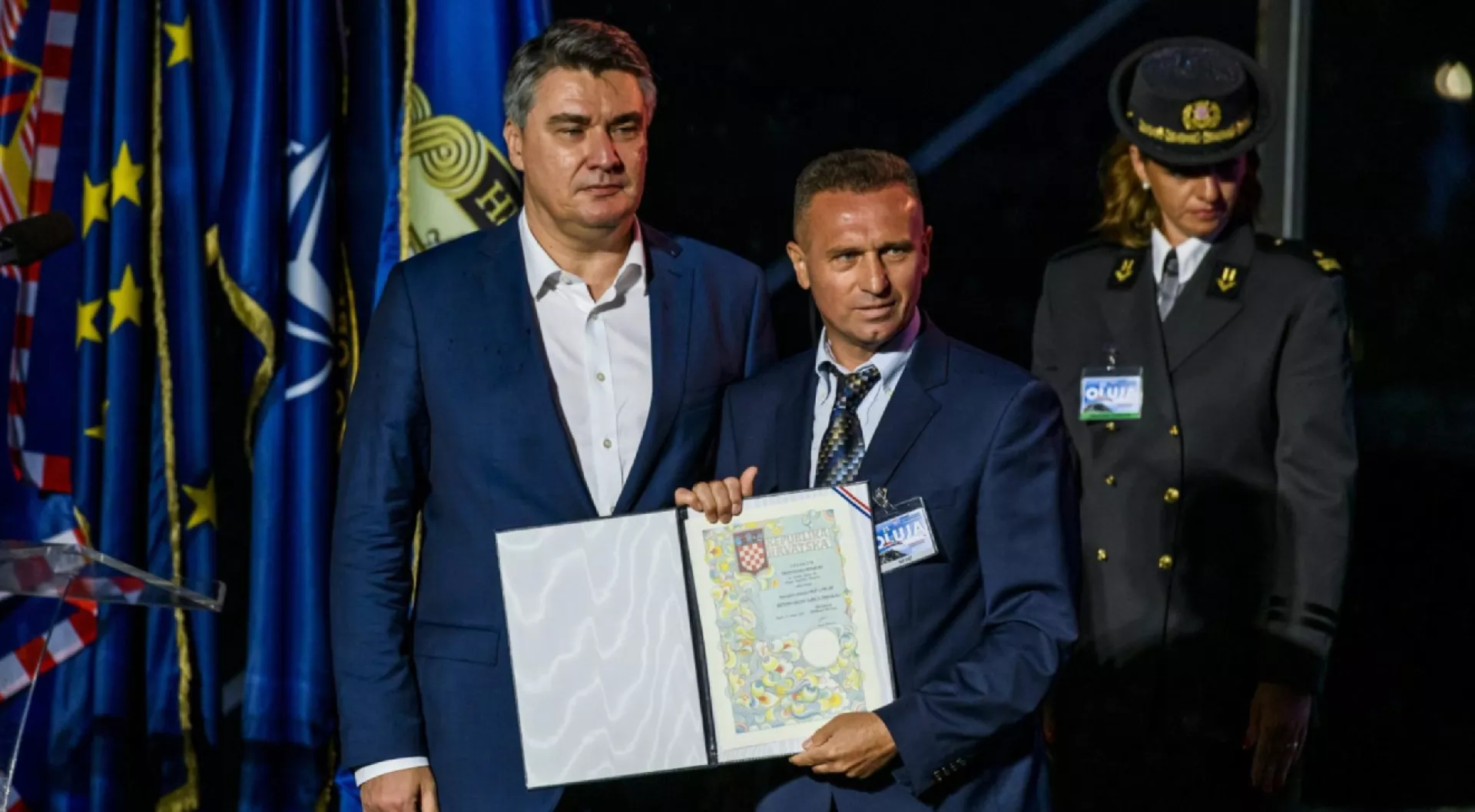
(Patria) - Zlatan Mijo Jelić, HVO general and wartime commander of Mostar's defense, now residing in Zagreb, against whom the BiH Prosecutor's Office confirmed one of the most extensive indictments in 2015 for war crimes against Bosniak civilians in prisoner-of-war camps, will continue to live as a free man in Croatia.
The County State Attorney's Office in Zagreb today issued a brief statement stating that on July 17, it made a decision to suspend the investigation against a Croatian citizen, born in 1970, initiated due to well-founded suspicion that he committed criminal offenses against humanity and international law, specifically war crimes against civilians and prisoners of war, due to lack of evidence.
Although the County State Attorney's Office did not state his name in its dry statement, Jutarnji list unofficially learned that the suspension of criminal prosecution refers precisely to Zlatan Mijo Jelić.
In October 2020, the BiH Prosecutor's Office handed over the criminal prosecution against Mijo Jelić to the DORH (State Attorney's Office of the Republic of Croatia) because Jelić, who previously lived in BiH, had moved to Croatia and become unavailable to the Croatian prosecution authorities. However, almost five years later, the DORH has suspended criminal prosecution against him.
The wider public in Croatia heard about Zlatan Mijo Jelić before the commemoration of the 25th anniversary of Operation Storm, in the summer of 2020, when he received a decoration from the hands of then and current President Zoran Milanović for the merits of HVO brigades and special police in the liberation of Croatia.
Milanović's act caused fierce criticism from camp survivors, media, and political representatives in Bosnia and Herzegovina.
It was then revealed that the BiH Prosecutor's Office had confirmed one of the most serious and extensive indictments for war crimes committed in the territory of Bosnia and Herzegovina, specifically in the wider area of Mostar, against Jelić back in late 2015.
However, he is unavailable to BiH prosecution authorities because he permanently settled in Croatia even before the indictment was filed, and renounced his BiH citizenship in 2002, retaining only Croatian citizenship.
The BiH Prosecutor's Office based the indictment against Jelić on evidence that Hague investigators had obtained for the trial of six Bosnian Croats - Jadranko Prlić and others, as well as for the trial of Mladen Naletilić Tuta and his "punitive battalion".
The Hague Tribunal, as a reminder, permanently sentenced Prlić and the other five HVO military and political officials to a total of over 100 years in prison.
In the first-instance Hague verdict against Jadranko Prlić and others, the name Zlatan Mijo Jelić is mentioned in several places. In a footnote, on page 400 of the Hague verdict, it is stated that, according to documentation collected by the Hague Tribunal, Jelić, from June 5 to December 9, 1993, "on at least 235 occasions", "sometimes several times a day" commanded "the sending of detainees to work".
This refers to the forced sending of detainees, mostly Bosniaks, to dig trenches and perform other work on the front line against Serb positions, during which the detainees were exposed to crossfire in which they were killed and wounded.
The Hague verdict against Prlić and others lists the names of detainees who were killed during forced labor on the front line in the wider area of Mostar, as well as the names of detainees who were wounded during forced labor on the separation line, whose killings and injuries were proven beyond doubt in the Hague proceedings.
Using the documentation and evidence collected by the Hague Tribunal, the BiH Prosecutor's Office filed an indictment against Zlatan Mijo Jelić in 2015 for command responsibility.
The indictment charges him with war crimes against humanity committed through unlawful deprivation of liberty and detention of civilians, ethnic cleansing, ordering forced labor of prisoners of war, and responsibility for the deaths and injuries of at least 40 prisoners of war during forced labor on the battlefield in the Mostar area.
In the indictment, the BiH Prosecutor's Office accuses Jelić that, as a general of the HVO Military Police, he was directly responsible for the management of the Heliodrom camp in Mostar, where the HVO held about 200 prisoners in captivity.
From the brief statement of the DORH, it is impossible to know what the County State Attorney's Office in Zagreb undertook from October 2020, when it took over the criminal prosecution of Zlatan Mijo Jelić, to collect evidence for these serious accusations.
The DORH will inform the BiH Prosecutor's Office of its decision to suspend the investigation against Zlatan Mijo Jelić. The indictment against him in BiH remains in force.
What is already clear is that Croatia will not extradite Zlatan Mijo Jelić to Bosnia and Herzegovina because there is no interstate agreement between BiH and Croatia on the mutual extradition of suspects or accused persons for war crimes.
Extradition would not be possible even if this HVO general, who receives a high veteran's pension in Croatia, had not renounced his BiH citizenship.
Incidentally, in 2020, Zlatan Mijo Jelić sued Jutarnji list for an article in which details of the BiH indictment regarding the circumstances of his departure from BiH to Croatia were published, seeking 100,000 kuna for inflicted mental anguish.
He claimed that he was a free man in Croatia and that no one should mention what the BiH indictment accused him of.
The Municipal Civil Court in Zagreb, in the court proceedings, rejected most of his claims, with the explanation that Jutarnji list had accurately reported the allegations of the BiH indictment and the Hague verdict against Prlić and others, as well as the DORH's statements that they would initiate an investigation against him in Croatia.
However, despite this, the court ruled that Jutarnji list must pay Zlatan Mijo Jelić 2,000 euros for mental anguish due to allegations taken from BiH media that he fled from that country to Croatia in 2015 on the eve of the confirmation of the war crimes indictment, and that he renounced his BiH citizenship at the time, retaining only Croatian citizenship.
Zlatan Mijo Jelić submitted evidence to the court that he had moved to Croatia in 2011 and that he had renounced his BiH citizenship in 2002.
Komentari (0)
Prijavite se za komentiranje
PrijavaJos nema komentara. Budite prvi!
Minuta
Sve →Iz drugih kategorija

High Representative Not Elected: Germans, French and British Sabotaged Americans, New Attempt at End of June

ČOVIĆ WITHOUT MERCY: How Those Who Brought Ademović to Office Created a Political Hell for Him



Sunny Saturday, quite warm



Tragedy in Albanian resort: Two minors drown












