
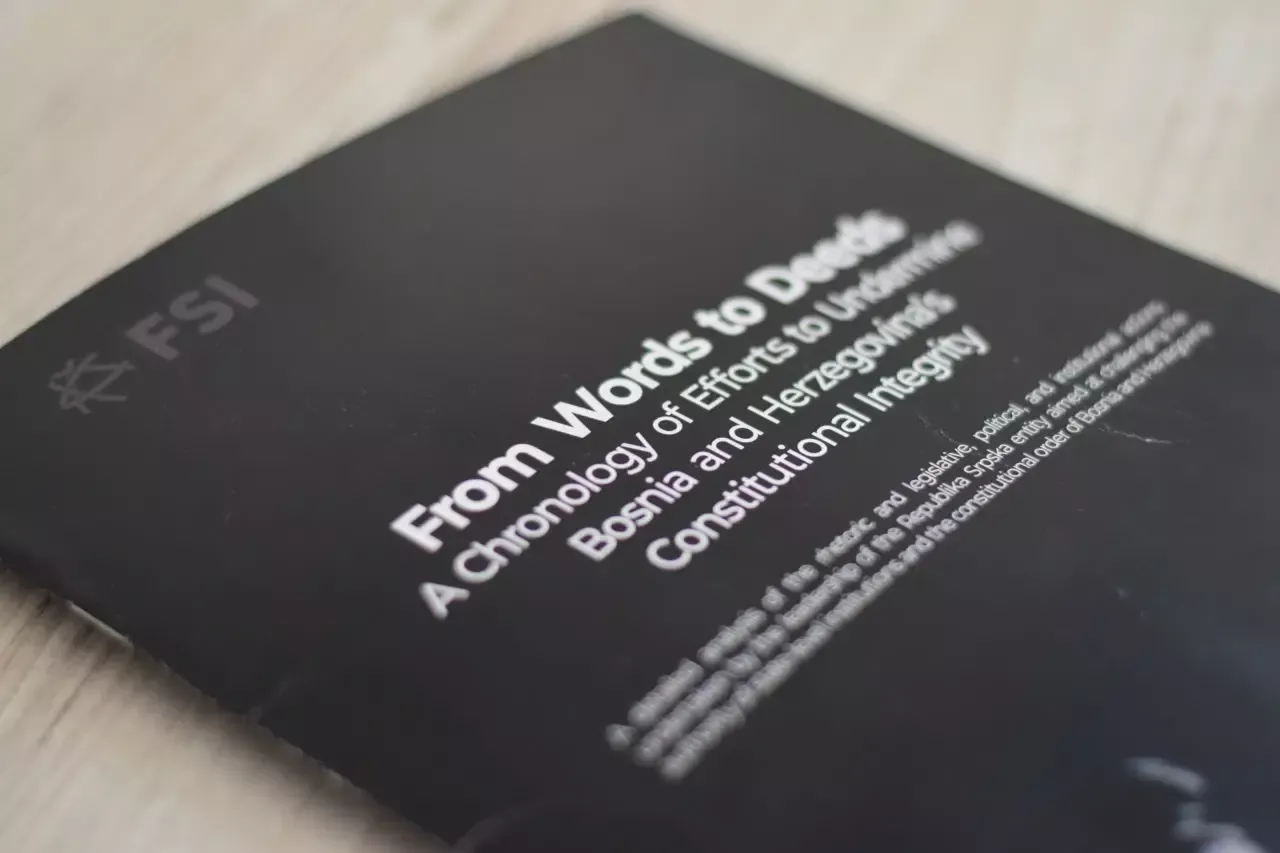
(Patria) - The Forum for Cooperation and Research (FSI) today presented the report "From Words to Deeds: A Chronology of Attempts to Undermine the Constitutional Integrity of Bosnia and Herzegovina".
The document provides a comprehensive and detailed analysis of the rhetoric, legislative, political, and institutional measures undertaken by the leadership of the Republika Srpska entity from mid-2023 to mid-2025, with the aim of limiting the competencies of state bodies and challenging the constitutional order of BiH.
The analysis points to all the steps that preceded the current political and legal vacuum, and its goal is to objectively share facts and information that can be useful for international understanding of the crisis.
"Although it is difficult to separate one political crisis from another in BiH, the analysis indicates that the current one is linked to the adoption of the law on immovable property management at the entity level, the suspension of which resulted in the adoption of the law on non-application of decisions of the Constitutional Court of BiH and the High Representative in the territory of the Republika Srpska entity.
Our goal was to objectively explain the chronology of causes and consequences by following the facts, so that external actors have a clearer understanding of what is happening in BiH. Now is the time to explore modalities for exiting the crisis, for the benefit of the citizens of BiH and the principles of the rule of law," the FSI stated.
The research team analyzed the legal and political implications of the moves by the authorities in Banja Luka. The research reveals how the parallel legal and institutional logic of Republika Srpska has led to the systemic collapse of inter-institutional cooperation, endangering the cohesion of the state and citizens' trust in the rule of law.
Particular attention is paid to hate speech and Islamophobia, which form the basis of the rhetoric accompanying the political and institutional actions of decision-makers.
"The publication warns of possible scenarios for the development of the crisis - from forced reintegration with international support, through the permanent paralysis of state institutions, to formal disintegration.
The first scenario represents institutional reintegration through the enforcement of laws. The state enforces the judgments of the Court of BiH and arrests those responsible, along with sanctions and conditional financing, which forces Republika Srpska to repeal unconstitutional laws and return to cooperation with state institutions.
Given the existing vertical structures of public finance control, the analysis warns that in such a de-escalation, communication would have to be established with certain officeholders in SNSD who have remained outside the crisis narrative, such as the member of the Presidency of BiH Željka Cvijanović.
Otherwise, it is difficult to create the political capacity that can unblock the institutions of BiH in the current relations," the FSI stated.
The second scenario is the establishment of a parallel legal order. Republika Srpska formally establishes a system that refuses to apply decisions at the state level, creating two mutually exclusive systems of governance and effectively blocking the unified rule of law in BiH.
In the long term, this situation would completely jeopardize BiH's European path and set a precedent for further dismantling of the state. However, the slowness and gradualness of such actions will create an effect of the public "getting used" to the new reality, without the alarm signal that is persistently expected.
The third scenario is the controlled containment of the crisis through political negotiations. In such a situation, international actors and moderate forces from Republika Srpska agree on a temporary moratorium on controversial legislation with political compromises and financial packages, restoring the semblance of functionality of state bodies without a permanent resolution of the constitutional dispute.
However, this also entails a series of compromises that the actors at the table cannot deliver, especially not the political factors in Sarajevo who must maintain the trust of their voters on this path.
The fourth scenario is escalation into an international crisis and foreign intervention. Further militarization of the Republika Srpska police and open obstruction of SIPA would lead to active involvement of the OHR and EUFOR in carrying out arrests, as well as possible "forced" measures that would restore the Dayton framework.
In the absence of such a reaction, and the absence of solutions from the aforementioned scenarios, formalized constitutional disintegration may occur.
This would lead to a fifth scenario, where Republika Srpska openly adopts a sovereignist "constitution", ceases to apply state laws, establishes its own armed and customs structures, and organizes a referendum on independence, leading to the final breakdown of the Dayton order and lasting destabilization.
FSI brings together prominent experts in law and politics, whose focus is on protecting the human rights of the returnee community in the Republika Srpska entity.
In the last five years, FSI has published numerous analyses on the protection of returnees' rights, hate crimes based on ethnic or religious intolerance, advocating for new programmatic solutions to support return, as well as directly on issues of discrimination in access to education, public services, and political participation of returnee communities in BiH.
The presented analysis has been translated into English and delivered to all international and domestic actors in Bosnia and Herzegovina.
Komentari (0)
Prijavite se za komentiranje
PrijavaJos nema komentara. Budite prvi!
Minuta
Sve →Iz drugih kategorija

High Representative Not Elected: Germans, French and British Sabotaged Americans, New Attempt at End of June

ČOVIĆ WITHOUT MERCY: How Those Who Brought Ademović to Office Created a Political Hell for Him



Sunny Saturday, quite warm



Tragedy in Albanian resort: Two minors drown












