
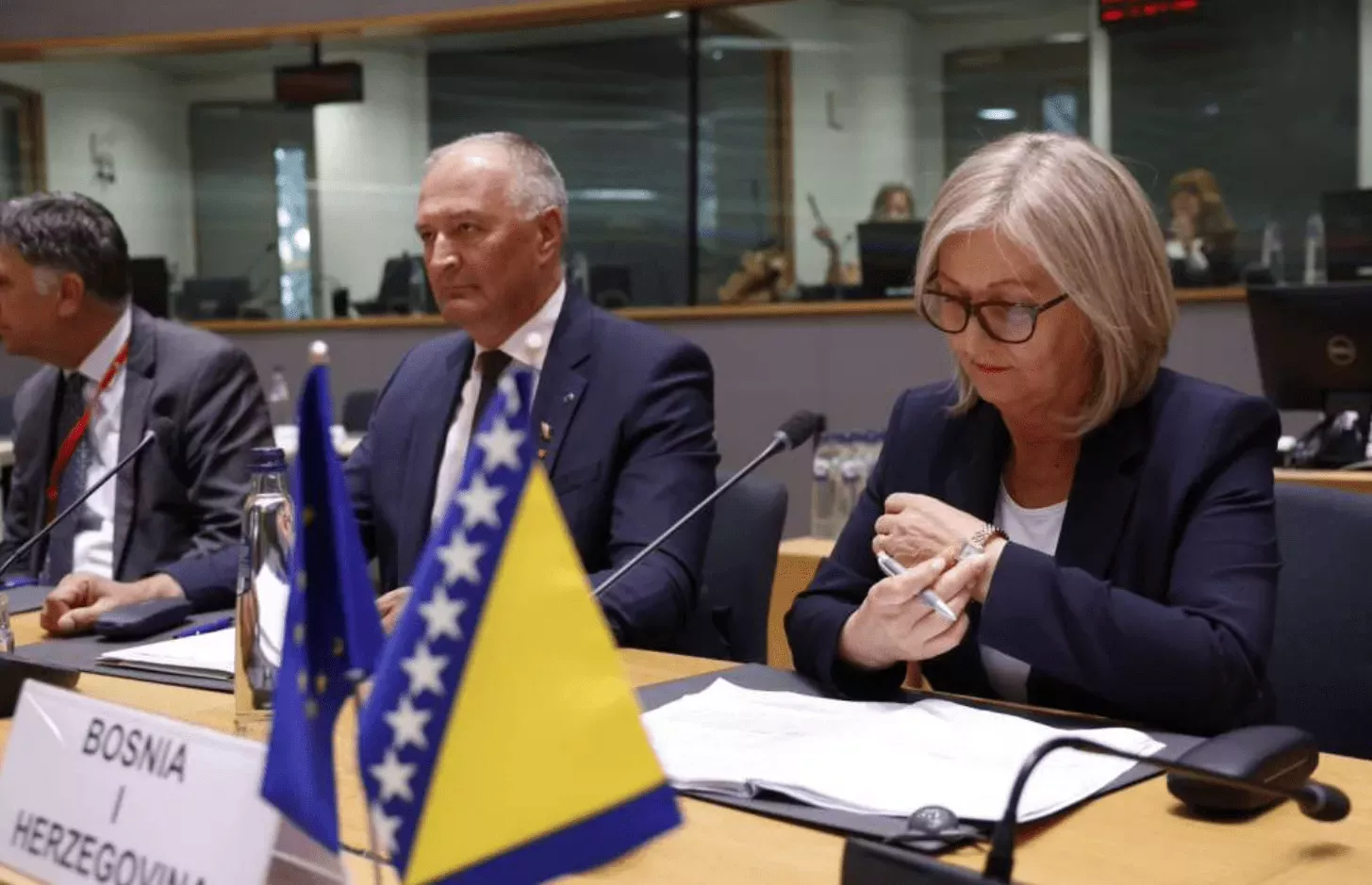
(Patria) - Borjana Krišto wrote in her own name, not in the name of the BiH Council of Ministers, reports Istraga.ba.
This is the essence of the letter sent by the Deputy Chairperson of the BiH Council of Ministers and BiH Minister of Defence Zukan Helez to the European Court of Human Rights in Strasbourg.
“I sent a letter,” Minister Helez confirmed to Istraga.ba.
According to Istraga's information, Helez informed the President of the ECHR that there is no relevant decision from BiH institutions to request a review of the ruling in the Slaven Kovačević v. Bosnia and Herzegovina case, and that the Chairperson of the BiH Council of Ministers, Borjana Krišto, wrote to the Court on her own initiative regarding the status of the agents who submitted the request for review of the ruling.
“I inform you,” Helez wrote to the President of the European Court of Human Rights in Strasbourg, “that the Council of Ministers of Bosnia and Herzegovina (Government) wished to consider the information regarding the Application: 43651/22 'Kovačević v. Bosnia and Herzegovina' submitted by the relevant ministry, as well as to decide on the status of persons performing duties in ECHR cases and further state actions at the Council of Ministers session, planned for October 26, 2023. However, the Chairperson of the Council of Ministers of Bosnia and Herzegovina (Government) decided not to put this topic on the session's agenda, which resulted in the Council of Ministers having no decision on the status of acting officials, especially after their mandate expired in June 2021, and there is no relevant government decision on submitting a request to the Grand Chamber,” Helez wrote.
Finally, Helez concluded, the Council of Ministers of Bosnia and Herzegovina is a collective body with a collective decision-making system, which means that the Chairperson of the Council of Ministers cannot act or decide independently on any matter, including communication with the European Court of Human Rights in Strasbourg.
Let us recall, the European Court of Human Rights in Strasbourg requested last month from the authorities in BiH to clarify whether the agents who requested a review of the ruling in the Slaven Kovačević case have the active legitimacy to represent BiH.
The "appeal" against the Kovačević ruling was sent on September 19, the last working day of Jelena Cvijetić in the position of BiH agent before the Court in Strasbourg. Twelve days before she sent the appeal, the current convocation of the BiH Council of Ministers appointed Jelena Cvijetić as the Ombudsman of Bosnia and Herzegovina.
This is the first time that Bosnia and Herzegovina is requesting a review of any decision of the European Court of Human Rights related to electoral legislation – i.e., constitutional order.
The European Court of Human Rights ruled that Slaven Kovačević, as a voter and citizen of Sarajevo, was denied the right to vote for a candidate for the Presidency of BiH from the Republika Srpska. The Court stated that the Presidency of BiH is a state institution and that all citizens must have the right to elect all members of the BiH Presidency. Thus, the Court effectively determined that, in addition to ethnic discrimination, territorial discrimination is also in force in BiH. To eliminate this discrimination, it is necessary to have a single electoral unit when electing members of the BiH Presidency and delegates to the House of Peoples of the Parliamentary Assembly of BiH.
According to the Rules of Procedure of the European Court of Human Rights, the request for review is decided by the Grand Chamber, composed of seventeen judges. The initial decision, we remind you, was made by seven judges. They voted 6:1. The only one who opposed the initial decision was the Austrian judge Gabriele Kucsko-Stadlmayer. It was on her dissenting opinion that agents Mijić and Cvijetić based their appeal.
For the request for review to even reach the Grand Chamber of seventeen judges, it is necessary for its merits to be initially determined by a Chamber of five judges.
This Chamber, by function, includes the President of the European Court of Human Rights and two Vice-Presidents. In addition to them, there are two rotating judges chosen from among the judges of the remaining sections. When considering a request for review of a ruling, no judge who participated in making the initial decision will be part of the Chamber.
Komentari (0)
Prijavite se za komentiranje
PrijavaJos nema komentara. Budite prvi!
Minuta
Sve →Iz drugih kategorija

High Representative Not Elected: Germans, French and British Sabotaged Americans, New Attempt at End of June

ČOVIĆ WITHOUT MERCY: How Those Who Brought Ademović to Office Created a Political Hell for Him



Sunny Saturday, quite warm



Tragedy in Albanian resort: Two minors drown












