
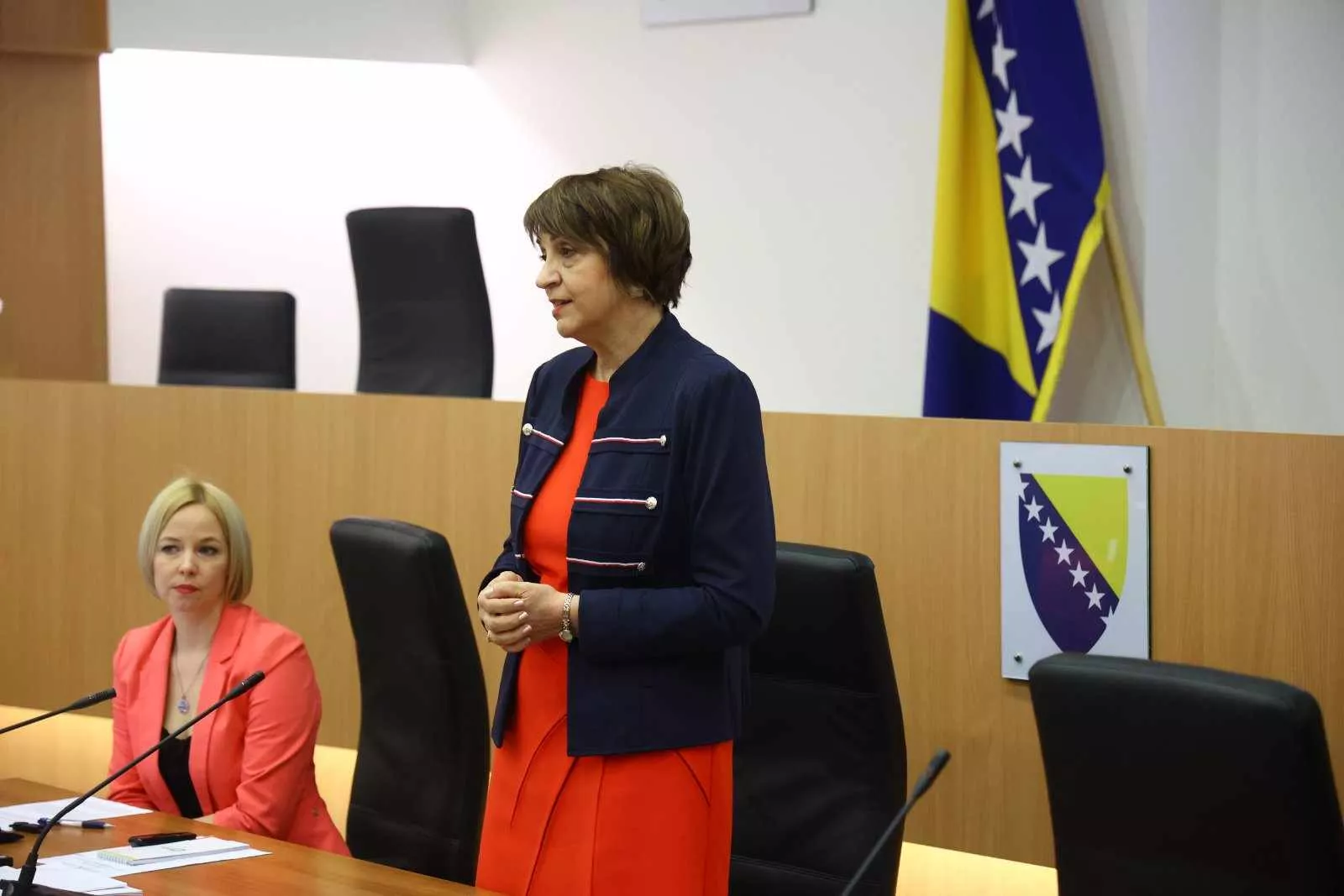
(Patria) - The President of the Central Election Commission of Bosnia and Herzegovina (CEC BiH) Irena Hadžiabdić stated that at this moment, the conditions for introducing new technologies in the 2026 General Elections are not met, as no concrete conclusions on the feasibility study have been adopted and no funds have been secured.
She said this at the conference "New Election Technologies: Experiences from Local Elections and Application in General Elections" organized today in Sarajevo by Democracy International in Bosnia and Herzegovina (DI BiH) with the support of CEC BiH and the Coalition for Free and Fair Elections "Pod lupom" (Under the Magnifying Glass).
According to their plan, Hadžiabdić added, funds were supposed to be secured by the end of April.
She emphasized that amendments to the Election Law should be urgently addressed, and CEC and partner agencies should be helped to create a reliable, convincing, credible, and secure system, and to procure the necessary equipment and applications for the general elections.
Hadžiabdić pointed out that CEC reports submitted to the Parliamentary Assembly of Bosnia and Herzegovina are periodically adopted.
- The PA BiH has adopted all our reports, except for the Second Periodic Report, which the House of Peoples will discuss on Thursday. In this way, politics has given us support - stated Hadžiabdić.
Hadžiabdić highlighted that new technologies were tested for the first time in the 2024 Local Elections, which gave them insight into election administration, voters, and technical operators.
- What is behind us is a very successful test, and all indicators speak to that - she said, adding that they had waited almost eight years for this test and pilot project.
She also reminded that the first activities for the introduction of technologies were initiated back in 2016 at the initiative of the non-governmental sector and the CEC due to the increasing demands of voters who had very low confidence in the electoral process as it had functioned until then.
- We reached a situation where, due to members of polling station committees who were exclusively appointed at the suggestion of political entities, we could not control the election process. We were aware of manipulative actions related to the voting process itself, and especially with manipulative actions such as altering results during the count - she said.
All of this, Hadžiabdić added, greatly eroded confidence in the process, and they sought new modalities to overcome this problem.
She cited slow counting as another major problem, due to the complex electoral system.
- In the last elections, when we had new technologies and when we replaced the presidents of polling station committees by appointing them as individuals who must not be connected to politics, we recounted ballots much less - she said.
Hadžiabdić emphasized that new technologies showed that results could be obtained in 40 minutes.
- In five minutes, 30 percent of the results arrived via scanner, and in 10 or 15 minutes, 60 percent of the results. We had problems in the implementation and presentation of results, but what we did, we did in just a month and a half, which is a great success - she said.
She also added that they could not have done anything without the donors who provided them with support.
- Without them, it would not have been realistic at all for the Central Election Commission, which lacked all possible knowledge about the equipment itself, its functioning, and information and communication technologies - she concluded.
Tihana B. Blanc, Director of the Election Integrity Support Project in BiH, assessed that the CEC had made a huge step forward by making elections in BiH more transparent and accountable, testing several pilot projects in seven municipalities and the Brčko District.
- The pilots have improved the electoral process in BiH and strengthened voters' confidence in the electoral process by generating election results automatically and transmitting them within minutes of polling stations closing - she explained.
She claims that the differences between manually and automatically counted results were negligible.
Blanc said that without improvements, the election administration in BiH could be susceptible to fraud and suspicion.
- Expanding the use of such technology from seven municipalities and the Brčko District to 143 municipalities is a major undertaking and requires significant effort and work.
This includes procurement, technology, logistics, programming, new software, training for polling station committees, technical experts such as operators so they know how to use these new technologies, work on adapting the legal framework for the introduction of such technologies, and training for election observers and civil society who need the necessary tools to observe such new technologies and elections - she explained.
Blanc said that these pilot projects were supported by the US Government and that she could confidently assess how the US government's policy is changing.
- In the US today, there is bipartisan support for the integrity of Bosnia and Herzegovina and the continuation of the successful implementation of the Dayton Agreement. However, what the new US administration has not expressed is the intention to provide long-term support, that is, to continue this type of assistance that would enable support for the CEC's pilot projects, new technologies, and other necessary support - she said.
But Blanc is confident that there are other bilateral and multilateral partners ready to provide support in this segment.
Participants had the opportunity to directly test the technologies used during the pilot phase and discuss opportunities for improving the electoral process in BiH.
The aim of the conference is to present the findings of the new election technologies pilot project, which CEC BiH conducted during the October 2024 Local Elections, and which the Pod Lupom coalition observed with the support of DI BiH.
The conference enabled them to inform the public and participants of the electoral process in BiH about the pilot project, share the conclusions of the feasibility study adopted by the BiH Parliament in April 2025, and present the key steps for the wider application of technologies in the 2026 General Elections.
Komentari (0)
Prijavite se za komentiranje
PrijavaJos nema komentara. Budite prvi!
Minuta
Sve →Iz drugih kategorija

High Representative Not Elected: Germans, French and British Against Americans, New Attempt at End of June

ČOVIĆ WITHOUT MERCY: How Those Who Brought Ademović to Office Created a Political Hell for Him



Sunny Saturday, quite warm



Tragedy in Albanian resort: Two minors drown












