
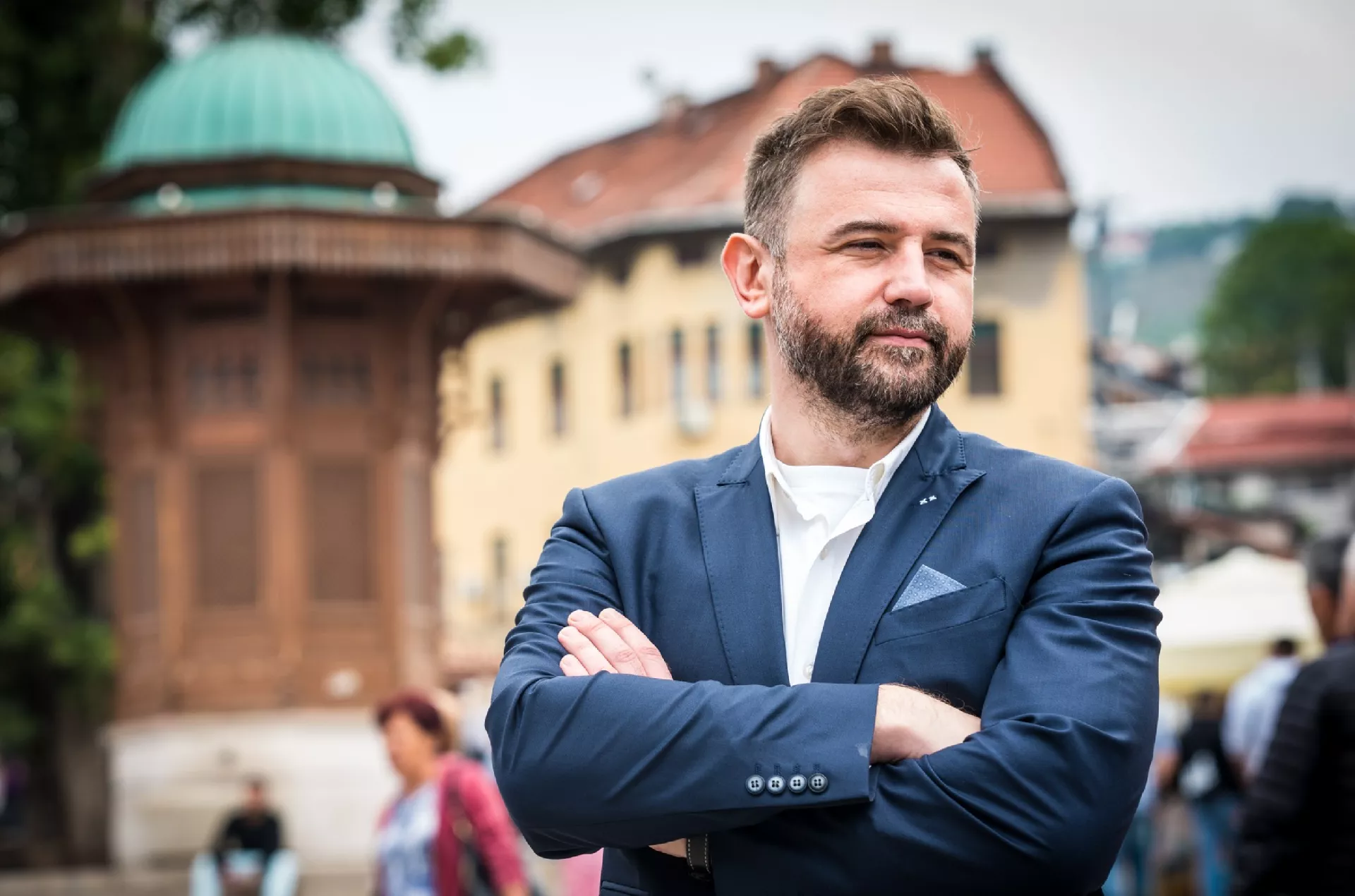
(Patria) - Relations between Belgrade and Sarajevo are not what they should be between two neighbors, says Dennis Gratz, DF MP in the Federal Parliament and candidate for mayor of the Sarajevo municipality of Centar in the local elections in October, in an interview with Danas.rs.
Gratz says that Sarajevans love Belgrade, the singer of EKV Milan Mladenović, and the historian Latinka Perović, not the leader of the radicals Vojislav Šešelj.
Speaking about the potential influence from Serbia on the local elections in October, Gratz pointed to the municipality of Srebrenica, where, according to him, the regime of Serbian President Aleksandar Vučić "considers it strategically important for Dodik's man to be the head of Srebrenica".
Gratz also adds that Vučić tried to be perceived as someone who had good relations with the then mayor of Srebrenica, Ćamil Duraković, while in reality, he secretly did everything to prevent the re-election of a Bosniak as mayor of Srebrenica.
Danas.rs: To start, how would you assess the relations between Sarajevo and Belgrade?
Gratz: Relations between Sarajevo and Belgrade are not what the capitals of two neighboring countries should be. The Belgrade that we in Sarajevo love is the Belgrade of the writer and philosopher Radomir Konstantinović, Milan Mladenović, Latinka Perović, writers Mirko Kovač and Filip David, and others, who in the 80s symbolized the best that Belgrade had, and in the 90s spoke the truth about the crimes against the citizens of Sarajevo.
The problem is that, instead of the aforementioned figures, the word of war criminals, such as Vojislav Šešelj, and their sympathizers has much greater power in today's Serbian public. Many Belgraders, including some of my friends among them, are angry that this is the case, but unfortunately, it has been like this for years.
When the Serbian Progressive Party came to power, Filip David said that Vučić, the current Minister of Internal Affairs Ivica Dačić, and Tomislav Nikolić must apologize to Sarajevo for everything they did in the 90s in order to turn a new page. They did not do that.
The President of Serbia, at times when he wants to build an image of a "regional factor of stability" in the eyes of the West, would prefer that the past is simply not discussed, and when he needs to strengthen his position among nationalists, he does not shy away from revisionism, as we have seen in the case of his engagement on the topic of the Srebrenica Resolution.
If there is no change, it will burden relations for a long time, because the question of the past is also a question about the future. Let's bring it to an individual, purely human level. Almost every family in Sarajevo has someone killed or wounded. How can you build trust with someone like Vučić, who supports the killers of your family members?
With the best will in the world, it is impossible. The only thing saving the relationship between the two cities are the personal relationships of people, cultural and other groups, which are an alternative to what Vučić symbolizes, and that is hope.
Danas.rs: How do you see the visit of CIA Director William Burns to Sarajevo, Belgrade, and Pristina?
Gratz: The US plays a key role in maintaining regional peace. The arrival of the CIA director in the region means that the American authorities want to give the impression that they are present and engaged in the region.
Danas.rs: How realistic is the claim that the President of Republika Srpska, Milorad Dodik, provoked the visit of the head of one of the most powerful intelligence agencies with his secessionist threats?
Gratz: The fact that the head of the American intelligence agency found time to come to BiH means that he had a good reason. The fact that he discussed the secessionist policy of the RS authorities at the meetings is also a clear signal.
Danas.rs: Speaking of Dodik, how do you see his sudden turn after Burns' departure, saying that "secession was never their policy"?
Gratz: This is a tactical statement. Given that American pressure on the RS regime has increased and materialized through financial sanctions, Dodik is trying to present himself in a better light. I think he is hoping for Trump's return to power and his goal is to politically survive until then, and if there is a change in Washington, he will see what the new possibilities are.
Whoever is in power in Washington, the decision on the eventual secession of Republika Srpska will certainly not be made by Dodik, but by the authorities in Belgrade. And it certainly could not be secession - for which Dodik himself lacks the strength - but an attempt at annexation. In other words, what the Russians are doing in Ukraine. The threat to peace in the region is not primarily Dodik, but the general sponsorship provided to him by Vučić.
The Hague Tribunal defined this type of relationship with the term general control, which Milošević had over the war leadership of Republika Srpska. Karadžić and others made moves, but Milošević provided them with an army, logistics, and determined the boundaries within which they could play. The war stopped when Richard Holbrooke realized that he should not negotiate with Pale, but exert pressure on Belgrade. This is the key to maintaining peace today.
Danas.rs: Given Serbia's previous "aspirations" towards BiH, the all-Serbian assembly, are any pressures/influences from Belgrade expected on the local elections in BiH scheduled for October, and how important are they to the authorities in Serbia?
Gratz: In Srebrenica, Serbian authorities regularly interfere in elections by bringing in voters from Serbia to tip the balance in favor of Dodik's candidate. Vučić's regime clearly considers it strategically important for Dodik's man to be the head of Srebrenica.
From 2012 to 2016, he tried to be perceived by the Western public as someone who had good relations with the then mayor of Srebrenica, Ćamil Duraković. In reality, he secretly did everything to prevent the re-election of a Bosniak as mayor of Srebrenica. Unfortunately, the rather negligent attitude of the Sarajevo authorities towards this issue also contributes to this.
Danas.rs: What are your expectations from the Local Elections?
Gratz: The Trojka parties have been in power in Sarajevo for 4-5 years, both at the cantonal and municipal levels, and for two years they have also been in power at higher levels. Thus, they have all the levers, but there is no change. Sarajevo cannot reach the level of development that Ljubljana and Zagreb have, let alone Western cities.
We are proud of the statehood of BiH and the identity of Sarajevo as the capital and a regionally recognized metropolis (due to everything we were in the former Yugoslavia and in independent BiH), and that is why Sarajevans are angry with the current authorities. Sarajevo once had the courage to organize the Olympics, and today the authorities are not capable of, as is popularly said, "painting what was built in Tito's time".
The situation is currently paradoxical, as the city has more money than ever in its history, even much more than during the Olympics, but the authorities are incompetent, even to the extent that we have the worst budget execution rate ever, e.g., in the central Sarajevo municipality. I am a candidate for mayor of the Centar municipality and I still dare not say what I plan to do if I win, but since the campaign starts in a few days, I can only talk about the current situation.
Sarajevo is a vital city, the famous Sarajevo spirit, which existed even in the hardest moments of aggression and siege, is still alive today. We saw this in the previous days, during the Sarajevo Film Festival (SFF), when the city becomes the center of the region. But this is not the result of the authorities.
The relationship of the authorities is best shown by the fact that the Municipality of Centar, although it promised it a year ago, has done nothing to provide premises for the SFF, so the best we have today is like a homeless person in their own city.
Komentari (0)
Prijavite se za komentiranje
PrijavaJos nema komentara. Budite prvi!
Minuta
Sve →Iz drugih kategorija

High Representative Not Elected: Germans, French and British Sabotaged Americans, New Attempt at End of June

ČOVIĆ WITHOUT MERCY: How Those Who Brought Ademović to Office Created a Political Hell for Him



Sunny Saturday, quite warm



Tragedy in Albanian resort: Two minors drown












