
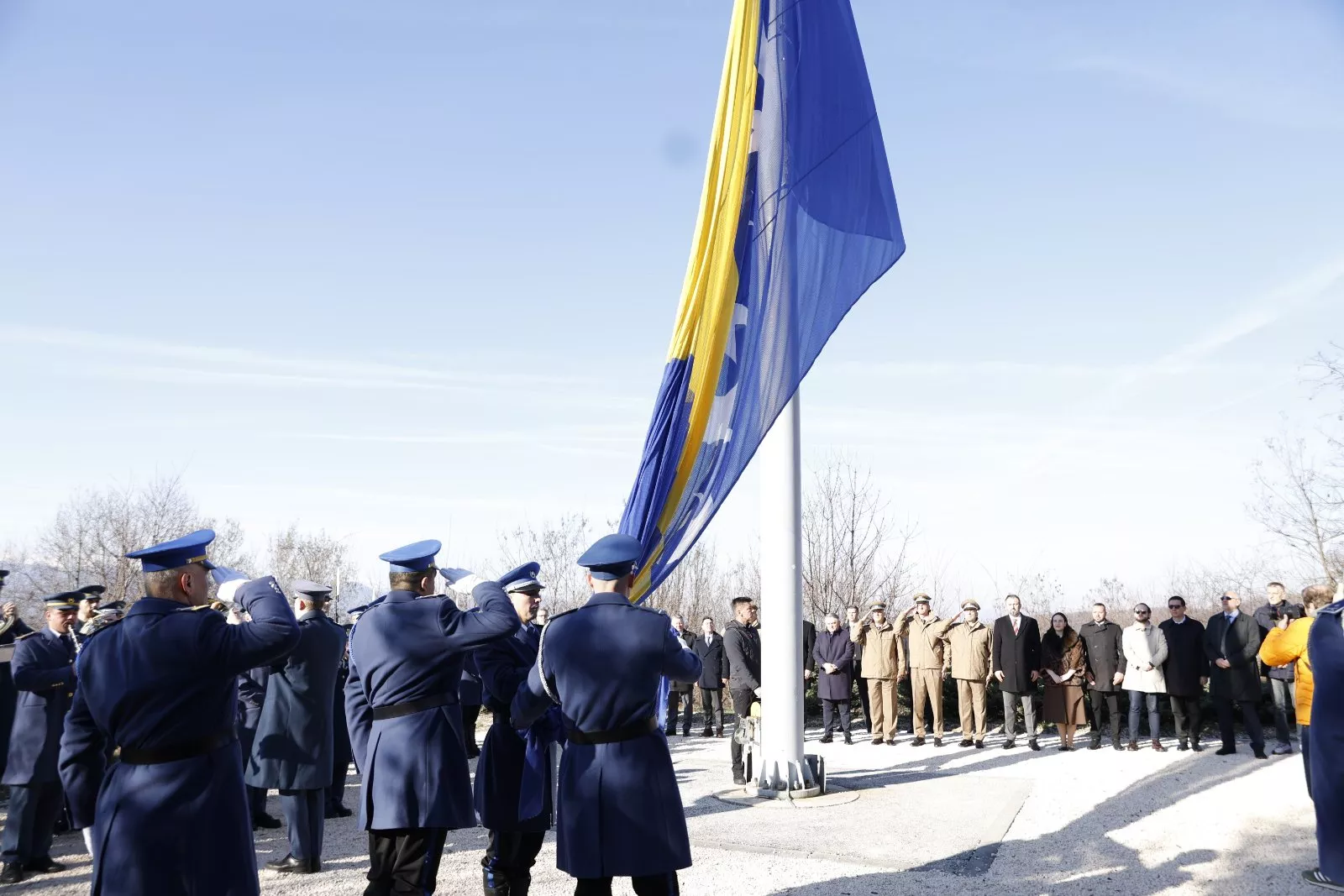
For NAP writes: Prof. Dr. Hazim Bašić, member of the Presidency of Krug 99
Independence Day of Bosnia and Herzegovina is a moment when the citizens of our country, in historically dramatic circumstances of the breakup of Yugoslavia, democratically decided that Bosnia and Herzegovina should be a sovereign and independent state.
The crisis in former Yugoslavia culminated in its dissolution, i.e., the state reached a state of unmanageability, which was also stated by the Arbitration Commission of the Peace Conference on Yugoslavia (Badinter Commission). This commission unequivocally stated that Yugoslavia was in the process of disintegration, which legally opened the way for the international recognition of new states.
Slovenia, Croatia, and Serbia were unprepared for the reform of the Yugoslav federation, after which Croatia and Slovenia, in the final phase of dissolution, embarked on the path to independence. On the other hand, Serbia recognized an opportunity to realize its old hegemonic ideas on the ruins of Yugoslavia.
Independence of Former Republics with Unchanged Borders
In such a situation, BiH did not have many choices, so at the recommendation of the Badinter Commission, a referendum on independence was organized. It is important to note that this commission had previously given Opinion No. 2, which established that '... whatever the circumstances, the right to self-determination cannot lead to changes in borders that exist at the time of dissolution, unless the interested states agree otherwise'.
The referendum on independence was a democratic choice of citizens for the future of the country. At the same time, it was also a cause for aggression against the Republic of Bosnia and Herzegovina. It should be emphasized that in the process of gaining its independence, SR BiH did not secede from former Yugoslavia, because Yugoslavia no longer existed at that time. Slovenia and Croatia were already independent states.
Significance of the Comma in the Referendum Question
Citizens of SR BiH voted on the independence of the Republic in a referendum where the question was: Are you in favor of a sovereign and independent Bosnia and Herzegovina, a state of equal citizens, the peoples of BiH - Muslims, Serbs, Croats, and members of other peoples living in it?
From the very formulation of the question, two important facts can be observed.
First, the referendum question in no way speaks about the ethnic territorialization of the state. It defined Bosnia and Herzegovina as a state of citizens, not as a collection of ethnic territories.
Second, the referendum question primarily speaks about the equality of citizens, not peoples. This is emphasized by the comma that separates that part of the sentence from the rest of the question. That comma is not a grammatical accident. It is a political and constitutional-legal message. After the comma, the most numerous ethnic groups from which these citizens come are briefly listed. Other peoples, whom the Dayton Constitution later classified as 'others', were not forgotten.
Using modern political-legal rhetoric, the essence of the referendum question can be interpreted in a way that 'individual rights are above the rights of any collective'. This formulation of citizen equality is also the basis of the modern European legal order. Nijaz Duraković particularly advocated for such a positioning of the comma in the referendum question, which actually determines the essence of the future organization of the state.
HDZ BiH had objections to the referendum question and demanded so-called 'national cantons'. For this purpose, the so-called Livno question was proposed, which read:
"Are you in favor of a sovereign and independent Bosnia and Herzegovina, a state community of constituent and sovereign peoples, Croatian, Muslim, and Serbian, in their national areas (cantons)?"
This question was not considered in the Assembly of SR BiH.
Continuity with ZAVNOBIH
It is an interesting fact that the essence of the referendum question correlates with one of the points within the Declaration on the Rights of Citizens of Bosnia and Herzegovina, which was adopted at the Second Session of ZAVNOBIH:
'The right to vote in a democratic Bosnia and Herzegovina - voters will exercise secret voting based on universal, equal, and direct suffrage; all citizens, male and female, over 18 years of age have active and passive rights, unless deprived of this right by law.' (Sanski Most, 01.07.1944.)
This shows that the idea of Bosnia and Herzegovina as a political community of equal citizens did not originate in 1992, but was confirmed by referendum as a continuation of ZAVNOBIH statehood. This provision of the Declaration from over 80 years ago is more modern in terms of democracy and human rights than the current Dayton constitutional solutions.
Conducting the Referendum and Attempts to Dispute It
Supporters of the then SDS did everything to prevent Bosnian Serbs from participating in the referendum. They also tried to physically prevent the referendum from being conducted, and many of them were already well-armed. Nevertheless, Serb citizens also participated in the referendum, especially in larger urban areas.
Despite attempts at obstruction, intimidation, and blockades, the referendum was conducted democratically and transparently. All actions related to the referendum were made democratically, from the decision of the Assembly of SR BiH, through the formulation of the question, to the final expression of the citizens' will.
The results of the referendum enabled the international recognition of R BiH as an independent state. European Community member states recognized R BiH on 06.04.1992, and the USA a day later. R BiH was admitted to full membership of the United Nations on 22.05.1992.
Historians agree with the view of Miro Lazović, who believes that 'March 1st will remain one of the brightest points in the history of BiH'. March 1st is proof that Bosnia and Herzegovina was not created by decree, nor by an imposed solution, but by the will of its citizens. That will was stronger than threats, stronger than weapons, and stronger than division projects.
March 1st is a State Holiday
The Law on March 1st was passed by the Assembly of R BiH on 28.02.1995, and the Decree on the promulgation of the law declaring March 1st as Independence Day of R BiH and a state holiday was signed by the President of the Presidency of R BiH, Alija Izetbegović, on 06.03.1995. The European Economic Community recognized this day as BiH Independence Day. Likewise, the continuity of legal regulations incorporated into the Dayton Constitution of BiH unequivocally confirms March 1st as a state holiday.
Followers of policies that opposed the referendum are still not giving up on rhetoric that calls for the division of the state or ethno-territorial restructuring. The path to gaining independence and the survival of the state was difficult, and the challenges that Bosnia and Herzegovina faces today have not disappeared. The independence of Bosnia and Herzegovina is not a finished process. It is a permanent obligation.
Komentari (0)
Prijavite se za komentiranje
PrijavaJos nema komentara. Budite prvi!
Minuta
Sve →Iz drugih kategorija

High Representative Not Elected: Germans, French and British Sabotaged Americans, New Attempt at End of June

ČOVIĆ WITHOUT MERCY: How Those Who Brought Ademović to Office Created a Political Hell for Him



Sunny Saturday, quite warm



Tragedy in Albanian resort: Two minors drown












