
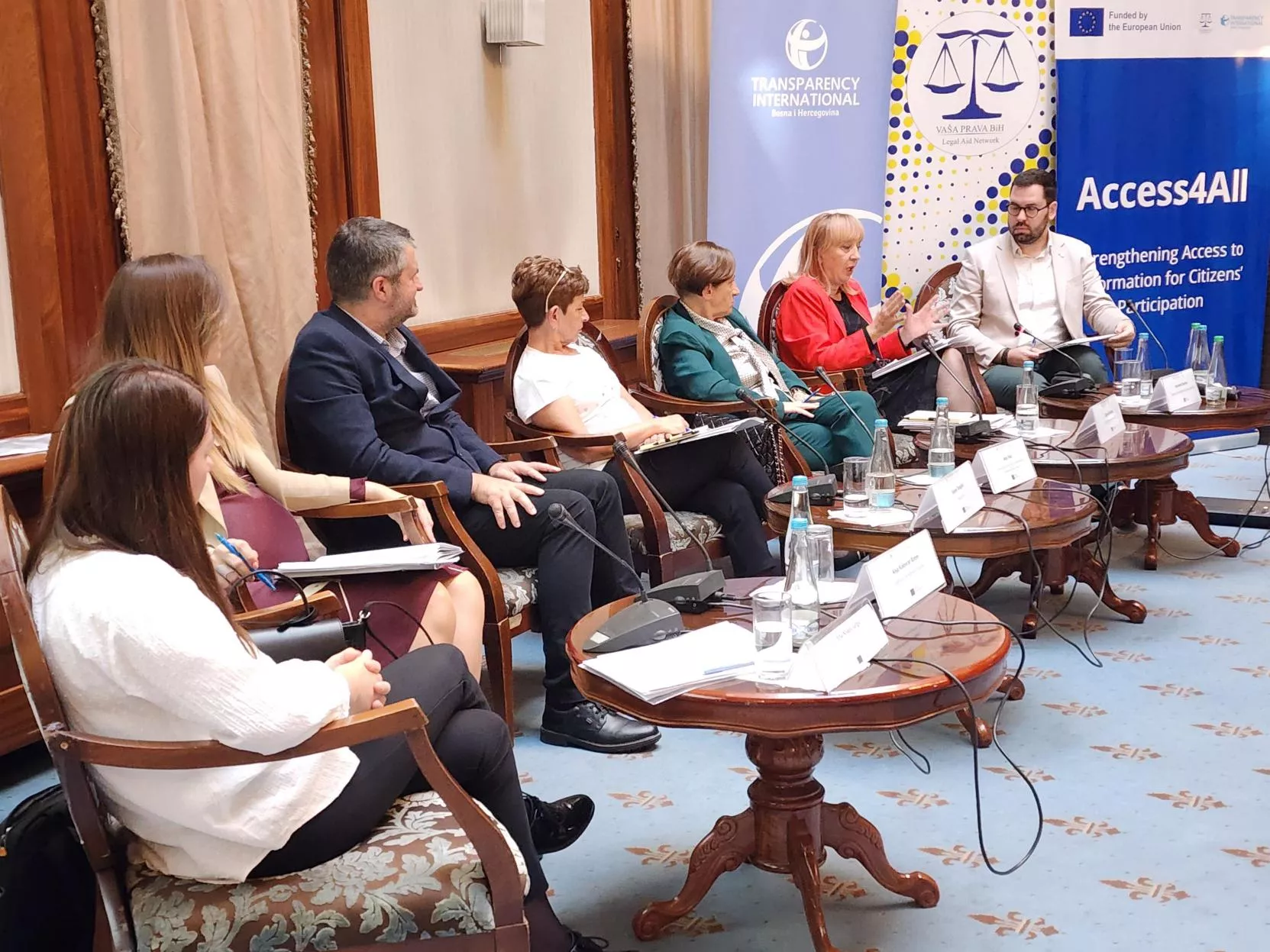
(Patria) - Exceeding deadlines, providing incomplete answers, or sending information in a format not prescribed by law are just some indicators of the unserious and arbitrary application of the Law on Free Access to Information in Bosnia and Herzegovina, making it difficult for citizens to access data that is public in nature, Transparency International announced.
Almost half of public bodies do not respond to requests for free access to information within the legal deadline, and only slightly more than a third of institutions, or 140 out of 394 covered by the research, provided all requested data within the legal deadline, according to research presented today in Sarajevo as part of the International Day of Universal Access to Information.
“Access to information is a key indicator of a state's level of democracy and is a mechanism that gives citizens the opportunity to participate in public processes,” said Aurélie Valtat, Head of the Department for European Integration, Political and Economic Affairs at the Delegation of the European Union to BiH, in her address at the opening of the conference “Challenges of Access to Public Information in BiH: From Law Adoption to Implementation”.
“Freedom of access to information is one of the foundations of a transparent and accountable public administration, as well as a tenet on which the EU idea rests, and progress in this area represents one of the most important aspects for the development of democracy,” Valtat added.
The research, conducted by Transparency International in BiH in cooperation with the organization “Your Rights” Bosnia and Herzegovina within the project “Access for all – Strengthening Access to Information for Citizen Participation” with the support of the Delegation of the European Union to BiH, covered 394 public bodies at all levels of government in Bosnia and Herzegovina, and requested information on expenditures for salaries, employment in 2022 and 2023, and service contracts concluded in the last three years.
The data indicates that public bodies most often justify their refusal to provide data by protecting personal information, as is the case with details of service contracts for which most institutions claimed were not of public interest, despite legal provisions and interpretations by the BiH Personal Data Protection Agency that the income of public body employees does not enjoy the same level of privacy protection.
The research pointed to a visible difference in treatment between levels of government in Bosnia and Herzegovina, with ministries at the BiH level responding within the legal deadline in 88.9% of cases, while only 68% of cantonal ministries responded on time. The data also shows that, although disputes due to violations of the law on free access to information are resolved within one to two years, there are significant deviations, with the Cantonal Court in Novi Travnik making a decision in just one month, while a decision from the Cantonal Court in Sarajevo was awaited since January 2019.
“The goal of the law on free access to information in BiH is to ensure that information under the control of a public body is a public good and to promote greater transparency and accountability of these public bodies, while the analysis of the application of this law shows that this is not the case,” said Marko Vujić, legal aid associate at TI BiH ALAC.
TI BiH has initiated 93 administrative disputes against public bodies for violating the law on free access to information in the past five years, and the fact that 86% of resolved cases were in favor of Transparency International in BiH indicates that public bodies interpret the law insufficiently precisely, diminishing the importance of public interest when deciding not to disclose requested data.
This research confirms earlier findings and analyses by TI BiH that public bodies show an unsatisfactory level of transparency and protection of public interest, creating a kind of legal uncertainty in the process of obtaining public information. TI BiH previously pointed out that after the adoption of four reform laws significant for Bosnia and Herzegovina's European path, including the new Law on Free Access to Information at the BiH level, the publication of data of public interest has not accelerated, nor have positive developments been recorded.
Komentari (0)
Prijavite se za komentiranje
PrijavaJos nema komentara. Budite prvi!
Minuta
Sve →Iz drugih kategorija

High Representative Not Elected: Germans, French and British Sabotaged Americans, New Attempt at End of June

ČOVIĆ WITHOUT MERCY: How Those Who Brought Ademović to Office Created a Political Hell for Him



Sunny Saturday, quite warm



Tragedy in Albanian resort: Two minors drown












