
By: Ernad Metaj
Young people, and increasingly the elderly, the unemployed, and increasingly the employed, are leaving Bosnia and Herzegovina. Let's not fool ourselves, most of them are not afraid of war; serious talk about it only started a month ago, while the exodus began much earlier. People are leaving because they are dissatisfied with life, they see no perspective in the future, and when we sum it all up, we have become hostages of our own decisions. Those we elected in elections have made us sick of the state, and those who do not vote also elected them, so they are not absolved.
These days, psychologist and political analyst Ibrahim Prohić has been writing about civic activism. It is hard to disagree with his observation that the external factor can (and will) preserve the borders of Bosnia and Herzegovina, but it cannot organize the state.
"That is the task of domestic politics and the citizens of Bosnia and Herzegovina," Prohić wrote.
From past practice, it should have been clear to Prohić, and to others, that external factor(s) cannot do this, because they are exclusively driven by their own interests. Time has shown that domestic ruling parties will not (perhaps do not know how), so it is clear that citizens remain.
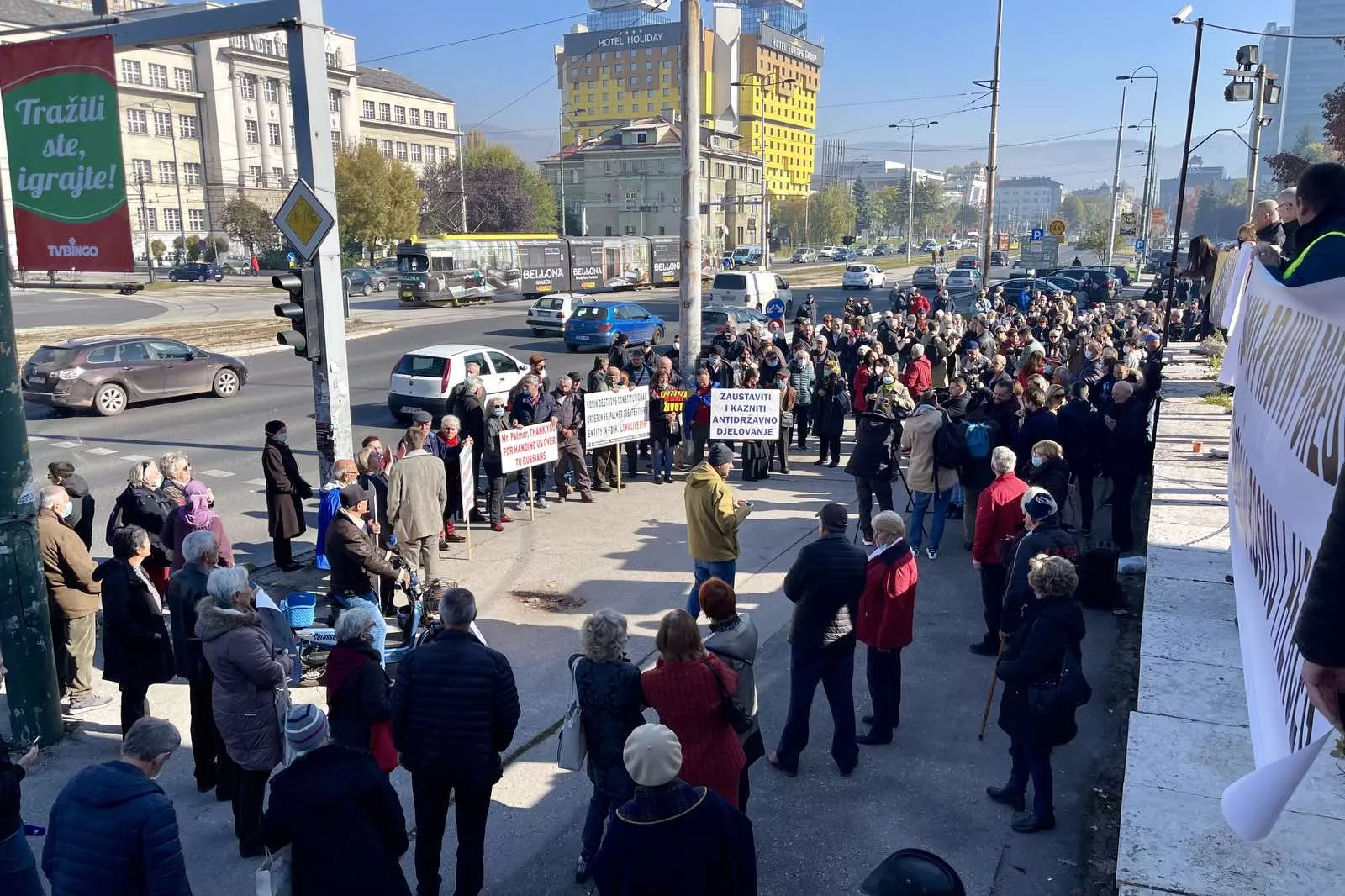
Unfortunately, their awareness and readiness for concrete action were reflected in the recent protests in front of the OHR and the US Embassy, where only a handful of people gathered. Besides being poorly attended, the protests were also misguided in terms of location choice. If we truly want change, now speaking about the Federation of Bosnia and Herzegovina, they should have been organized at Poljine, in front of Čović's estate on Radobolja, in front of the party branches that have a decisive influence on decision-making.
They do not need representatives of the international community to tell them what kind of Bosnia and Herzegovina it will be; that demand should be delivered by the citizens. For this, it is necessary to change the paradigm that stifles civic activism, because its strength is currently hypothetical, which allows the ruling elites to still have effective power.
"First, it is necessary to become aware of this, and then articulate dissatisfaction into a social project in order to stop the retrograde and destructive projects that are already underway," Prohić believes.
In his opinion, the winning combination is "movement plus politics." In other words, led by intellectuals, citizens would form a movement that would choose its political favorite and make a "public contract" with him that would foresee reforms, but also control over their implementation.
Prohić's idea is not to be dismissed, primarily because it engages citizens to finally effectively care about their own destiny, although it may initially face an obstacle in that it seeks to favor exclusively one political option.
In this regard, a discussion about the final implementation could be opened. If citizens showed that they can have effective power, work could also be done to exert pressure on as many political options as possible to understand the necessity of correcting their own policies, while still leaving room for citizens to have a choice.
In that direction, for a start, they could agree with the view of long-time journalist and social worker Konstantin Jovanović that there should be more of us who will send a message to politicians to stop convincing us that we cannot be together, even though that is our only normal state. It is time to first connect the humanity that exists on both sides of the entity border. Jovanović correctly stated that no one except criminals and people in power is "comfortable" in this kind of Bosnia and Herzegovina.
After thirty years, ethnonationalism has brought us nothing good, and again it only offers us conflicts and war as a future. They can be prevented only if it is shown that there is a majority of people who do not want to sacrifice their children again for interests that are not reflected in creating a better social standard through higher wages, protection of domestic production, better healthcare and education. Bosnia and Herzegovina needs a movement in which everyone can be what they want, a Serb, a Croat, a Bosniak, a Roma, an Albanian, an alien, but before that, they will be a person who wants a state in which they can live on their salary or pension. The practice according to which Bosnians and Herzegovinians are well only outside their homeland must stop. In this regard, we have previously written that it is encouraging that the Movement for the State is being formed in the RS, although no idea of this kind should remain limited to only one part of Bosnia and Herzegovina.
State borders are important, but equally important is what kind of state it will be, that is, how much it will pursue the authentic interests and needs of its citizens.
Komentari (0)
Prijavite se za komentiranje
PrijavaJos nema komentara. Budite prvi!
Minuta
Sve →Iz drugih kategorija

High Representative Not Elected: Germans, French and British Sabotaged Americans, New Attempt at End of June

ČOVIĆ WITHOUT MERCY: How Those Who Brought Ademović to Office Created a Political Hell for Him



Sunny Saturday, quite warm



Tragedy in Albanian resort: Two minors drown












