
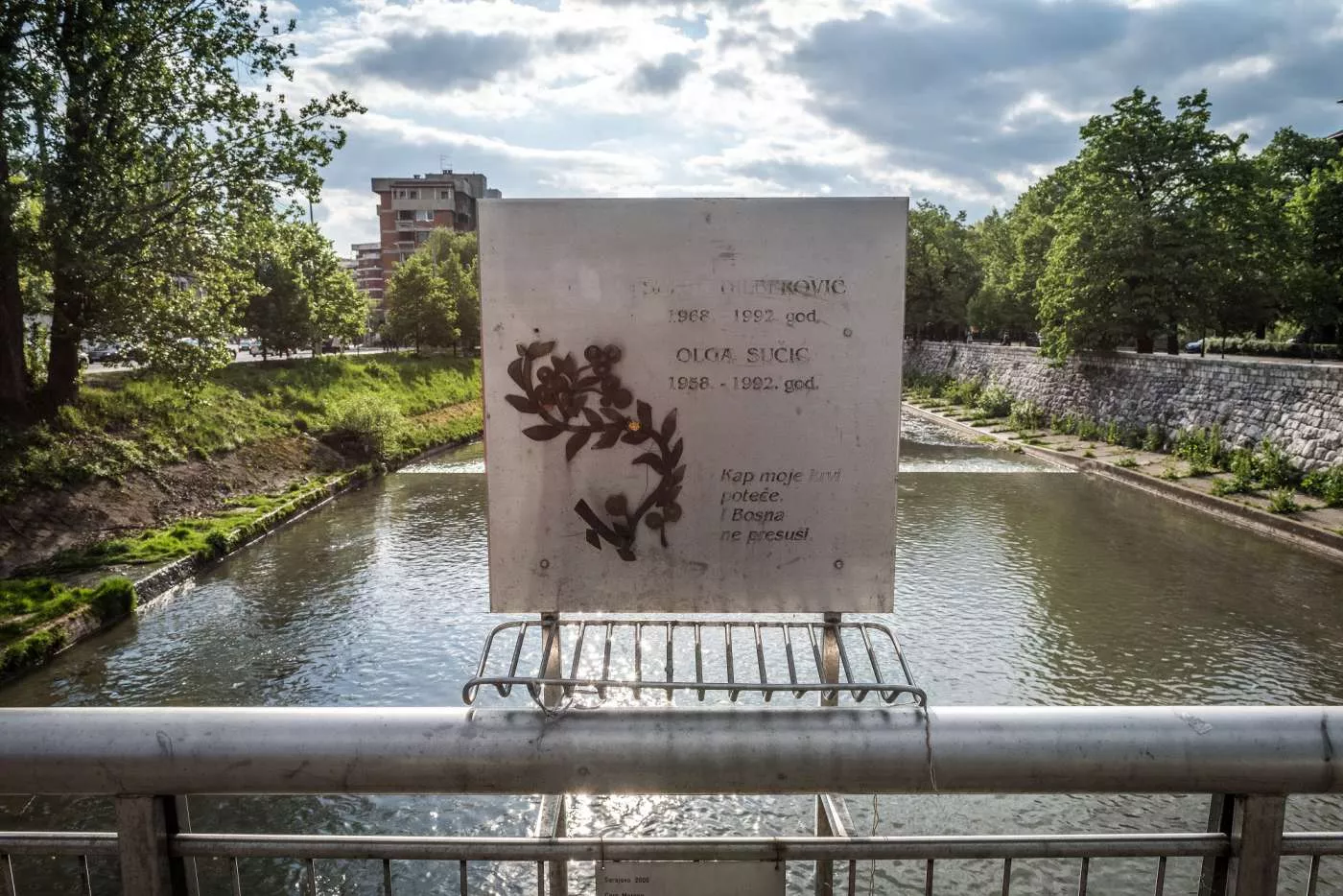
(Patria) - On this day 34 years ago, the siege of Sarajevo began, lasting 1,425 days and becoming one of the longest in the history of modern warfare.
The siege began with the seizure of Sarajevo International Airport by the JNA, on the night of April 4-5, 1992. The four-year blockade of the capital was called the “Siege of Sarajevo.”
On that April 5, 1992, peace demonstrations were held, where citizens of Sarajevo demanded that the aggressor forces remove the barricades and withdraw. Several tens of thousands of people sought to prevent war and opposed the already prepared aggression against independent Bosnia and Herzegovina. The gathered citizens were on the plateau in front of the Assembly of the Republic of Bosnia and Herzegovina, at the Vrbanja Bridge.
On the orders of the SDS, snipers fired from the roof of the Holiday Inn hotel at the demonstrators. After the demonstrations held at Marijin Dvor, the gathered demonstrators headed towards the then Vrbanja Bridge. Snipers positioned in a building opposite the gas station opened fire on the people and killed Suada Dilberović and Olga Sučić on the bridge. Suada and Olga were the first victims of the siege when civilians were fired upon. That day, Muhidin Šabanović was also killed during the demonstrations.
However, that April 5 saw another victim. The aggressor seized the Police Academy of the then MUP of the Republic of Bosnia and Herzegovina for training personnel in Vraca. At the time of the attack, there were about 800 students in the school, nearly 400 of them under 18 years old.
Sixteen-year-old Samir Mišić, a student and member of the 20th class, was killed on April 5, 1992, and was posthumously awarded the “Golden Police Badge.” A memorial was erected in the Police Academy compound in 2016.
According to official records, the attack on the school was ordered by the then Deputy Minister of the MUP of the Republika Srpska, Momčilo Mandić. The Special Unit of the MUP of the Republika Srpska took part in the attack.
The attack on the school began shortly after 3:00 PM.
The school director, Husein Balić, refused to surrender. Armed with school weapons used for training, he confronted the Serbian special forces led by Milenko Karišik. Just a few days earlier, Karišik had been Balić’s colleague and a teacher to the students he then fired upon. Balić stated in an interview that they had traitors within their ranks at the school.
The attack on the students was also supported by Duke Slavko Aleksić with his army, the Serbian population from Vraca, and Serbian police officers to whom Radomir Spaić, commander of the Sarajevo Fire Brigade, distributed firefighter uniforms. School director Husein Balić appealed for someone to help him and the students, but could not get assistance. The unjust battle raged non-stop until the early evening hours.
The commander of the 4th Corps of the Yugoslav People's Army (JNA), General Vojislav Đurđevac, ordered the commander of the 49th JNA Brigade to move with one battalion of troops towards the school in Vraca, ostensibly to prevent the conflict.
However, the opposite happened. Members of the 49th JNA Brigade joined the attacks on the police school. The professors were captured and taken to Pale. Before being exchanged, they were tortured for five days.
The students were held captive in the “Radojka Lakić” elementary school near the Police School. As director Balić recounted, a Serbian fighter was playing with his rifle while guarding the captive students, and the rifle discharged, hitting Mišić in the head.
No one from Samir’s family could attend his funeral at the Bare cemetery in Sarajevo, as they were trapped in blockaded Rogatica. After being released from captivity, Police School director Balić, along with several professors, lowered him into the grave.
From April 5, over the next 1,425 days of the siege, an average of 329 shells fell on Sarajevo daily, and this city holds a specific record. Namely, it is the record of 3,777 shells fired on Sarajevo in a single day. This happened on July 22, 1993.
The shells caused enormous damage, destroying civilian, cultural, and religious buildings. People and children were killed, hospitals were shelled. In the hills around Sarajevo, 120 mortars and 250 JNA tanks were stationed, later falling into the hands of the aggressor. Their goal was to starve and demoralize the population in the cruelest ways. As stated in the verdicts against Radovan Karadžić and Ratko Mladić, Sarajevo and its citizens were terrorized.
During the siege of Sarajevo, more than 11,000 people were killed, including 1,600 children, and 50,000 people were lightly or seriously wounded.
Since 2020, April 5 has been commemorated as the Day of the Beginning of the Siege of Sarajevo.
Komentari (0)
Prijavite se za komentiranje
PrijavaJos nema komentara. Budite prvi!
Minuta
Sve →Iz drugih kategorija

High Representative Not Elected: Germans, French and British Sabotaged Americans, New Attempt at End of June

ČOVIĆ WITHOUT MERCY: How Those Who Brought Ademović to Office Created a Political Hell for Him



Sunny Saturday, quite warm



Tragedy in Albanian resort: Two minors drown












