
By: S. Omeragić
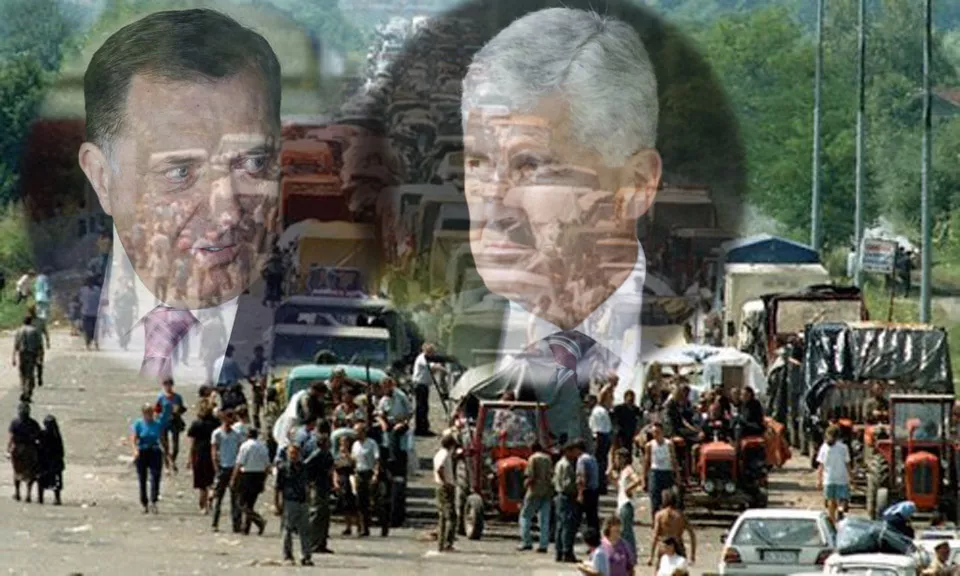
The 22nd anniversary of the Croatian military operation “Storm” is being marked. Many in Bosnia and Herzegovina are wondering if Milorad Dodik will congratulate his partner Dragan Čović?
In RS, Dodik is being blamed for many failures. For the first time, talk began about Dodik’s strange omissions.
Aleksandra Pandurević, a Member of Parliament in Bosnia and Herzegovina, cast doubt on Dodik last week: "When you start from... how the celebrations of 'Storm' are unquestioningly tolerated, how Kolinda is welcomed, who goes to celebrate Operation 'Maestral' in which so many Serbs died, from abandoning the lawsuit for crimes against Serbs in Mrkonjić Grad, and that he handed over the Jasenovac materials to Croatia".... She expresses doubt that the President of RS is a Croatian man.
Therefore, from the Serbian side, a package of long-suppressed crimes is being opened for the first time. Primarily, the one in Mrkonjić Grad. Why should that crime have happened when the town was almost exclusively populated by civilians and very few soldiers. Many believe that the crime against the population of Mrkonjić was intended to destroy coexistence and thus slander the birthplace of modern Bosnia and Herzegovina. Why is the crime against the civilian population of Krajina being silenced? It’s not just about Dodik’s double standards. This is a much deeper problem: the complete betrayal of Krajina in Croatia.
Journalist Dragan Tanasic writes about the last moments of Jovan Rašković, the first political leader of the Serbs of Knin. There was a sincere relationship between them. Rašković told Tanasic that Milošević was “wicked and a sinister paranoiac”!
After his last meeting with Milošević, Rašković told Tanasic everything, saying that the Serbian leader had insane demands: “You, professor, should order the Serbs of Krajina to provoke unrest in Croatia.”
“Jovan Rašković was exhausted to death… And when, with the greatest effort, he got up from his chair, intending to leave the office, Milošević’s most monstrous demand followed: ‘Wait, professor, I haven’t finished yet! You should also organize the murders of uniformed Serbs in Krajina, policemen and soldiers, so that it is blamed on the ZNG, and after that, you should withdraw all your deputies from the Sabor!!!’”
“Dragan, remember and record what I am about to tell you… He is completely insane! You will see, in just one night he will betray us – all Serbs – in Croatia and Bosnia and leave us in the lurch… It will be a ‘crystal night’ for all the unfortunate people there… All of this has long been prepared in Milošević’s and Tuđman’s kitchen.”
Soon, Tuđman came to Milošević’s aid. From a twenty-minute conversation, the Zagreb media published a few sentences by Rašković taken out of context, such as: “Serbs are a crazy people!”. Rašković was attacked by ordinary people on the street and was then definitively crushed. Tanasic concludes: “I am personally convinced that this vile act was carried out in collusion between Milošević and Tuđman, in order to disgrace Professor Rašković among all Serbs. Because, at that very time, they were making their ‘historic’ deals in Karađorđevo.”
Even today, many remember the statement by Borisav Jović from February 1991: “Serbs in Croatia are a Croatian problem, and as far as we are concerned, Croats can do whatever they want with them. They can impale them”. In April 1994, Feral Tribune would record that Jović called the Serbs of Krajina “those damned Serbs”.
David Owen writes in his memoirs that he was shocked when leading Russian diplomats Andrey Kozyrev and Vitaly Churkin told him and Cyrus Vance that they were “too convinced of the possibility that the Serbs would stand up for their ‘sacred cows’ – Kosovo and Krajina”.
The Knin Krajina and the Serbs of Knin had long been sacrificed in the constant and thorough dealings of Milošević and Tuđman. Krajina was superfluous there and hindered the actual divisions. The last, most severe offensive on Bihać was intended to ethnically cleanse the Bihać Krajina area of Bosniaks and settle the Serbs of Knin in their homes. But when the offensive failed, Milošević said: “Franjo, here is Cazinska Krajina for you. It is Turkish Croatia and it doesn’t interest me.”
Therefore, Storm was a long-agreed operation between Tuđman and Milošević to expel Serbs from Croatia. There was practically no defense, and the mass and brutal killing of civilians was aimed at causing fear that would definitively deter Serbs from returning to their homes.
Milan Babić, a official of the Republika Srpska Krajina, knew the most about these facts. He committed suicide after everything, although it was always speculated that it was an assassination. Milan Babić opposed rapprochement with Karadžić because he considered him a liar and a turncoat. However, he had to go to Pale. On one occasion, when he was begging for help from Aleksa Buha, the so-called Minister of Foreign Affairs of Republika Srpska, Buha snapped at him not to ask for the impossible, because Tuđman was offering them six percent more territory of Bosnia if they gave up Krajina. This meant that Bosnia had already been divided between Serbian and Croatian fascism. And so precisely that its territory could be ceded in percentages.
Karadžić, unfortunately, sold Kninska Krajina for ordinary oil tankers and minor food aid from Croatia for the population of RS. During 1995, a few months before the military operation “Storm” began, Tuđman increased oil shipments to Karadžić. Two oil convoys, one from Split, the other from Zadar, set off towards Bosnia and Herzegovina. UN military observers meticulously followed all convoys. According to them, this oil was a gift to the Serbs to help the HVO soldiers and refugees after the defeat by the Army of RBiH.
In September 1994, Hrvoje Šarinić wrote about Karadžić’s proposals to Tuđman: “Bosnian Serbs are ready to give up Knin, although they have threatened to unite with it until now”. Šarinić writes that a Serb, a businessman from Vienna, was a frequent link for his contacts with Karadžić. In September 1994, the “businessman” proposed a “gentlemen’s agreement between Tuđman and Karadžić” to Šarinić. According to the agreement, Karadžić would “prevent the unification of RS and RSK, and in return, Croatia would have to economically help Republika Srpska and politically unblock it.”
Božidar Vučurević, one of the SDS leaders, confirmed: “As far as I know, there is a gentlemen’s agreement between Tuđman, Milošević, and Karadžić to exchange territory”...
While Slavonia and SAO Krajina were falling, Karadžić was shelling Sarajevo, Bihać, and the corridor near Brčko and Odžak. From all of this, it is evident that RS was created not only on the genocide of Bosniaks but also on the sacrifice of the Serbs of Krajina. It was a historical unprecedented mix of crime and trade in human lives and territory. It should be said that the organized emigration of the Serbian population from Kninska Krajina began a few days before “Storm”, which was allegedly a surprise operation.
There are too many secrets that are still carefully guarded by both the Serbian and Croatian sides from their citizens. If only Dodik congratulates Čović on the successful expulsion of the Serbs of Knin, then one of the biggest public lies from this region will finally become acceptable. Many details suggest that the cooperation between the leaders of HDZ and SNSD is definitively based on the old agreements of Milošević and Tuđman, Karadžić and Boban. Cheap laments and even cheaper tears from the Serbian media over the fate of Croatian Serbs are on display.
Komentari (0)
Prijavite se za komentiranje
PrijavaJos nema komentara. Budite prvi!
Minuta
Sve →Iz drugih kategorija

High Representative Not Elected: Germans, French and British Sabotaged Americans, New Attempt at End of June

ČOVIĆ WITHOUT MERCY: How Those Who Brought Ademović to Office Created a Political Hell for Him



Sunny Saturday, quite warm



Tragedy in Albanian resort: Two minors drown












