
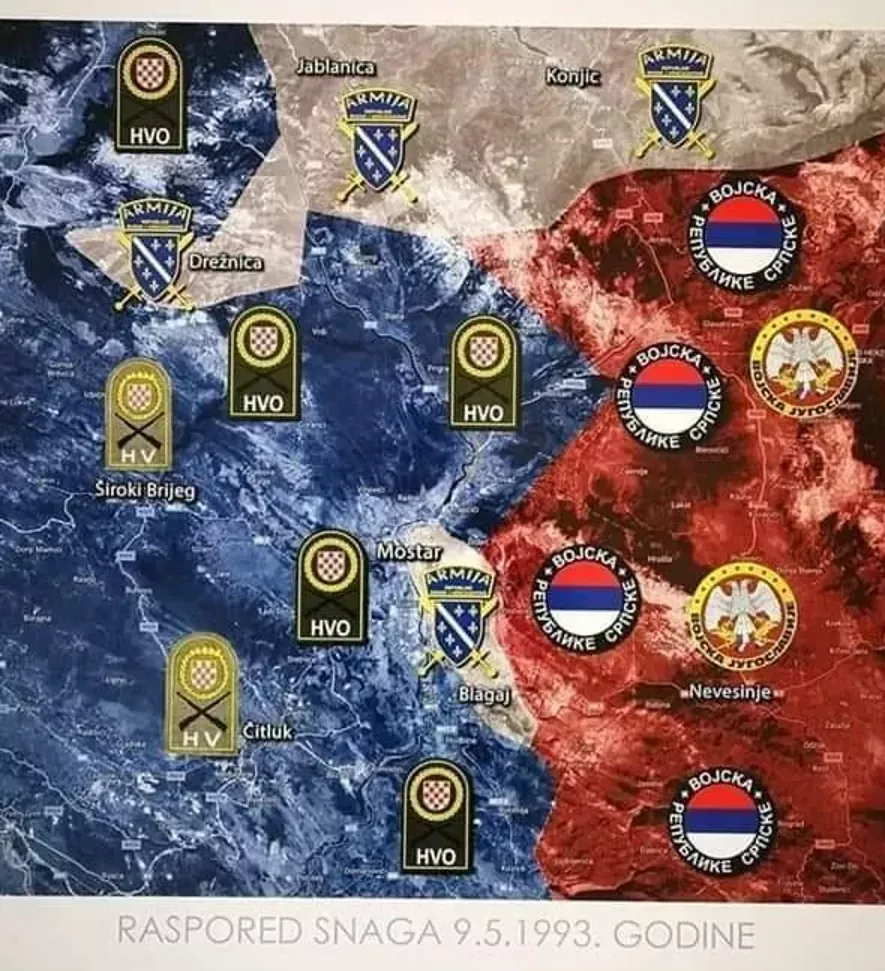
(Patria) - On this day 31 years ago, at dawn on June 30, 1993, the most important battle in the history of Mostar began.
The eastern part of Mostar had already been under siege for 50 days, since May 9, by the HVO and HV on one side and the Greater Serbian aggressor on the other, writes Vijesti.ba
Sons of Herzegovina
The book "Heroes of Mostar" records that "completely unprepared and unready for another war, after the first aggression by the Serb-Montenegrin soldiery had just ended, Mostar residents could only seek salvation from the attacks of the HVO and HV in strengthened unity, solidarity, and mutual sharing of common misfortune under the auspices of their Army, the army of their sons in whom they believed and in whose strength they could only rely."
It was a true superhuman struggle, a firm unity of the people and their army, built on daily desperate resistance and the fight for survival of people who depended on each other and were encouraged by the fact that they were on the side of justice and defending their only homeland.
Mostar anxiously listened to all the news from besieged Sarajevo, firmly determined to defend itself from the Croatian criminals who tried so "bravely" to wipe this people, already exhausted and tormented for months by the first aggression, and the almost completely destroyed and burned eastern part of the city, off the face of the earth.
Deblockade of Mostar
In such a horrific atmosphere of complete occupation and general scarcity and hopelessness among the people, exposed to daily shelling, the citizens of Mostar, seeking salvation, turned to themselves and the self-organization of their survival. It was clear that they were abandoned both by the world and by the possibility of help from the central government in Sarajevo, which was completely blocked by Serbian occupation, and units outside Sarajevo were not receiving orders for military assistance to Mostar, which caused particular frustration and anger among the city's citizens, it is recorded in the first edition of the book "Heroes of Mostar".
There was no help from anywhere except the realization that the deblockade of the city had to be carried out by their own forces. Anything else meant collapse and definitive disappearance.
Preparation of the Plan and Terrain
In complete secrecy and at enormous risk, a group of leading figures from the military and political leadership patiently and day and night prepared the ground and prerequisites for the deblockade of the city at the end of May. The decision to initiate the deblockade of the city was agreed upon in the house of Derviš Travnjak, in Krpin sokak near Razvitak, after the well-known gamekeeper Jusuf Jusa Pajić came on foot through the war lines with the HVO to the Army lines from Bijelo Polje with a letter from patriots calling on the Army to break through and liberate the Bjelopolje valley. Pajić also provided all information about the deployment of HVO forces. The soldiers who organized the deblockade still had many doubts, caution, and fear of the operation's failure. Amer Bilalović, a member of the 4th Corps Command, also played a key role with his information in assisting the deblockade of the city.
Any offensive action at that time seemed impossible, as the Army of BiH soldiers in Mostar had no ammunition, and it was a matter of days before the first defense lines would fall. At the beginning of June 1993, the decision was made for a group of Nevesinje fighters to try to break through the enemy's territory to Bjelimići and Konjic to bring much-needed ammunition.
The choice fell on experienced fighters who knew the territory deep within the lines of the Serb-Montenegrin aggressor: Huso Lerić, Ibrahim Demirović Hećim, Ramo Džiho, Nedžad Čamo, and Mirsad Pajević Garo. Their task was to bring ammunition for the deblockade of Mostar through Bjelimići, upper Nevesinje field, Velež mountain, and Podveležje.
Silent Convoy
With the great and selfless help of the management of the "Igman" company, the Konjic and Bjelimići brigades, 16 horses were purchased, equipped, and loaded in Odžaci. A group of brave individuals set off on a long and uncertain journey on the night of June 4/5, 1993, and the ammunition arrived in Mostar three to four days later. All of them joined the Mostar group on their return, risking their lives: Mahinić Sudo, Doctor Mahinić Alija, Čopelj Osman, Čopelj Mirsad Malecki, Šipković Ibrahim Đido, Golić Ismet, Pajević Esad, Zolj Senad, Jugo Midhat, Imamović Emin, and Čehić Mirsad. The silent convoy of horses and people moved stealthily at night between the aggressor's positions, resting during the day, hiding from the enemy.
The main toponyms on the path of salvation and victory were: Odžaci - Živanjski do - Crvanj - Gornja Bijenja - Karče, Sopilja - Ravna Velež - Mala Velež - Kokorina - Kružanj - Dračevice.
This heroic task was also successfully completed.
A group of commanders, led by Midhad Hujdur Hujka, and the city leadership began all detailed preparations for the deblockade in a private house. Huso Lerić proposed that Šerif Špago and Miralem Jugo work on the deblockade plan, which was accepted. This plan was later realized with the involvement of the Corps, with the assistance of Budaković, Jugo, Špago, and Malkoč. The 4th Corps Command, led by Commander Arif Pašalić and his associates, carried out all preparatory actions for the operation, and the direct command of the action was led by the First Mostar Brigade, headed by Midhad Hujdur Hujka.
Execution of the Operation
The operation of a well-organized, brave, and sudden breakthrough from complete encirclement by the HVO and the deblockade of Mostar at the northern gate of the city was carried out at dawn on June 30, 1993. It was a surprisingly successful military operation that resulted in the unexpectedly rapid capture of the entire Northern Camp barracks that same morning, the former "Mostarski bataljon" barracks, formerly of the JNA, which the HVO had temporarily named after its fallen member Tihomir Mišić. The attack was a surprise to the HVO military forces present in the Northern Camp barracks, so some surrendered, while others escaped by fleeing across the Neretva River.
The military operation of the Army of RBiH units to deblock occupied Mostar was carried out exclusively with their own forces, organized from within, without any military assistance from outside, and was undoubtedly of crucial importance for the final outcome of the war and the collapse of the occupation in the center of Herzegovina. The units of the Mostar Brigade broke the Mostar encirclement, took control of the Northern Camp, and in an unstoppable advance liberated the entire territory of the Bjelopolje valley, all the way to connecting with the army forces of Drežnica, Jablanica, and Konjic, after which new supply corridors were opened and connections were made with Sarajevo, Zenica, and beyond. The eastern part of the city was saved by this action.
Death of Hujka and Comrades
In the operation to liberate the Northern Camp on June 30, 1993, a large number of fighters died, including the legendary commander of the First Mostar Brigade of the Army of the Republic of Bosnia and Herzegovina, national hero Midhad Hujdur Hujka. As always before, Hujka was on the front line with his fighters in this battle as well. His deputy, Esad Humo, was wounded by the same grenade during the breakthrough with him.
In the battles for the deblockade of Mostar that day, in addition to the legendary commander Midhad Hujdur Hujka, his comrades also lost their lives: Sabahudin Balavac, Zoran - Popaj Imamović, Jusuf - Jaba Jelovac, Faris Kalaba, Ifet Logo, and Miralem Šaldo.
According to a written statement sent to the editorial office of the book "Heroes of Mostar" by the Organization of Families of Martyrs and Fallen Fighters of the City of Mostar, signed by Azra Mahinić, president of the Management Board, during the three days of combat operations for the deblockade of the city, 42 members of the Army of RBiH lost their lives. On the same day, during the liberation battles in the wider area of Bijelo Polje, the following fighters of the Army of RBiH were killed: Hivzo Abaza, Senad Ajanić, Ramiz Ćorić, Smail Ćupina, Zekerijah-Bosanac Ćosić, Ćamil Đubur, Armin Gačić, Enver Hajdarović, Amer Kotlo, Sanjin Mekić, Mustafa Merdan, Saudin Mustafić, Senad Omerika, Meho Šendro, Nazif Šito, Šaćir Tojaga, Hakija Čolić, Sead Gološ, while Esad Šehović was killed in the fighting in Opine. Thus, on that decisive day alone, when the breakthrough from the encirclement of Mostar was carried out, 26 fighters were killed.
The combat operations to liberate the Bjelopolje valley lasted for the next two days.
In the battles for deblockade during July 1, 1993, the following members of the 4th Corps of the Army of the Republic of Bosnia and Herzegovina were killed: Alija Agić, Jusuf Zvizdić, Ramiz Dedić, Ramiz Husnić, Mujo Jelovac, Semir Studenović, Mirsad Sulejmanagić, Edin Tiro, Admir Žujo, Senad Zlomušica, Nermin Barina, and Sead Omanović.
The next day, July 2, 1993, the following were killed in battles: Džemil Dedić, Osman Marić, Galib Pervan, and Smajo Marić.
While the battle for the liberation of the northern valley of Mostar was still in full swing, Semir Drljević Lovac was appointed commander of the First Mostar Brigade, and Esad Humo became his deputy.
Collapse of the Croatian Occupation
The joining of numerous forces, consisting of armed Bosniaks who, without much thought, voluntarily and without delay responded to the call of the 4th Corps Command of the Army of the Republic of Bosnia and Herzegovina and Commander Arif Pašalić, and began to massively leave the ranks of the HVO, realizing the deception and betrayal in the military and political goals of the Croatian side, was also of great importance in the deblockade of the city and the collapse of the Croatian occupation of Mostar.
Mostar began to breathe again, and a new strength and strengthened self-confidence were felt among the fighters and citizens. The city that summer of '93 continued to live under the terror of shelling and sniping from HVO and HV positions, in an environment of all sorts of scarcity and poverty, but also with the ever-present conviction that the final defense of Mostar and Bosnia and Herzegovina was no longer in doubt, and that even the much-needed peace was no longer far away.
Strategically of decisive importance, the military victory at the northern gate of Mostar, organized from within and relying exclusively on its own forces and capabilities, further encouraged the fighters of the Army of RBiH to persevere in the defense of Mostar until the end. Especially after its ranks became increasingly numerous, more connected, and motivated, when the majority of armed Bosniaks, leaving the HVO units and ranks, joined the army of their country, which – from the beginning of the aggression, clearly and to the end – had sworn to defend a unified and independent state of BiH, which would be a common state for all its citizens.
After Mostar was connected by a corridor to the free territory, it was possible to reach Jablanica in about ten hours of walking over the Glogovo mountain massif, on top of which a tent logistical base was established for resting people and horses, storing food and ammunition.
Soon, a detachment of horse handlers was formed, who took care of the horses daily, accompanied people, carried equipment for the army and hospital, and supplied the army with food collected from the territory of Drežnica, Jablanica, and Konjic.
Komentari (0)
Prijavite se za komentiranje
PrijavaJos nema komentara. Budite prvi!
Minuta
Sve →Iz drugih kategorija

High Representative Not Elected: Germans, French and British Sabotaged Americans, New Attempt at End of June

ČOVIĆ WITHOUT MERCY: How Those Who Brought Ademović to Office Created a Political Hell for Him



Sunny Saturday, quite warm



Tragedy in Albanian resort: Two minors drown












