
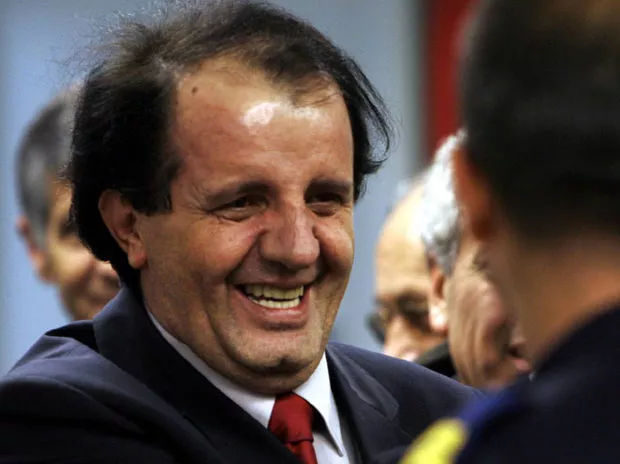
Of all the former Yugoslav states, only in Bosnia and Herzegovina can former secret police members and intelligence officers of the JNA's KOS be legally at the head of political parties. This situation still represents a serious security deficiency for Bosnia and Herzegovina, more precisely for Bosniaks, who are the only nation in the Balkans without their own intelligence service.
Only such a service could control the chaotic situation in public, which has been equally intensely fostered in this country from the first day after the war until today. Modernization of security systems would permanently remove many actors from the scene. At least we wouldn't have to listen to the political speeches of some generals. One of them is Sefer Halilović.
It is illogical that the state has not yet systematically "dealt" with KOS members, about which books have been written, transcripts of intercepted conversations of commanders have been published, and finally, statements from witnesses who are still alive. Sefer Halilović, a former JNA intelligence officer, codenamed "Boris," pushed units of the Army of the Republic of Bosnia and Herzegovina into mutual conflicts and prepared a coup. These are facts in the statements of numerous witnesses, as well as in intercepted conversations after the rebellion of some brigades in Sarajevo on July 2 and 3, 1993, and the October cleansing of these units of criminals.
Retired general of the Army of the Republic of Bosnia and Herzegovina, Sefer Halilović, has apparently continued his activities even after the war, as evidenced by the public statement of the Association of Bosnae-Green Berets, which sharply criticized his statements this year, when he said on TV1, unprovoked, that in the event of war, Republika Srpska would not last even 15 days. This was evident undermining of the Dayton Peace Agreement and a call for new conflict. Therefore, Halilović threatened a new war!
The Association of Bosnae-Green Berets, which brings together organizers of resistance during the war in Bosnia and Herzegovina in the early 1990s, war veterans, volunteers, and combatants, stated that Halilović's statements reflect his private views, and that Bosniaks do not desire conflict even in their deepest thoughts.
They posed a logical question: For whom does Sefer Halilović work and in whose name does he speak, if everything he says exclusively serves Greater Serbian goals?!
The wartime facts about his obvious undermining of this country are still alive. There are statements from witnesses who are still alive, which deeply compromise Halilović. Books with authentic documents and stenograms have also been written about his wartime activities, which support almost identical witness statements.
Before the Green Berets, the Association of Generals of BiH also told Halilović: "Enough." The Association of Generals expelled Halilović from its ranks as a reaction, response, and a kind of denial to the film 'How Bosnia and Herzegovina Was Betrayed,' by Semir Halilović, son of Army General Sefer Halilović. The film was financed by the Ministry for Veterans' Affairs of Sarajevo Canton, headed by a minister from Halilović's party.
Three associations, the Association for the Protection of the Achievements of the Struggle for BiH, the Association of Generals of the Army of BiH, and the Association for the Protection of the Name and Work of 'TO' BiH, responded with the documentary 'Sefer Halilović - Villain,' due to, as they stated, the defamation of the Army of BiH.
That Halilović also sought to influence others in a very crude and criminal manner during the war is evidenced by the statement of Ahmed Tabak, who was arrested on October 3, 1993, in Parsovići, by order of the commander of the 45th Brigade, Hasan Hakalović (who remained close to Halilović after the war and was on the BPS list). Tabak was brutally tortured and beaten for several days to extract statements against key figures of the then military, political, and police leadership of the Republic of Bosnia and Herzegovina.
Tabak testified that in the house where he was detained were Haso Hakalović, the security officer of his brigade Jusuf Hadžajlija alias Homeini, and young men whose names or nicknames he later learned: Adis Pirija (Hadžajlija's son-in-law), Alija Demirović, and a certain Mesar, whose origin was from Sandžak.
"There was another soldier there, I assume from security, who treated me very politely, and who quickly left my 'interrogation.' Homeini started questioning me about how I was, what I was, where I was from, looking at the documents I had with me, and then he exclaimed: 'I know who you are, you are a spy planted by the MUP into the ranks of the Army!'" while I had a military ID and MUP accreditation, for easier performance of my assigned tasks.”
In his testimony, Tabak also states that they tried to plant white powder on him (alluding to drugs), which belonged to his travel companion Jasminka, but it was just ordinary aspirin.
"After Jasminka left, Mesar lunged at me and started beating me with his hands and feet. Homeini, Alija, and Adis joined him, beating me on the floor with their fists, feet, and a police baton, all four of them hitting me at the same time. Then, with constant threats and occasional blows, they asked me (especially Mesar) about things that made my brain stop: 'How much money did you take to Switzerland for Alija Izetbegović, how much did you pay for his house in Switzerland, how much money did you take for Delić and Bakir Alispahić, and how much for Hadži Čengić, how much did you pay for their houses, etc.?'
The more I tried to explain that I had no idea about that, the more their attacks and blows intensified," Tabak's statement reads.
In the afternoon of October 3, 1993, they gave him a statement to write, but apparently unsatisfied with what he wrote, they beat him again, demanding he write another one.
"That night they took me to the house across the street, where I slept in a room with military police. The next day (Tuesday) they came for me around 10 AM and took me back to the same room. There, in addition to the four regulars (Homeini, Mesar, Alija, and Adis), I found new individuals: Ramiz Delalić-Ćelo and Semir (son of Sefer Halilović), a boy of 11-12 years old. Delalić asked me if I knew 'Ayat al-Kursi' and, with Semir, Sefer Halilović's son, he attended my further 'interrogation' - being kicked, punched, beaten with a baton, cursed at, yelled at, etc.”
"Together with him, all the time, was Sefer's young son, Semir. I want to note that Ramiz Delalić-Ćelo was only an observer of the physical abuse inflicted on me," testifies Tabak.
Therefore, it is terrible that Sefer was willing to expose his minor son to such trauma.
"After they left, they gave me another statement to write, and when Homeini read it, they continued to beat me, referring to certain parts of the statement they were dissatisfied with. At one point, when it became absolutely clear to me that after all this, and with the visit of new people that day, they would not let me leave alive, all bloody, swollen, and disfigured, I ironically asked: 'Mr. Homeini, please don't beat me anymore, tell me what to write, and I will write it and sign it, or you write what you deem appropriate, and I will sign it!'
Then all four of them lunged at me and literally beat me, the hardest so far. "Mesar" hit me with a baton on my mouth and face, and chipped my tooth on my upper right jaw with a police baton. That night they put me in the attic of a house located about twenty meters from the room where they were 'interrogating' me. My armed guards were housed on the first floor. At an hour unknown to me, I woke up, went downstairs to the toilet, and managed to escape through the toilet window.
For three days I hid in the forests of that area, and for three nights I walked to Fojnica. I knew these areas extremely well because I had passed through them countless times. On the night of Friday to Saturday, October 8/9, 1993, I managed to sneak into Fojnica and reach my sincere friend Pašalić Mensur, efendija. He was horrified when he saw me in what condition I was and when he heard my story.
On Saturday evening, I was taken home, and when I put all the pieces together and obtained certain information, it became definitively clear to me: On the day of my arrest, the entire state, military, and police apparatus was absent: President Izetbegović was in Brussels, Ganić and Silajdžić in Vienna, Army Commander Delić and Minister of Internal Affairs Alispahić were "detained" with UNPROFOR in Bosnia Krajina, where conflicts with Fikret Abdić broke out," testifies Tabak and adds: "On the other hand, someone consciously identified me as a person 'close to all these people, Izetbegović, Delić, Alispahić, Hasan and Halid Čengić'...
"It was necessary to extract 'evidence,' written statements, from such a person, by hook or by crook, to 'implicate' those who were absent at that moment for malversation, and to greet their return with a new order, dismissals, etc. And after those signed statements, I would probably have ended up with a bullet in my head, with the explanation that a few kilograms of drugs were found on me, that I killed the guards while trying to escape, and so on, which fits such a narrative," are the words from Tabak's testimony.
This testimony given by Tabak was later accidentally confirmed by a transcript of a conversation between Ismet Delalić Ćelo, deputy commander of the Ninth Mountain Brigade, and the Army of BiH security officer Jusuf Jašarević. Namely, Delalić, through a conversation with Jašarević, not knowing that everything was being recorded, said that he was present at Ahmed Tabak's torture: "At Zuka's headquarters, they met with Sefer, and he says they arrested some efendija (Tabak) who knows a lot about Delić, about this and that, and he says, he sent me to Mesar, Sefer's son was also there, to see who this is and what it is." "Who sent you?" Jašarević asked. "Sefer, or rather, he sent Mesar to go and interrogate him, to beat him, and I said I'd go too to see who it is and what it is. When I got there, I saw this man, they were beating him, they were harassing him," Delalić said.
Jašarević asked him what Sefer's goal was in torturing a man to find out something about commander Rasim Delić? What information about Delić did he want to obtain?
"I don't know," said Delalić, "but ever since he was removed from that position, he has always been looking for things against Delić, against this one, against that one.”
This stenogram of the conversation between Delalić and Jašarević was published in its entirety in Fikret Muslimović's book "Liars and Murderers."
Izet Jurkić, commander of the Ninth Mountain Brigade in the Sarajevo Corps, was a witness when his deputy Delalić confirmed that a hodja from Visoko (Tabak) was arrested, interrogated, and beaten in Herzegovina.
Therefore, Sefer Halilović's insatiable ambition is evident, the only question is with what background all this was done. He became suspicious when badges, keychains, and posters with his image began to be printed in the spring of 1993. In the midst of hunger in Sarajevo, hundreds of thousands of marks were spent on promoting the image of Army Commander Sefer Halilović.
Many officers were confused by these facts. When a rebellion of some units broke out in Sarajevo on July 2 and 3, it became known that Sefer Halilović was behind these events. A massacre and a real intra-Bosniak war, like the one with Fikret Abdić, were avoided at the last moment. At that time, Rasim Delić was appointed commander of the General Staff of the Army of the Republic of Bosnia and Herzegovina instead of Sefer Halilović. Halilović was given the position of Chief of Staff of the ARBiH. But, after a short stay in Herzegovina, three months after his transfer to the position of Chief of Staff of the ARBiH, he was removed from all functions.
The order for his dismissal was unanimously adopted by the Presidency of the Republic of Bosnia and Herzegovina.
"There were reasons for Halilović's dismissal, and they were consciously not disclosed, for the protection of the country's interests and security, and the unity of the Armed Forces of BiH," states the document 'Conclusion of the Collegium of Commanders,' from April 1994, which implements the order of its supreme commander, the Presidency of the Republic of Bosnia and Herzegovina.
Komentari (0)
Prijavite se za komentiranje
PrijavaJos nema komentara. Budite prvi!
Minuta
Sve →Iz drugih kategorija

High Representative Not Elected: Germans, French and British Sabotaged Americans, New Attempt at End of June

ČOVIĆ WITHOUT MERCY: How Those Who Brought Ademović to Office Created a Political Hell for Him



Sunny Saturday, quite warm



Tragedy in Albanian resort: Two minors drown












