
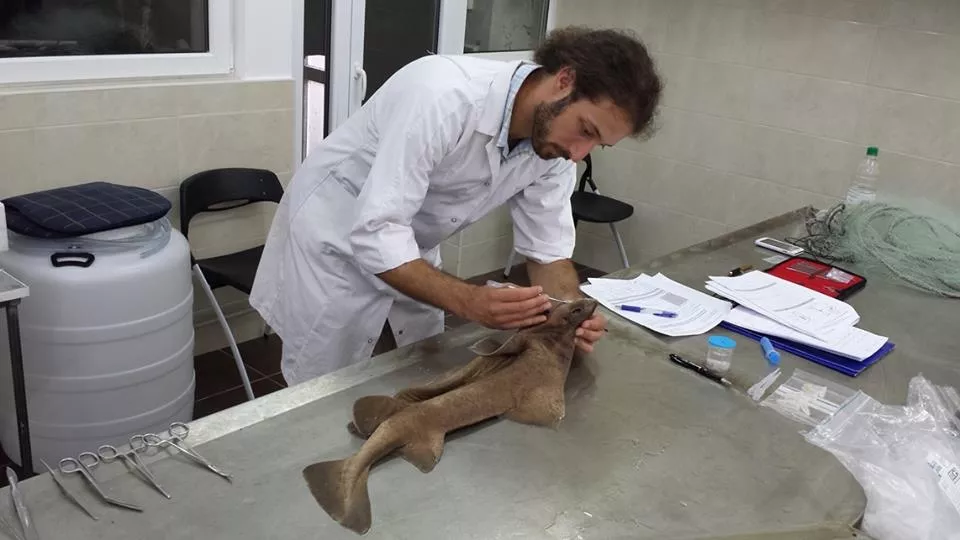
The angular rough shark, Oxynotus centrina (L.), is one of the rarest deep-sea sharks in the Mediterranean Sea - with only a few documented encounters in the past 100 years. Experts from the Institute of Marine Biology in Kotor, Montenegro, recently caught one such angular rough shark. The research was assisted by BH expert Andrej Gajić, a research associate and head of Sharklab ADRIA. Gajić tells Patria that the latest case of the angular rough shark perhaps best confirms the richness of the Mediterranean Sea.
- The angular rough shark is a very rare species that usually inhabits depths of 100 to 750 meters, and rarely shallower than 100 meters – explains Gajić for the Patria news agency.
- It is a very specific and completely harmless species. It usually inhabits muddy types of bottom or smaller reefs. The MEDITS surveys conducted between 1994 and 1999 at depths of 10 to 800 meters showed that the species was caught in only 0.6 percent of nets, while the largest number of individuals were caught on the continental shelf (between 100 and 200 meters depth). Adult specimens grow to 73-75 cm, with a maximum total body length of 150 cm.
Anterior to (in front of) both dorsal fins, there is one spine each. It consumes a wide range of prey, primarily worm-like invertebrates (polychaetes and sipunculids), and sporadically bony fish, crustaceans, and echinoderms. They spawn once a year, or less frequently, usually producing 10 to 12 offspring (maximum 23). According to the IUCN, within the entire Mediterranean Sea, it is designated as critically endangered, while at the international level it is designated as vulnerable – says Gajić.
.jpg)
Angular rough shark Photo: Andrej Gajić
Although, he says, reports from local fishermen indicate constant catches of this species, in science, experts consider only those data that have been published as such in relevant scientific journals as valid – in which there are only a few written records of encounters with this species, not only in the Adriatic but also in the entire Mediterranean Sea.
There were even foreign claims, which can also be read on English Wikipedia, indicating that this species is regionally extinct within the Adriatic Sea – which, says Gajić, is, of course, incorrect.
- Given that these are still unpublished studies, at this moment I cannot reveal details about the find itself or the insights we have gained during the studies. However, what is important to emphasize is that these studies involved the Institute of Marine Biology (Kotor) and employees of the Institute of Oceanography and Fisheries in Split, who invited us to provide a kind of expert contribution to this work and entrusted us with the entire study. It is very important that local/regional institutions on the eastern coast of the Adriatic Sea join forces and work together more often on joint projects, activities, and other research, which will bring comprehensive benefits leading to a much better knowledge of the species that inhabit our sea but will also enable adequate resource management – says Gajić.
In addition to this significant find, Sharklab ADRIA conducted numerous field surveys of rays within the Bay of Neum during the year, which contributed to a much better understanding of the population ecology of the studied species, their distribution, and frequency within the bay.

Ray Photo: Andrej Gajić
At this moment, Sharklab ADRIA is actively working on mechanisms for educating local fishermen, primarily to recognize the importance of conserving certain species and establishing sustainable management of the resources at our disposal.
- Field surveys have indicated the presence of numerous species that had not been described within the surveyed area until now, which represents a significant contribution to the fauna of our country, but also to the entire Adriatic Sea – says Gajić, writes Patria.
Komentari (0)
Prijavite se za komentiranje
PrijavaJos nema komentara. Budite prvi!
Minuta
Sve →Iz drugih kategorija

High Representative Not Elected: Germans, French and British Sabotaged Americans, New Attempt at End of June

ČOVIĆ WITHOUT MERCY: How Those Who Brought Ademović to Office Created a Political Hell for Him



Sunny Saturday, quite warm



Tragedy in Albanian resort: Two minors drown












