
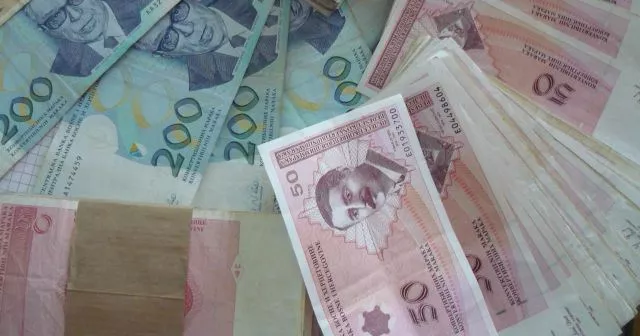
There are 28 banks participating in payment transactions in BiH, and the modernization of payment transactions has led to significant improvements: transaction transfer speed has increased, costs have been reduced, and European standards have been adopted, reports the BiH news agency Patria.
Basically, there are two types of transactions in domestic payment transactions: interbank and intrabank. In the case of intrabank payment transactions, when two clients have accounts in the same commercial bank, the execution of such a transfer is completed within that bank, by transferring funds from the payer's account to the account of the recipient. These orders do not go through the systems at the Central Bank.
On the other hand, interbank payment orders involve payments between clients who have accounts in different commercial banks. These orders must go through the systems at the Central Bank. These systems are RTGS (Real Time Gross Settlement), or BPRV (gross settlement in real time), and another system called giro clearing, which operates on the principle of net settlement.
The BPRV system is fully based on SWIFT, which means that a bank from Bosnia and Herzegovina that wants to conduct domestic payment transactions must be a member of SWIFT (an international network to which mostly all banks in the world are connected). The system is very efficient and allows for prompt settlement between banks. This means that the sending bank, via the SWIFT network, sends a payment order (in its own name or in the name of a client) to another bank for execution. The receiving bank immediately receives the order and is able to disburse funds to the client, as it has simultaneously received coverage in its account at the Central Bank.
Therefore, it is a gross settlement, i.e., orders are executed one by one, immediately after being sent from the bank. All orders can be sent through this system regardless of the amount, but if the order is larger than KM 10,000.00, it must be processed this way. Commercial banks generally use the designation "urgent" to use this system. Payment through this system is more expensive and in practice is mainly used for large amounts (over KM 10,000.00). The Central Bank charges commercial banks fees for these payments, regardless of the amount: 1.2 KM for an order executed by 12:00 PM, and 3 KM for an order executed after 12:00 PM. On the other hand, commercial banks charge clients fees in accordance with their business policy. Only 2% of orders, whose value is more than 80% of the total amount of all interbank orders, are processed annually through the BPRV system.
The second system is the giro clearing system and it operates on the principle of net settlement. For the needs of this system, the Central Bank has established a special telecommunications network throughout Bosnia and Herzegovina, which also includes the organizational units of the Central Bank (Main Bank of Republika Srpska in Banja Luka, Main Unit Sarajevo, and Main Unit Mostar). Net settlement takes place in three daily cycles (10:00 AM, 1:00 PM, and 3:00 PM). Commercial banks prepare client orders (which are not marked as urgent and are less than KM 10,000.00).
At the aforementioned times, the Central Bank collects all orders and performs their net settlement, after which it debits/credits the banks' accounts for the net balances. After the final settlement is completed, the original orders are forwarded to the commercial banks for their final execution. The Central Bank charges commercial banks fees for these payments, regardless of the amount: 10 feninga for an order executed in the first settlement, 15 feninga for an order executed in the second settlement, and 20 feninga for an order executed in the third settlement. Approximately 98% of orders, whose value is less than 20% of the total amount of all interbank orders, are processed annually through the giro clearing system.
It is important to note that the BPRV and giro clearing systems are open for operation on all working days from 8:00 AM to 4:00 PM, except for Saturdays and Sundays, and January 1st and 2nd, and May 1st and 2nd.
The systems have been continuously operational without any interruptions since January 5, 2001, to date, thanks to the highest quality technical and telecommunications solutions. In addition to the system at the primary location in Sarajevo, an identical system has been installed in Banja Luka, which would be activated in case the primary location becomes inoperable.
Preparations for the transfer of payment transactions to banks began in mid-2000 and lasted for about half a year. Payment transactions in BiH were transferred from the Payment Operations Institute (ZPP, ZAP, and SPP) to commercial banks on January 5, 2001. Forty banks out of a total of 57 received licenses to conduct payment transactions from the banking agencies of the Federation of BiH and Republika Srpska.
Komentari (0)
Prijavite se za komentiranje
PrijavaJos nema komentara. Budite prvi!
Minuta
Sve →Iz drugih kategorija

High Representative Not Elected: Germans, French and British Sabotaged Americans, New Attempt at End of June

ČOVIĆ WITHOUT MERCY: How Those Who Brought Ademović to Office Created a Political Hell for Him



Sunny Saturday, quite warm



Tragedy in Albanian resort: Two minors drown












