
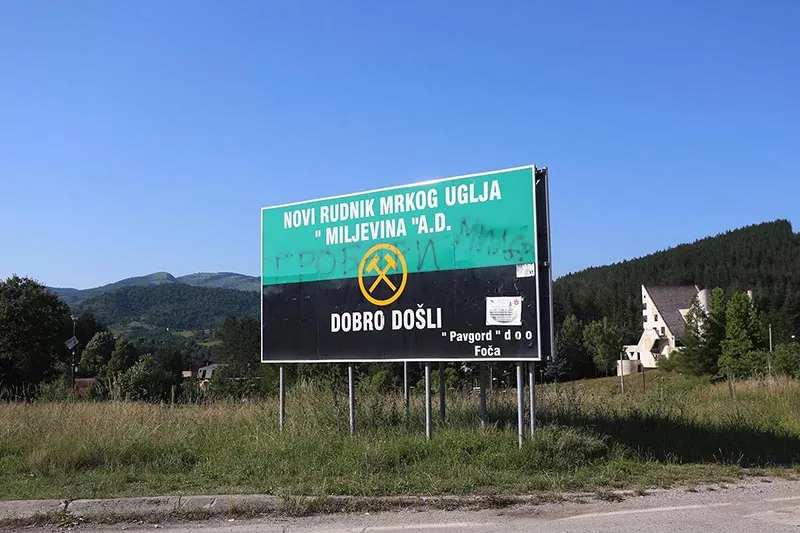
Gordan Pavlović from Foča bought the New "Miljevina" Lignite Mine for six million KM. This also gave him the right to exploit coal, with a market value of at least three billion KM.
According to data from the Center for Investigative Journalism (CIN), Pavlović did not fulfill the obligations of the sales contract to have 100 employees at the Mine at the end of the three-year operating period, but the relevant ministry did not fine him nearly 600,000 KM for it. Instead, the same ministry provided Pavlović with an incentive for coal exports amounting to 266,433 KM during that period.
After taking over the Mine, Pavlović did not continue underground exploitation, as announced in the National Assembly of Republika Srpska (RS), which approved the sale of "Miljevina". He closed the pit and conducts exploitation only from the open-pit mine.
Mine Transformation
Lignite exploitation from "Miljevina" near Foča began in 1947 from the "Nozdre" pit, and four decades later, the "Budanj" open-pit mine was opened. Until the beginning of the 2000s, the Mine was a state-owned enterprise, and after privatization, it was transformed into the Joint Stock Company Lignite Mine "Miljevina". The majority ownership of 80 percent was retained by the Government of Republika Srpska (RS) and its funds, while small shareholders, including employees, received the rest. However, the business was not successful.

The New "Miljevina" Lignite Mine was established on the assets of the Joint Stock Company Lignite Mine "Miljevina" which is in bankruptcy. (Photo: CIN)
One of the employees from that period, mining technician Momčilo Andrić, says that the workforce was not well distributed and that there were many more employees in administration than miners in the pits.
"For example, there were 50 of us here, and 200 of them there," says Andrić.
Due to outdated and inadequate equipment, exploitation at the open-pit mine stopped, and underground exploitation was difficult. By mid-2006, the Mine's operating loss amounted to slightly over 12 million KM. The accounts were blocked, and the debt to employees exceeded one million KM.
Employees sought help from the Government of RS, i.e., the relevant ministry, where initiating bankruptcy proceedings was suggested as one of the options. After that, 83 employees submitted a request to the Basic Court in Trebinje to initiate bankruptcy proceedings, which were opened in November 2006. Lazo Đurđević was appointed as the bankruptcy administrator.
According to the documentation he prepared at the time, the book value of the Mine's assets amounted to slightly over 34 million KM. Đurđević told CIN in an interview that the claims of employees and other creditors recognized were around 7.6 million KM.
According to that calculation, all debts could have been settled by selling the assets.
However, the administrator says that the book value of the Mine was not realistic, so court experts made a new assessment. Land of 225,499 m2, buildings, equipment, inventory including 15,000 tons of coal, and intangible investments in geological exploration of the coal basin were estimated at 8.1 million KM.
All assets, except for two administrative buildings and unexcavated coal, were offered at auction, where the Government of RS appeared as the buyer with a price of 4.9 million KM. The sales contract was signed in January 2008 by the relevant minister Rajko Ubiparip and bankruptcy administrator Đurđević.
The administrator says there is no issue with the Government of RS buying the assets of a company in which it was the majority owner. "Anyone can buy it," says Đurđević. He says that this money paid off a larger part of the total debt, including the debt to employees, and that there is still 2.7 million KM to be paid to various suppliers. He says that the administrative buildings will be difficult to sell because refugees are housed in them.
Formation of a New Company
From the purchased assets, the Government of RS formed the New "Miljevina" Lignite Mine, where a few employees continued coal exploitation.
Former employee Andrić says that this was the best period for the employees. "We worked extremely well. We had good salaries." He told CIN that at that time there were many interested parties in buying the mine, but he doesn't think they all had serious offers. "There were various opportunists. I think there were about fifty different delegations: from Vietnam, Russia, the Czech Republic, Western countries, and all sorts of local ones," says Andrić.

Coal from "Miljevina" is sold on the BiH market and exported to Serbia, Hungary, Montenegro, and Kosovo. (Photo: CIN)
Three companies submitted offers to purchase "Miljevina" to the Government of RS: "Inox-Tehnomont" from Grude, "Euro Invest" from Moscow, and "Pavgord" from Foča. The first two withdrew from the purchase, and the Government of RS accepted the offer from the Foča-based company, preparing an Information document for the National Assembly of RS about it.
The Information stated that "Pavgord" offered six million KM for the purchase of the mine and an investment of 10 million KM in equipment and infrastructure. Furthermore, existing employees would be retained, new ones hired, and lignite exploitation would continue in both open-pit and underground mines.
MP Vukota Govedarica stated at the Assembly, held in July 2010, that the Information was incomplete. "From this, I fear that we cannot see anything at all, and I don't know if this miracle can really happen in Foča in the next three years."
With 47 votes in favor and 15 abstentions, the National Assembly of RS accepted the prepared Information and approved the Government's decision to sell "Miljevina" to "Pavgord".
The following month, the Prime Minister of RS, Milorad Dodik, and the owner of the company, Gordan Pavlović, signed a sales contract which, among other things, defined the price of 6 million KM, a three-year investment in the company's share capital of 10,125,000 KM, and 100 employees during the three-year period.
The sales contract obligated Pavlović to continue coal exploitation during the three-year period, but it did not specify that it must be both underground and open-pit, as stated to the MPs in the National Assembly of RS. Furthermore, the contract stated that production would be improved by granting a concession for lignite exploitation as soon as possible, which was not discussed in the National Assembly of RS.
According to information obtained by CIN, and reported by the BiH news agency Patria, four months after signing the contract, Pavlović received a concession for coal exploitation for a period of 30 years, but the competent RS institutions do not allow access to the concession contract. According to data from the Ministry of Finance of RS, upon concluding the concession contract, Pavlović paid a one-time concession fee of 87,750 KM, as well as slightly over one million KM for the use of mineral resources until May 2015.
The President of the RS Concessions Commission, Predrag Aškrabić, told a CIN journalist that the granting of concessions in the privatization of mining companies is agreed upon directly with the relevant ministry: "In principle, it goes by inertia."
This explains why Pavlović did not buy the assets of the old mine from administrator Đurđević, although there were discussions on the topic, but instead bought a new mine from the Government of RS, which was composed of those old assets. Đurđević told CIN in an interview that he was only selling assets without a concession. "I don't grant concessions. I have nothing to do with the pits, neither open-pit nor underground."
According to data from the Government of RS, there are about 40 million tons of potential coal reserves in Miljevina near Foča. One of the post-war directors of the Mine, Aleksandar Golijanin, believes that this is the amount of coal in the pit, while there are still about 10 million tons on the surface. "It is an exceptional resource, exceptional," says Golijanin.
Given that the lowest market price for coal from "Miljevina" is 60 KM per ton, this gives the deposit a potential value of at least three billion KM.
Failure to Fulfill Contractual Obligations
According to data obtained by CIN journalists, Pavlović did not continue underground exploitation at the Mine; instead, upon taking over the Mine, he ordered the pit to be closed.
"Underground exploitation requires skilled personnel, and they are not available in Miljevina," says Golijanin.
About 40 workers are employed at the mine, working 12 hours a day with an average salary of 600 KM. According to the company's financial data, at the end of the three-year operating period, the Mine did not have one hundred employees as agreed. The penalty for failing to meet the employment obligation is 10,000 KM per employee and could have been collected from the submitted guarantees for the fulfillment of contractual obligations, which were set at half a million marks with a limited validity period.

After Gordan Pavlović took over "Miljevina" five years ago, he closed the pit and continued exploitation only from the open-pit mine. (Photo: CIN)
Given that at the end of 2013, 41 workers were employed at the mine, this means Pavlović should have paid a penalty of almost 600,000 KM. The Ministry of Industry, Energy, and Mining of RS confirmed that the penalty was not collected and that they did not control the fulfillment of the contractually defined obligations.
In the explanation provided to CIN, it was stated that Pavlović submitted a guarantee of 100,000 KM for the fulfillment of contractual obligations, which was valid until January 17, 2012. Given that he increased the company's share capital by 10,125,000 KM in the meantime, "he thereby fulfilled the contractual obligation in terms of investment in the company, so it was not necessary to submit bank guarantees for the second and third years of investment."
Incentives Instead of Penalties
Not only was he not penalized for unfulfilled contractual obligations, but the New "Miljevina" Lignite Mine from Foča also received privileges from the Government of RS. According to data from the Ministry of Industry, Energy, and Mining of RS, during the three-year operating period, this Mine received export incentives worth 266,433 KM.
In the period from 2011 to 2014, coal worth 20.8 million KM was exported from "Miljevina" to Serbia, Hungary, Montenegro, and Kosovo, according to data from the Foreign Trade Chamber of BiH.
In addition, numerous public enterprises in BiH also purchase coal.
Financial indicators show that in four years of operation, from 2011 to 2014, Pavlović earned 15.3 million KM from the Mine, which is almost equal to his investments in the purchase and development of "Miljevina."
Nevertheless, Pavlović is not satisfied with the business. He refuses to be interviewed, but in a brief conversation with CIN journalists, he said that his business is not going well and that he wants to close the Mine, reports Patria.
Komentari (0)
Prijavite se za komentiranje
PrijavaJos nema komentara. Budite prvi!
Minuta
Sve →Iz drugih kategorija

High Representative Not Elected: Germans, French and British Sabotaged Americans, New Attempt at End of June

ČOVIĆ WITHOUT MERCY: How Those Who Brought Ademović to Office Created a Political Hell for Him



Sunny Saturday, quite warm



Tragedy in Albanian resort: Two minors drown












