
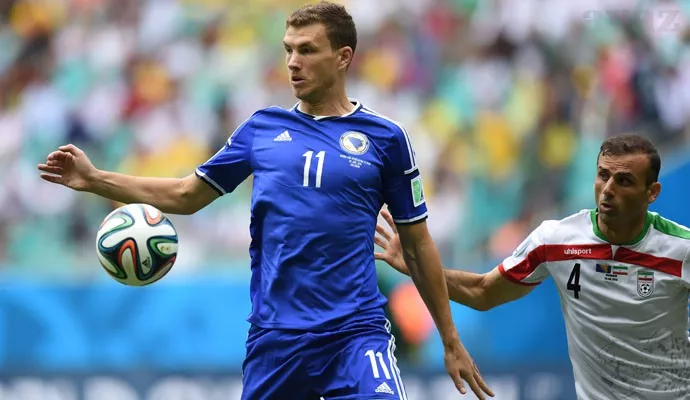
Bosnia and Herzegovina has never in its history had such a famous athlete or public figure as Edin Džeko, the best player and top scorer of the Bosnia and Herzegovina national team and the leader of the Dragons at the World Cup in Brazil, according to an analysis by the Bosnian news agency Patria (NAP).
Although within expert, media and fan circles there is still debate about whether and to what extent Džeko is the best footballer, scorer or striker, it is quite clear that the young man from Sarajevo is currently by far the most famous Bosnian in the world.
The scale of his popularity is difficult to measure, but more than 1.2 million fans on his official Facebook profile speaks volumes. No media outlet in Bosnia and Herzegovina or the region has even close to the reach of Džeko's Facebook page.
Džeko has been one of the best players of Manchester City, the current English champion and one of the best and richest clubs in Europe and the world, for several years. He also gained fame in Germany, where he conquered the Bundesliga with the then-anonymous Wolfsburg and became the top scorer. With his 10 goals in the qualifiers, he led the Bosnia and Herzegovina national team to the World Cup in Brazil and was one of the best forwards in the first round of the competition.
This is only part of the incredible football success of this young man, whose family still lives in Briješće near Sarajevo, and who took his first football steps in the besieged city and scored his first official goals on the pitches of the Premier League.
Bosnia and Herzegovina has also had great aces and famous players of world caliber before, such as Hasan Salihamidžić, Sergej Barbarez or Elvir Baljić.
However, Džeko's rise is specific and, thanks to certain circumstances, is in many ways different and on a much larger scale than any before him. Playing for City, Džeko rode the wave of the tremendous expansion in popularity, as well as economic influence, of English football and the sport in general. Today he has millions of fans and supporters from Singapore in the east to St. Louis in the west of the globe. His image, his games and his jersey are a mainstay not only for Bosnian boys chasing a ball, but also for tens of millions of others, especially in the Muslim world.
Many expert interlocutors of the Bosnian news agency Patria (NAP) believe that Džeko is, at this moment, the strongest brand this country has, and he has long surpassed national and regional frameworks.
And, when a person, a famous individual, reaches such a stage, almost every public action, contact, relationship, statement or photograph has its economic consequences. The Bosnian public finds this hard to get used to, which is especially shown by the attitude of national media during the World Cup in Brazil.
Džeko has long ceased to be just "our Dragon" and "a neighborhood guy working abroad", but also a multi-million dollar investment of wealthy Arab sheikhs, who, among other things, bought Manchester City.
Behind big stars, whether in sports or show business, there is often an entire marketing industry that financially develops the brand and name of the famous person. Someone who has once become famous and marketable can hardly suddenly return to a "normal life" - not because they don't want to, but because it causes economic losses to the industry that invested millions in that name and brand.
It is a pity that Bosnia and Herzegovina, as a state, did not invest more significantly in the brand that Džeko has become; then we would probably have stronger economic effects. Far more was invested in his football development, and subsequently in the fame that has an economic result, by the clubs he played for or plays for. However, despite this, Bosnia and Herzegovina also enjoys indirect economic benefits from Džeko's success and popularity, especially the media that follow him.
Therefore, there is no doubt that the state, the public, and especially the media should have more understanding for the burden that Džeko, despite everything, proudly and diligently carries, especially in the national team jersey. Džeko has, whether we want to admit it or not, surpassed the frameworks of Bosnian football, the state and society, and as such, the domestic public must accept him.
Only then will we perhaps understand why our Dragon, off the football field, has to be careful about what he says, who he talks to and what he does. He no longer has to play the star, as many before him did; he is a true star. His fame has become an economic factor, and Džeko cannot, even if he wanted to, ignore it for the sake of the grumpy Bosnian public. Instead of criticizing him, perhaps we could enjoy more, and even take advantage of the fact that one of the best forwards of today is from our neighborhood.
Komentari (0)
Prijavite se za komentiranje
PrijavaJos nema komentara. Budite prvi!
Minuta
Sve →Iz drugih kategorija

High Representative Not Elected: Germans, French and British Sabotaged Americans, New Attempt at End of June

ČOVIĆ WITHOUT MERCY: How Those Who Brought Ademović to Office Created a Political Hell for Him



Sunny Saturday, quite warm



Tragedy in Albanian resort: Two minors drown












