
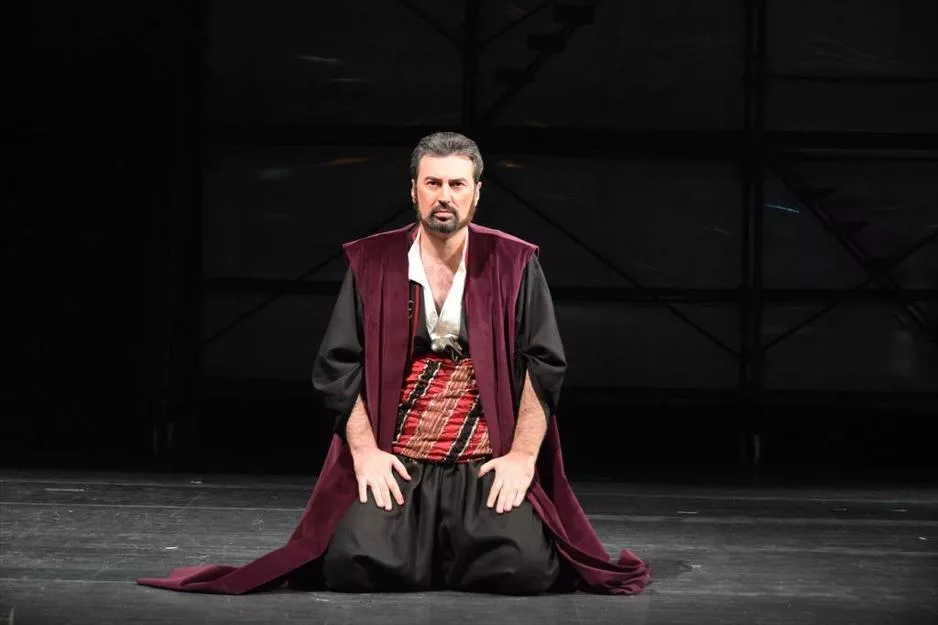
SARAJEVO, (Patria) - On Saturday, February 2, 2019, at 7:30 PM, the opera by composer Asim Horozić, “Zmaj od Bosne” (Dragon of Bosnia), directed by Ozren Prohić, with a libretto by Nijaz Alispahić, will be performed on the stage of the National Theatre.
The costumes for this opera were created by costume designer Vanja Popović, who, along with Ozren Prohić, also contributed to the set design.
The performance features soloists and the choir of the NPS Opera, the NPS Ballet, Sanela Pepeljak, Amar Bojičić, Nadin Đipa, and the Sarajevo Philharmonic Orchestra conducted by Nada Matošević Orešković, a guest from Croatia.
The 1830s. In the Bosnian town of Gradačac, the young and powerful captain Husein-beg Gradaščević holds court. The era of beheading disobedient Bosnian heads has passed, but unrest and dissatisfaction still linger. The Ottoman Empire has weakened, and one of its European provinces (Bosnia) is in the focus of major powers. Sultan Mahmud II and the Sublime Porte are doing everything to preserve the former power of the Empire by introducing radical reforms, which do not bypass Bosnia, the “Sultan’s dearest possession.”
A spark of rebellion still smolders in Bosnia, and in this historically turbulent sequence, it grows into a widespread movement led by the youngest and most powerful captain, Husein-beg Gradaščević. Open conflicts between the Bosnian army and the Ottomans begin, culminating in a magnificent victory for the Bosnians at Kosovo Field, after which Husein-kapetan returns to Bosnia with his army. Gradaščević declares himself vizier of Bosnia, moves from his native Gradačac to the vizierial city of Travnik, where he begins his rule over a free and autonomous Bosnia. Sultan Mahmud II does not accept the defeat and the turn of events in Bosnia. He prepares for a new military campaign and tasks the zealous Rešid-paša with pacifying and bringing the rebellious Bosnians to reason, restoring order in Bosnia, and bringing the rebellious leaders, led by Husein-kapetan, as prisoners to Istanbul. At the same time, he sends Osman-paša Gradaščević, Husein's older brother, on a peace mission, which ends in complete failure.
The pleas of Husein's mother, Meleć-hanuma, to reason with her son and persuade him to obey the Sultan were in vain. Even the Herzegovinian ayans and captains are no longer with Husein-beg; at Sarajevo Field, where the decisive battle takes place, they withdraw their allegiance and fight on the side of the Ottomans. Husein-kapetan’s army suffers a complete defeat. With a small group of like-minded individuals and family members, Husein-beg takes refuge in his native Gradačac, and then flees across the Sava to Osijek, into the territory of the Austro-Hungarian monarchy.
Husein-beg spends difficult days in exile in Osijek. Through his friend fra Ilija Starčević, he futilely attempts to gain an audience with Metternich or Emperor Franz, hoping to resolve the fate of Husein-beg and his friends. Finally, Herr Apel, adjutant to General Radošević, arrives and delivers a written decision from the War Council in Vienna ordering the extradition of Husein-beg and his friends to Belgrade, and then to Istanbul, where the Sultan and the Sublime Porte will decide the further status of the imprisoned Bosnian rebels. Husein-kapetan had to comply with this humiliating decision.
Upon arrival in Turkey, the prisoners are housed in the fortress of Trapezunt on the Black Sea coast. Difficult days of imprisonment and uncertainty ensue. Finally, the Sultan's envoy arrives and informs Husein-beg that he will finally be received in audience by Sultan Mahmud II himself. The Sultan attempts to reason with Gradaščević, offers him the release of his friends, high honors, and a comfortable life, as long as he renounces Bosnia and the fight for its autonomy. Husein-beg refuses all the Sultan's flattering offers and is again returned to the dungeons of Trapezunt, where he soon ends his young life.
On Thursday, February 7, 2019, at 8:00 PM, the Hungarian State Dance Ensemble will officially open the 25th Sarajevo Winter Festival 2019, under the motto – Noise and Fury, on the stage of the National Theatre Sarajevo.
The Hungarian State Folk Ensemble, the number one folk ensemble in Hungary, was founded in 1951 with the aim of collecting, preserving, and presenting the treasures of Hungarian folklore. The diverse repertoire of the Hungarian State Folk Ensemble has made it one of the most successful ensembles in the world: during its sixty-year existence, the Ensemble has performed in 53 countries on four continents and entertained over 9 million people. The Ensemble's repertoire consists of authentic and contemporary performances.
This program pays tribute to Zoltán Kodály, a world-renowned composer, musicologist, and educator. In Hungarian virtuosity, you can follow the joys and sorrows, as well as the rituals of holidays and everyday life. This production is characterized by richly shaded lyrical-associative images, stage events, and playful variations of spatial and temporal planes.
On Friday, February 8, 2019, starting at 12:00 PM, the Ballet of the National Theatre Sarajevo will perform the ballet fairy tale “Thumbelina” by Hans Christian Andersen for the youngest audience, directed and choreographed by Nermina Damian.
Born from a barley grain given by a witch to a poor but kind woman, Thumbelina was a delicate and charming little girl. She was no bigger than a thumb, hence her name Thumbelina. She slept in a walnut shell, and a rose petal served as her blanket. She danced all day. Mrs. Frog, upon seeing her, wanted Thumbelina to be the wife of her son, Froggy, and thus stole her.
Many water lilies grew in the stream, so the frog placed Thumbelina there. A beautiful white butterfly had long been circling Thumbelina, immensely enchanted by her. But Thumbelina was stolen again by a May beetle, who caught her in flight and carried her away.
A little later, other May beetles visited them, and they did not like Thumbelina. They were disgusted: “She only has two legs. How ugly she is!”
Thumbelina was alone again, all summer and autumn. Then came the long and cold winter. Mrs. Mouse found Thumbelina. Thumbelina was proposed to. This time by Mr. Mole. Mr. Mole was rich, wearing a plush long coat. If she had agreed, she would have lived in his underground home.
In the darkness, Thumbelina found a frozen and starving swallow, whom she nursed all winter. And when spring arrived and the sun warmed the earth, the Swallow flew away. Thumbelina was left alone, sadly bidding farewell to the sun.
Help arrived precisely from the Swallow, who had not forgotten her. Flying on the Swallow's wings, they arrived in the land of flowers.
Here she met the Prince, who placed a golden crown on her head and wings on her back. She received the most beautiful gift, a new name – Maya.
On Saturday, February 9, starting at 8:00 PM, Sarajevo Winter, the National Theatre Sarajevo, and the Sarajevo Philharmonic Orchestra announce a “Gala Concert” during which soloists of the NPS Opera, along with artists from Korea, will present a top-tier artistic spectacle.
On Thursday, February 14, 2019, at 7:30 PM, as part of the XXXV Sarajevo Winter Festival 2019, the National Theatre Sarajevo will premiere the drama by Bertolt Brecht,
“The Caucasian Chalk Circle,” a co-production with the MESS festival, directed by Paolo Magelli, with adaptation and dramaturgy by Željka Udovičić Pleština. The first rerun is scheduled for February 15, 2019, starting at 7:30 PM.
The work was written by Bertolt Brecht, a universal genius, playwright, writer, poet, director, and theatre theorist. He deserves special recognition because his plays are still performed in theatres around the world today. The core ideas of his works revolve around socialism, pacifism, and internationalism. His sarcastic style, which never leaves him in his works, appears with warm compassion for the poor and weak. In developing his style, he drew upon the achievements and themes from the oldest to modern literature.
On Saturday, February 16, 2019, at 7:30 PM, the ballet “Prometheus Bound” will be performed on the stage of the National Theatre Sarajevo, choreographed and directed by Belma Čečo Bakrač, who also wrote the libretto based on the motifs of Aeschylus' tragedy “Prometheus Bound.”
The performance features soloists and the ensemble of the NPS Ballet, with guests from Belgrade, Milan Rus and Igor Pastor, the NPS Opera choir, and the Sarajevo Philharmonic Orchestra conducted by Nada Matošević Orešković.
“What is permitted to Jupiter is not permitted to an ox,” says an old Latin proverb. Are there lesser and greater values? Can those who consider themselves superior oppress and exploit the weaker? Can the manipulation of fear turn people against each other and lead them to self-destruction? The ballet performance “Prometheus Bound” attempts to find answers to these questions, while also examining where empathy stands today and what has happened to happiness and hope.
On this uncertain path of searching, we encounter the figure of Prometheus, who, as a rebel, grows into a symbol of the struggle for justice and freedom of thought. Because of his need to help others, to stand against tyranny, Prometheus becomes a victim of the absolute system of rule, headed by the lord of life and death, the great Zeus. The inner energy of Prometheus, in the cry of one who suffers, endures, and believes, is the primary inspiration for the choreography of this performance. Composer Marjan Nećak, through his magical music, brings to life the fantastic worlds of gods and humans, and by creating astonishing atmospheres, presents a great challenge to the choreographer.
The uniqueness of this piece, in both musical and choreographic terms, lies in the ritual that is of existential importance to the characters in the performance and which imposed itself as the basis for creating the choreographic concept.
On Monday, February 18, 2019, at 7:30 PM, the play “Leptir” (Butterfly), directed by Emir Z. Kapetanović, based on the text by Aleksandar Radunović, can be seen on the small stage of NPS, EN FACE.
“The dramatic text Leptir has a simple structure with a classic dramatic plot, adhering to Aristotelian unities (time, place, and action). This, so to speak, school example of a drama allows the actor to bring their acting skills to the forefront. Without many external means, excessive scenography, or excessive makeup and mask adjustments, it allows the actor to embody a character of flesh and blood – placing emotion at the forefront. Such a text is a perfect choice for a small, chamber-type stage like the small stage of the National Theatre Sarajevo. The text speaks about alienation within the family due to a lack of communication, which is a problem for many families today. Communication within families today is conducted via mobile phones, computers, and other means of communication that do not involve the presence of real emotion. Therefore, such performances are needed today more than ever before.”
The number of seats is limited, so we invite you to secure your tickets in time!
On Wednesday, February 20, 2019, at 7:30 PM, the drama “The Phoenician Women” will be performed on the stage of the National Theatre Sarajevo, directed by Ozren Prohić.
The adaptation of the ancient play “The Phoenician Women” (Euripides) by Lada Kaštelan corresponds to the present day, dealing with universal and topical themes. The contemporary approach to the ancient tragedy shows how much has changed throughout history, but how only man has not changed. Specifically, this is a story where brothers kill each other out of envy and the struggle for power, but also due to fate, i.e., the curse of their ancestors. The general atmosphere is one of apprehension – anticipating disaster, the dissolution of everything into dust.
In Lada Kaštelan's adaptation, the feminist line of the play is emphasized. Women are at the center of events, much more represented than in Euripides' work. No one is living their life; everyone is watching it pass them by. When they decide to react, it is already too late. And so it goes in circles. Everyone is waiting for a better tomorrow that will never come, because it is within us, not outside us. We need to make things better ourselves, not wait for someone else to do it for us.
On Friday, February 22, 2019, at 7:30 PM, at the National Theatre Sarajevo, we expect the multimedia promotion of SUADA AND MUŠO: FOOTBALLER AND BALLERINA, a promotion of a book and film about our stars Suada Kavazović-Mušović, prima ballerina of the Sarajevo Ballet, and Džemaludin Mušović, a top athlete. Authors of the book: Dinko Omeragić and Indira Kučuk-Sorguč.
Author of the film: Indira Kučuk-Sorguč. EXHIBITION SUADA AND MUŠO: FOOTBALLER AND BALLERINA. Authors: V. Hasanbegović and I. Kučuk-Sorguč.
On Saturday, February 23, at 7:30 PM, the comedy “A Flea in Her Ear” will be performed, directed by Admir Glamočak. “A Flea in Her Ear” is one of Feydeau's best and most frequently performed plays. His witty, quirky, and virtuously written texts are adored by audiences worldwide. Feydeau's theatre is close to farce, full of boisterous comedy, incredible plot twists, and absurdity.
On Monday, February 25, at 7:30 PM, the National Theatre Brno from the Czech Republic will be a guest on the stage of the National Theatre Sarajevo as part of the Sarajevo Winter 2019 festival. Through the drama “Vera,” they will tell the life story of the athlete Vera Born.
On Tuesday, February 26, at 7:30 PM, the famous opera “The Barber of Seville” by Gioachino Rossini will be performed on the NPS stage. The performance features soloists and the choir of the NPS Opera, the Italian group “Zero Positivo,” and the Sarajevo Philharmonic Orchestra conducted by Dario Vučić.
The production is a co-production with the Embassy of Italy in BiH. The group Zero Positivo aims to give this production of The Barber of Seville a completely contemporary expression. We will not reveal what will happen, but we can say that the performance is the result of research that has gone through as many as three studies and three elaborations of dramatic projects aimed at stripping bare and defining the essence of the characters, personalities, and psychological transformations of Rossini's figures.
In order to achieve this essence, our production focuses on music, movement, and words, reducing everything that is scenographic decoration and false vintage costume design to only the most essential elements. Simply put, we will try to tell a story about the love between two young people, within which Rossini entertains himself by complicating things to further emphasize love as a feeling. We will tell it as we see it, celebrating a small part of our society in the best possible way.
Respecting the music and the text, from which we have absolutely no intention of deviating or, even worse, distorting them, we hope that this production, in the correct spirit, can approach and enter on tiptoe into a different world than the one we are accustomed to visualizing when mentioning The Barber of Seville. We take the risk, respecting what, in our opinion, is the foundation of theatre in music, i.e., communicating emotion, preferably positive.
On Thursday, February 28, 2019, starting at 7:30 PM, the play “The Lady of the Camellias,” a ballet in two acts and seven scenes based on the novel by Alexandre Dumas fils, will be performed on the stage of the National Theatre Sarajevo. The choreography is by Vasily Medvedev, a guest from Russia. The performance features soloists and the ensemble of the NPS Ballet, accompanied by the orchestra of the Sarajevo Philharmonic, conducted by Samra Gulamović.
DUMAS SON - ON THE LADY OF THE CAMELLIAS - ALPHONSINE PLESSIS
(From the preface to the reissued edition of the play The Lady of the Camellias, Paris, 1867.) The person who served as my model for the heroine of The Lady of the Camellias was named Alphonsine Plessis. She changed her name to a more resonant and elegant one – Marie Duplessis. She was tall, very slender, with black hair, a rosy and white complexion… In 1844, when I first saw her, she was in the bloom of her beauty. She died in 1847 of tuberculosis at the age of twenty-three. She was one of the last few courtesans of noble character. That is surely why she died so young.
She lacked neither wit nor self-sacrifice. She met her end in poverty, in a luxurious apartment overrun by her creditors. Elegance was innate to her; she dressed with taste, walked gracefully, almost nobly. Some considered her a woman of high society.
Théophile Gautier dedicated a few lines of a eulogy to her, in which one could see the fading of that lovely soul who, like a few others, made the sin of love immortal. Marie Duplessis did not experience everything I attributed to Marguerite Gautier, but she could have. The reason she sacrificed nothing for Armand was that he did not want her to… No one called her the Lady of the Camellias during her lifetime. The nickname I gave Marguerite was a product of my imagination. However, it indirectly returned to Marie Duplessis a year after her death, when the novel was published. If you ask at the cemetery for the grave of the Lady of the Camellias, the caretaker will lead you to a small square monument, on which, beneath the name Alphonsine Plessis, a wreath of white camellias is attached to the white marble. That grave now has its legend.
The Lady of the Camellias (1848) was first written as a novel and later adapted into a play and for stage performances.
Komentari (0)
Prijavite se za komentiranje
PrijavaJos nema komentara. Budite prvi!
Minuta
Sve →Iz drugih kategorija

High Representative Not Elected: Germans, French and British Sabotaged Americans, New Attempt at End of June

ČOVIĆ WITHOUT MERCY: How Those Who Brought Ademović to Office Created a Political Hell for Him



Sunny Saturday, quite warm



Tragedy in Albanian resort: Two minors drown












