
Written by: Rasim Belko
In the political kitchen of Bosnia and Herzegovina, consociationalism is increasingly being served as the dish of the day. On the menu, it sounds tame—a governance model that guarantees representation for "all" and preserves peace. But if you peek behind the scenes, you will see that what is being cooked is not coexistence, but slowly but surely—political separation.
Proponents of consociationalism like to emphasize that it is a solution tailored to "realities on the ground." By these "realities," they mean the fact that the political leaders of the three constituent peoples cannot—and do not want to—imagine a state that functions outside ethnic divisions. Consociationalism, in this interpretation, is not a transitional solution but constitutional cement that solidifies the lines of division created by the war.
The political theory of consociationalism, developed in a nuanced form for some European states, rests on an agreement among elites who share power while civil society develops. In Bosnia and Herzegovina, the elite do not agree to share power—but to share territory, resources, and control. This is not a bridge to a legal and orderly state, but a pontoon crossing towards its final disintegration.
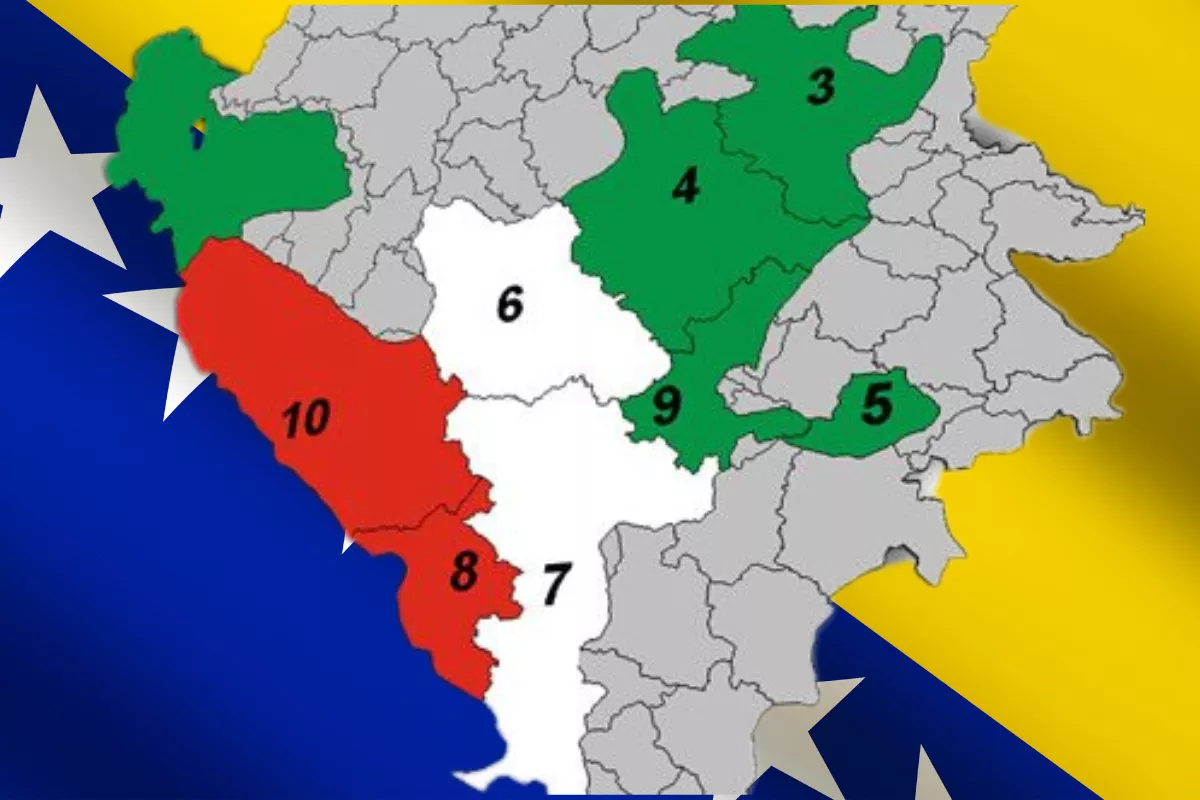
Accepting such a model means abandoning the idea of a unified space of a sovereign state. In it, every reform becomes a hostage to ethnic veto, every law a subject of endless bargaining, and every change—a threat to the "national interest" interpreted exclusively by the ethnic political caste. The state is reduced to a collection of cantons, entities, and districts that live parallel political lives and meet only in a common blockade.
And while international diplomats utter words like "compromise" and "dialogue" with a smile, domestic politicians translate them into their own language: "status quo" and "control."
Today's arrangement in Bosnia and Herzegovina, founded on ethnic exclusivity, cannot and will not lead the state towards Euro-Atlantic integrations. Not because citizens do not want it—on the contrary, the majority support it—but because the ruling elites cannot allow it.
Ethnic exclusivity has enabled the development and deep entrenchment of corrupt octopuses, each carefully placed in its own ethnic backyard. Three political centers—Bosniak, Croat, and Serb—have turned their "national interests" into a screen for networks of patronage, clientelism, and crime.
The judgments of the European Court of Human Rights (Sejdić-Finci 2009, Zornić 2014, Pilav 2016, Šlaku 2016) have for years clearly stated that the current system discriminates against citizens who do not belong to the "constituent peoples" or do not wish to declare their ethnicity. However, instead of these judgments being a reason for change, domestic political leaders use them as proof that "foreigners are unrealistic," while they "defend the Constitution." Thus, ethnic exclusivity becomes an institutional guarantee for preserving power—and corruption.
This is sufficiently illustrated by data from the Parliamentary Assembly of BiH, which shows that in the period 2010–2020, the mechanism of "protection of vital national interest" was used or threatened to be used in more than 200 cases, often to block laws and decisions crucial for reforms needed for EU integration. Examples include the blocking of:
• The Law on Conflict of Interest (multiple times from 2013 to 2021);
• The Law on Public Procurement in line with EU directives (blocked in 2018);
• The Law on State Property (continuous blockade from 2010 to the present);
• Amendments to the Election Law in line with the judgments of the European Court of Human Rights (blocked in all attempts since 2010).
Genuine democracy, an independent judiciary, and transparent administration would spell the end of this idyllic arrangement. The rule of law does not recognize ethnic "protected zones," nor does it distinguish between "our" and "their" corruption. If laws truly applied equally to everyone, the tentacles of the octopuses would begin to snap one by one—and that is a nightmare for each of the ethnic political elites.
The system is so skillfully tuned that every new party that comes to power, regardless of its color and ideology, quickly learns the rules: do not touch the foundations of ethnic exclusivity, and the system will reward you abundantly—with positions, resources, immunity from the law. Ideology is flexible, privileges are permanent.
That is why Euro-Atlantic integrations within this framework serve only as a political prop. In campaigns, they are a promise; in negotiations, a currency for backroom deals; and in practice—a dead letter. The European Union and NATO are not just a geopolitical goal; they imply a completely different political ecosystem—one in which corruption, discrimination, and ethnic exclusivity have no place.
And therein lies the reason why Serbian and Croatian politics were so vehemently and unreservedly against the positive decision on the appeal in the case Kovačević vs. BiH. Such a judgment strikes directly at the core of ethnic exclusivity—it demolishes the construct according to which only the "constituent" peoples have full political capacity, while all others are second-class citizens.
However, almost equally indicative was the reaction of Sarajevo, i.e., Bosniak politics. It was quiet, evasive, restrained—as if watching from the sidelines, not wanting to disturb the carefully maintained image of its own "multi-ethnicity." At the same time, this silence was not accidental; behind it lay an equal discomfort at the possibility that BiH might one day become a truly democratic society in which every citizen would have the full scope of guaranteed rights, regardless of ethnic affiliation or non-affiliation.
Because true equality means the end of political trading in ethnic identities—and that is the currency with which all three national politics pay for their survival.
Because consociationalism and ethnic exclusivity in BiH do not mean stability but institutionalized stagnation. They are a political merry-go-round on which the same figures always ride, while the people pay for tickets and watch the same shows. Only here, unlike in an amusement park, the merry-go-round never stops.
Until one day it collapses under the pressure of the distribution of spoils on the geopolitical map of world power. And that is what is currently threatening Bosnia and Herzegovina. The Cyprus scenario is on that map, just as it was on some napkin maps three decades ago.
Komentari (0)
Prijavite se za komentiranje
PrijavaJos nema komentara. Budite prvi!
Minuta
Sve →Iz drugih kategorija

High Representative Not Elected: Germans, French and British Sabotaged Americans, New Attempt at End of June

ČOVIĆ WITHOUT MERCY: How Those Who Brought Ademović to Office Created a Political Hell for Him



Sunny Saturday, quite warm



Tragedy in Albanian resort: Two minors drown












