
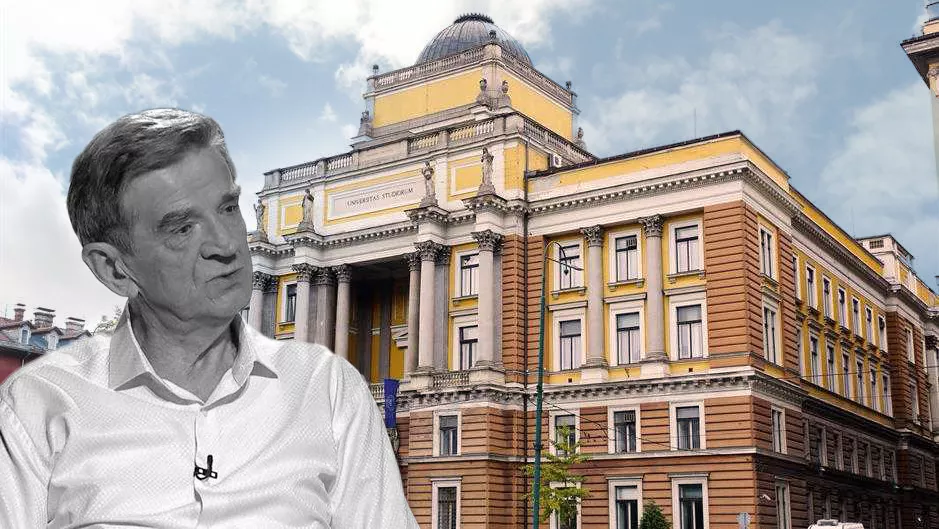
The recently adopted (unfortunate) Law on Higher Education of Sarajevo Canton (ZOVKS) has introduced some positive provisions in this area, such as stricter control over the engagement – in fact, moonlighting – of some teachers outside their parent institution, or organizational unit.
Of course, there are some other positive provisions in the Law, but the Law, in general, is very bad, essentially devastating even compared to previous laws. One could write at least as much about its dominant weaknesses, and by that I mean the strategic orientation of the Law – as the Law itself is long, but in this review, I will focus only on some of its key points – on those that strategically and fundamentally define it as negative.
The Law introduces too much normativity into the higher education system at UNSA. This is in conflict with the essence of this institution as the most conscious part of society, because it must be sufficiently free within itself to be creative, and not so strictly constrained by norms. This is a path towards strict bureaucratization that is incompatible with academic creativity, with the universe. I will illustrate this orientation of the Law with only two "mechanisms" that the Government has introduced into the Law.
First, and most importantly, the Government has devised a Law to stipulate that the majority in the Governing Board consists of members of the academic community, and a smaller part of members from the Government. This is good in principle, and it has been extremely controversial until now. However, in connection with this "concession" by the Government, a "trick" has been implemented that neutralizes the "gain" of the academic community. Namely, the Governing Board has been given excessively large powers by the Law, which dramatically bureaucratize UNSA and neutralize, as I said, that apparent "concession" to the academic community. The Law stipulates that the Governing Board can dismiss deans and the rector. Such a provision is a product of the Government's logic, which does not understand the specifics of the large institution UNSA, which has over 30 constituent units from all scientific fields, and it is a logic that does not distinguish the Governing Board of UNSA from, say, the Governing Board of KP Vodovod i kanalizacija, which is simply terrible. With such powers, the competencies and authority of the Senate, which is truly a powerful scientific and teaching body with irreplaceable competencies, are significantly reduced.
Namely, the work of the Senate as the most competent body for teaching and scientific research is led by the rector; the Senate elects the rector and consequently – the rector is responsible to the Senate. Only the Senate has the real competencies (in the professional and scientific domain) to decide on the work of the rector. The Governing Board does not have, like the Senate, enough competent people in teaching and science for them to decide on the fate of the rector and deans, and thus on matters within the jurisdiction of the rector and the Senate. Therefore, such powers of the Governing Board are absurd, extremely bureaucratic – incompetence is built into them. Furthermore, there are relatively few members in the Governing Board, so it is easy to manipulate the Governing Board; it is easier for a small number of people to be used compared to the much larger and more complex Senate, which means there are great possibilities, regardless of the Government's trick about a larger number of members from the academic community, for decisions/dismissals, etc., to proceed according to some/someone's party or group whims and goals. Through the Governing Board, control over UNSA becomes complete, while at the same time its most competent and important body – the Senate – is suspended in the most significant domains. Obviously, this is a dramatic degradation. The Government has not understood the essence of UNSA's functioning, the rector-dean-Senate relationship. Therefore, I repeat that for them, the Governing Board of UNSA is the same as, for example, the Governing Board of a utility company. Fundamentally important specifics are neglected. (By the way, while watching the live broadcast of some parts of the Assembly session, I was completely discouraged, overwhelmed by the direct insight into how some members of the Government/Assembly – and they decide on the fate of UNSA – absolutely do not understand the subject matter they are discussing and making decisions on.)
Second, let's pay attention to another mechanism for degrading academic competence and dignity.
The Law regulates evaluation, i.e., student assessment of teachers' work. Almost all the most important things in academic life – including this – are brought into an inverse position in the Law, upside down, in plain language. Teachers should evaluate students, not students evaluate teachers. Of course, there is sometimes teacher arbitrariness that should be sanctioned by faculties, i.e., the Faculty's Teaching-Scientific Council, but not to introduce it as a mechanism in the Law. In principle and by the logic of things, a student is not competent to evaluate the work of their professor. Then, it is also logical to expect in this case that precisely bad students will be the loudest in evaluating their teachers, and the question is by what mechanism the validity of these student evaluations will be determined, which can realistically be expected to be vindictive, vengeful, and therefore destructive. Of course, teachers will protect themselves from such student evaluations by appeasing them, and this is the wrong path because students should follow the methods, achievements, and goals of the teachers, the academic standards of the teachers, not the other way around. Precisely in line with this, the specter of pass rates arises, which is already producing negative effects in faculties and will only produce them more now thanks to this Law. Passing at all costs! Through too frequent exam periods to optimize pass rates (a method of appeasing weaker students!), by insisting on the criterion of passing, pressure is exerted on teachers who, over time, adapt to it, and – in order to receive positive evaluations from their students – will significantly lower academic/teaching criteria. This is certain, and it leads to a degradation of quality. Bureaucracy does not understand that the pass rate is not the same as quality, and bureaucracy relentlessly defines pass rate as quality. This is a big mistake and a misunderstanding of essential things. With the aforementioned mechanisms, teachers at UNSA are already being turned into examiners instead of primarily being lecturers. And this is contrary to the academic spirit and university level.
The specificity of UNSA in this regard is also contained in the following. University teachers have re-election, which is a strong mechanism for their constant, but competent, verification. Every few years, an assistant/teacher undergoes a re-election process in which their competence and validity are verified at several levels, and each is optimally competent: a commission, whose qualifications have always been taken into account as a fundamental condition, writes a report on the candidate (I emphasize the word candidate; a teacher is, essentially, until the last rank, always in a candidate status). This report is reviewed by the Teaching-Scientific Council of the Department (the emphasis is on the dual component: both teaching and scientific, which means that both their teaching and scientific work are evaluated); then this evaluation is verified at a higher instance – at the Teaching-Scientific Council of the Faculty, then at the professionally and scientifically competent group of the University, and finally at the Senate of the University. This is truly an impressive path of constant checks and verifications of the teacher's work, and it can be suspended or annulled by the evaluations of some vindictive and uninformed students.
The powers of the Governing Board overlook all these specifics; it is not the same as the Governing Board of Vodovod i kanalizacija! In principle, in all previous cases, it is about a priori suspicion of the professor's work (instead of the other way around) and allowing them to be sanctioned precisely by those subjects or bodies that are not competent to evaluate them; this has been done by this Law from assistant to rector; therefore, it is a consistent and serious devastation of academic quality and dignity.
Another very important thing that the Law, in its bureaucratic inclination, overlooks is the neglect of the importance of basic scientific positions, or units at UNSA. Namely, the Law generally aims at integration as regulation and control at the highest instances of UNSA (up to the empowered Governing Board) and does not sufficiently take into account the fundamental fact – that the parent departments, or parent faculties, are the units where scientific research, and thus teaching work, is developed. Therefore, it is necessary – in order to truly advance science and teaching – for the Law to pay the greatest attention to the autonomy and development of these basic units, which are losing their subjectivity along with the faculties due to bureaucratic centralization.
A particular problem is that our society, and therefore our Government, does not pay enough attention to the rejuvenation of staff. I have been warning about this for years. It is very difficult, or impossible, to hire assistants – as a special expression of mercy. For example, in the Department of Oriental Philology where I work, no assistant has been hired for years (and it's not much better elsewhere), so I ask the Government: what kind of departments are these where there are no assistants; what is the future there; what kind of development of the University is this, what kind of strategy does not have staff development at its core?! The University is rapidly aging and will simply collapse in a relatively short time. Who is aiming for this? Those who pass laws do not understand that it is not the same to "promote" a docent and hire someone as a clerk somewhere. Meanwhile, administration is flourishing in faculties: bureaucracy has a logic and inertia to reproduce itself, not to reduce itself. It is devastating to what extent forms have taken over academic life, how desperately every academic freedom is being tried to be confined within rigid forms...
The Government behaves towards the University as towards its opponent or rival, whereas the Government should establish a partnership and consultative relationship with UNSA, listen and even seek recommendations from the University, given its great capacities.
The transition to the treasury is also a special negative story. The Government does not hide that its main goal is to control financial flows. It's about money, not improving UNSA! It is true that some deans had enormously high salaries, but a Law that punishes the entire and huge academic community because of individuals should not have been passed. That is the wrong path. In short, by transitioning to treasury financing, many faculties will be discouraged from generating their own income, or from working on commercial projects that are very valuable services to society. And this is a significant setback for both UNSA and society.
Finally, it should also be said that the academic community could not boast of general social engagement. In this regard, I have personally been criticizing that community for years. However, with such a Law, the academic community is not stimulated at all to improve teaching and scientific research work, but this Law will only increase the demotivation and apathy that has already gripped this community, and this is an almost immeasurable loss for the entire society.
Given the enormous potential of UNSA, this Law has caused great damage not only to UNSA but also to the entire society. This will only become apparent later, when the damage is irreparable. I am convinced, unfortunately, that those who passed the Law are not even aware of what they have actually done.
Komentari (0)
Prijavite se za komentiranje
PrijavaJos nema komentara. Budite prvi!
Minuta
Sve →Iz drugih kategorija

High Representative Not Elected: Germans, French and British Sabotaged Americans, New Attempt at End of June

ČOVIĆ WITHOUT MERCY: How Those Who Brought Ademović to Office Created a Political Hell for Him



Sunny Saturday, quite warm



Tragedy in Albanian resort: Two minors drown












