
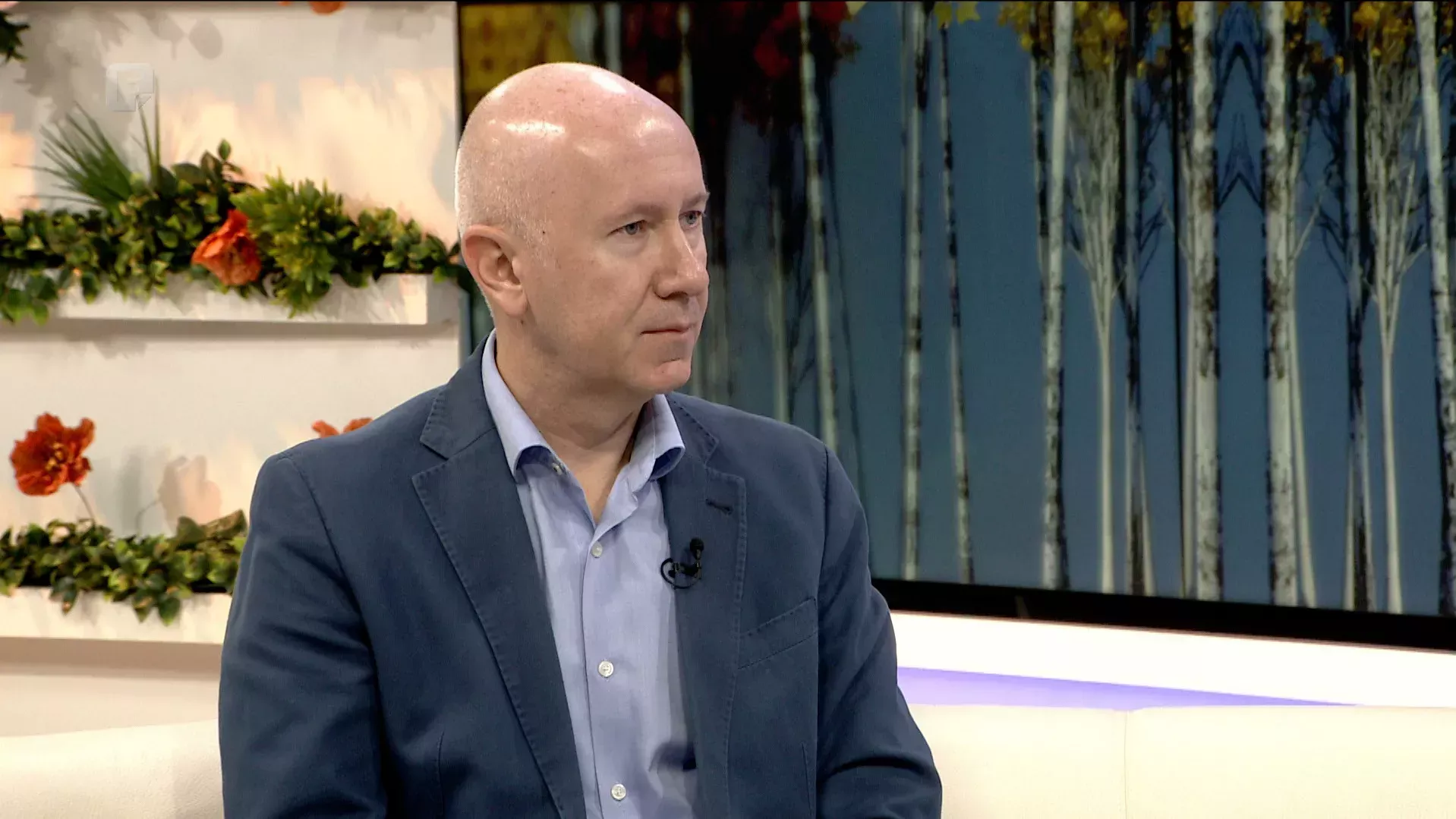
(Patria) - Milan Dunović, head of the DF caucus in the House of Representatives of the state parliament, was a guest in the political minutes of FTV's Morning Program.
What does he expect ahead of the European Council session?
Will the European Commission's proposal for conditional green light to open negotiations with the Union be confirmed? Will we fulfill the requested conditions by March next year?
Is the Draft Agreement on opening negotiations with Frontex a step forward? What about other reform laws? How to resolve issues of state property and the Election Law? Is it realistic to expect the dismissal of state ministers Staša Košarac and Zukan Helez?
- Mr. Dunović, the European Council is meeting today and tomorrow. What can Bosnia and Herzegovina expect? Will the European Council confirm the European Commission's recommendation for conditional opening of negotiations with the country?-
"You know, when we read all these reports, the question arises whether it is conditional, whether it is a recommendation to continue on our path, or if it is some kind of red light, and the essence is that we as a society, as a political system, are not fulfilling our obligations. We are not fulfilling the fourteen priorities that were set for Bosnia and Herzegovina back in 2019, and we actually expect the European Union to somehow say, 'Okay, forget those priorities, we can open negotiations.' That will not happen. We must take real steps, and unfortunately, those steps are not happening.
When we talk about the competencies of the state parliament, laws that are harmonized with European Union standards are not being adopted there. Even those five famous laws that were talked about a lot in the past period are not harmonized with European Union standards, and this is not just my opinion. It is not just the opinion of international actors who have explicitly stated it, but it is written in the laws themselves. I always say, here is an example of the law on the HJPC, which many politicians said was now a European law; in that law itself, specifically in Article 26, it literally says, 'Within one year, the Parliamentary Assembly of BiH will harmonize this law with European directives.' So, at this moment, it is European, and that obligation for a year, we know how obligations that fall under the jurisdiction of parliaments, including the state parliament, end. Then it somehow falls into oblivion, and nothing happens."
- Sometime at the end of this month, that law should come into force, so we have that year left. As you said, it is a fact that we have not really done much to fulfill those fourteen priorities, nor the eight plus one that we received last year after being granted candidate status. Today, the European Council is also considering Ukraine and Moldova and opening negotiations with them. Are these countries really ahead of us? -
"These are political decisions. We must be honest, these are political decisions, and Bosnia and Herzegovina is at a moment and in a geopolitical situation that can accelerate our path. However, one day, whether it will be in March or later at this moment is perhaps less important; the essence is important. At one point, when negotiations open, it does not mean we have become a member of the European Union. We have many countries that have been in the process of negotiating and harmonizing their legislation for a long time, but there is no positive step.
So, in addition to these fourteen priorities, there is another moment that is rarely discussed, especially in political life. When you talk to politicians, unfortunately, we have many politicians who do not understand it at all, yet they are actively involved in politics, and we have those who deliberately ignore it. One of the fundamental problems when negotiations eventually open, and we want and do everything to join the European Union.
The question arises whether Bosnia and Herzegovina can be a member of the European Union with its current state structure. With the current coordination mechanism adopted by the Council of Ministers in 2016, and that coordination mechanism is a concrete reason why the delegation was so large during the visit to Brussels last week. The coordination mechanism stipulates that cantons give consent, and entities give consent for the state to speak with one voice. We see in practice how it works when consent from all cantons and both entities is sought for any decision to speak with one voice.
So, let's not lie, the European Union does not want countries in its family where, for example, if the European Union wants to make any decision, even a trivial one, consensus is required. We see that the European Union is facing this problem, that they are trying to change the consensus in decision-making in a way that decisions can be made by a two-thirds majority. To change that decision, they need a consensus that they cannot get. Now imagine a decision in the future when Bosnia and Herzegovina, with this coordination mechanism, is a full member; a decision is on the agenda, but that decision cannot be made until every canton in Bosnia and Herzegovina and both entities give consent to the state level, for the state level to say, 'Okay, we are for that decision.' So, the European Union does not need that problem, but Bosnia and Herzegovina and the citizens of Bosnia and Herzegovina need a functionally organized system with the rule of law where we all have equal civil rights. Unfortunately, that is not the case now."
- The European Union constantly states that Bosnia and Herzegovina needs constitutional and electoral reform, but when we mention the coordination mechanism, the Party of Democratic Action participated in its adoption. Recently, the party's president, Bakir Izetbegović, says it is a good solution, that it was even assessed as a step forward on the EU path, and that it is actually a reflection of the state of BiH-
"We can interpret every political problem in Bosnia and Herzegovina and every decision in two ways. One way is how Mr. Izetbegović did it, saying, 'You know, the European Union assessed it positively.' Yes, they assessed the adoption of the coordination mechanism positively because the coordination mechanism is mandatory for a country, not just Bosnia and Herzegovina, any country, to speak with one voice. And they assessed that in that segment, you now have a coordination mechanism. On the other hand, my opinion is that this coordination mechanism is not good for the reasons I explained earlier because powers are given to lower levels of government not to be asked; we in Bosnia and Herzegovina always have the intention and desire in political life and seek opportunities, unfortunately, to block something. So, in that coordination mechanism, I see the possibility of blockades from every canton and through every entity."
Komentari (0)
Prijavite se za komentiranje
PrijavaJos nema komentara. Budite prvi!
Minuta
Sve →Iz drugih kategorija

High Representative Not Elected: Germans, French and British Against Americans, New Attempt at End of June

ČOVIĆ WITHOUT MERCY: How Those Who Brought Ademović to Office Created a Political Hell for Him



Sunny Saturday, quite warm



Tragedy in Albanian resort: Two minors drown












