
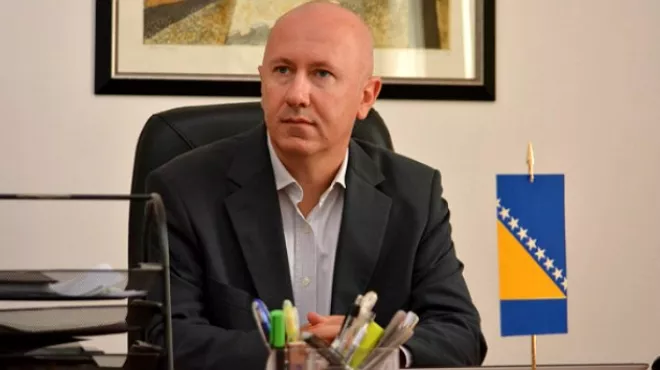
Vice President of the FBiH, Milan Dunović, in an interview with the Patria agency, talks about the current political situation, the need to respect the Constitution of the FBiH, the referendum in RS, and how, as a representative of the Democratic Front in the executive branch, he encounters constant obstruction.
Patria: In recent times, ideas about merging cantons, or the "restructuring" of the FBiH, have been heard more and more loudly, under the guise of reducing administration. How do you view such announcements, and is there another intention hidden behind them?
Dunović: The "restructuring" of the Federation of BiH is an abundantly exploited topic recently, and I believe that the main goal of those initiating this topic is to achieve war aims and the "rounding off" of ethnically pure territories. In today's political life, both in the Federation of BiH and in the RS, there is less and less talk, even declaratively, about citizens. National leaders, as they call themselves, the presidents of national parties, believe that their obligation in political action is actually to protect the vital national interests of the people, but only of the constituent people to whom they themselves belong by birth. They think, speak, and behave as if Bosnia and Herzegovina is a state in which only collective rights of peoples exist, but not the rights of citizens, people, neighbors, and acquaintances who struggle with everyday problems.
Now, the aforementioned leaders, in the name of all of us, the citizens of the Federation of BiH, take the liberty to explain to us how the FBiH should be reorganized with the aim of reducing administration. None of the aforementioned genuinely wants to tell the citizens of the Federation of BiH, and of the whole of Bosnia and Herzegovina, that proposing a reduction in the number of cantons and creating so-called mega-cantons has nothing to do with reducing administration and improving the functioning of the Federation of BiH. It is, in fact, an HDZ plan to establish an administrative unit in which members of the BiH Presidency would be elected in the way the HDZ wants, in which the management of public enterprises would be of one nationality, in which only party cadres would work in public administration, and so on. I believe it is irrelevant whether that administrative unit would be called "Herceg-Bosna" or "Megacanton" when it is clear to everyone that this is about the third entity.
Patria: In the current coalition of SDA, SBB, and HDZ BiH, it is clear who is in charge, so the question arises whether this idea of Dragan Čović will pass without a decisive stance of "Bosniak unity." We could even say that it has met with certain approval from the SDA president, Bakir Izetbegović.
Dunović: It is clear that the HDZ is the initiator of the idea of restructuring the Federation of BiH, which is in line with the policy they have been publicly promoting lately. However, what I consider a big problem and a complete turn in the vision of the future of Bosnia and Herzegovina is that the aspirations for a third entity have found fertile ground in the ruling political Sarajevo. I am primarily thinking of a good part of the SDA that agrees to the division of our only homeland into three parts, but I am also thinking of the SBB, which is supposed to fulfill one single task, and that is to engage its media-voting machinery to achieve the SDA's desire to satisfy Čović's needs. I deliberately say media-voting machinery because I think one cannot go without the other. Namely, a good part of SDA and SBB voters in no way want the division, neither of the Federation of BiH into two entities, nor further division of BiH.
Now, through the media, they are trying to brutally control the thinking of the average, patriotically oriented voter, primarily from the Bosniak corpus. I believe that this is the goal of "Bosniak unity," which ultimately, for the umpteenth time, fulfills Dragan Čović's wishes.
Personally, as the Vice President of the Federation of BiH, I will never agree to divisions on a national basis, and I believe that the citizens of BiH understand that calls for national divisions, which we have been hearing in recent months from some political party leaders, wrapped in the cellophane of reforms, are not our future. I sincerely hope that more and more citizens of BiH will start to believe their own eyes and that they will prevent further divisions that are being served to all of us through democratic means, using their right to vote.
I am always in favor of reforms, reducing administration, a better business environment, a better educational system, but never for unconstitutional laws under the guise of reforms, increasing administration by appointing politically suitable individuals to leadership positions in state civil service, introducing additional burdens for entrepreneurs, and not collecting taxes because the FBiH Government passes conclusions that laws do not apply to certain companies that are "close" to them, two schools under one roof, and all other plans intended for the citizens of the Federation of BiH. Categorically NO to such plans, and I will insist on that.
Patria: You are in a specific situation, holding the position of Vice President of the FBiH even though the DF has left the government and SBB has joined the coalition. What is your relationship with the President of the FBiH, Marinko Čavara (HDZ BiH), and Vice President Melika Mahmutbegović (SDA)? Do you have joint meetings, and what do you discuss?
Dunović: I must admit that functioning on such a principle is quite a challenge. Political life in Bosnia and Herzegovina could have been defined for years as "finishing" tasks through party colleagues in the executive branch. As strange as it may sound, I believe that the fact that I am the only DF official in an executive position throughout BiH has accelerated my political maturity. I haven't had the time or space not to get involved in my work. I encounter various obstructions, disrespect for my political views from members and the Prime Minister of the FBiH Government, political sabotage, and unfairness in performing daily tasks. A fact that sufficiently supports what I have stated is the seven requests for constitutionality review that I have submitted to the Constitutional Court of the FBiH in my work so far, in just over a year and a half.
In the Federation, it has become common to violate the Constitution and for no one to bear the consequences. I have often been called a reform obstructionist because of the appeals filed with the Constitutional Court, but the essence is that I am the only one out of a total of 6 authorized appellants (the President and two Vice Presidents of the FBiH, the Prime Minister and two Deputy Prime Ministers of the FBiH Government) trying to draw attention to the violation of the FBiH Constitution, because I believe it is unacceptable in the 21st century to live by the principle of political force and outvoting at all costs. This, in a way, answers part of the question regarding cooperation with colleagues Čavara and Mahmutbegović. Politics is the art of the possible, so I try to ensure that operational matters requiring the consent of all of us are done as well as possible and within the given deadlines.
In other matters, I must admit that my commitment to implementing the Constitution of the FBiH is not recognized by them as something positive, but on the other hand, it is understandable to me, though unacceptable, that these may not be their personal views, but the views of their party leaders. I don't have such a problem, because the president of the Democratic Front, Mr. Željko Komšić, just like me, believes that respecting the Constitution is something that is above party policies and goals. I derive additional satisfaction from working in this way and from the fact that the DF is a party that, not only declaratively but also substantially, shows with every move that the interest of the state is always above the interest of the individual and the party.
Patria: The coalition in the FBiH is "cracking" on important issues. The Law on Games of Chance, the rights of veterans, the law on forests... What do you think is the real cause: the interest of each party or something else?
Dunović: All of the above! A prosperous society cannot be built on the principle of mistrust, satisfying party and personal interests, outvoting, invoking national endangerment, and so on. I believe that a true partnership has never existed, for the simple reason that there is no common state-building denominator among the coalition partners who are now in power. In fact, there is nothing, except the desire for domination, but economic and national domination over those who are different from oneself. The bigger problem will be answering the question of what we will do if this coalition is stable. Stability can only be built around common ideas. I think they will very soon, immediately after the elections, be united by a common goal: the complete dissolution of the state and the dubious sale of all state resources. Then we will all feel the stability of the coalition.
Patria: How do you comment on the situation surrounding the referendum in RS, and what is the position of Serbs in the FBiH on this issue who live outside of RS? Is there pressure from RS on Serbs who, for example, live in Sarajevo?
Dunović: There has been so much talk about the referendum that, as someone who makes great efforts to send certain matters for review to the Constitutional Court of the FBiH, I am terribly concerned by the fact that the Constitutional Court of BiH is being attacked. What is being done with the decisions of the Constitutional Court of BiH is completely anti-Dayton, and even some media outlets are being put in a position to debate the court's decisions. The Constitutional Court has made a decision, and there is nothing more to say. There is no higher instance that can review it. That's how it is, and the decisions should be implemented.
Politically speaking, RS denies the existence of Serbs in the Federation of BiH. The leadership of RS in no way tries to positively influence the cultural, economic, or any other aspect of the lives of citizens of the FBiH who are of Serb nationality. They also consider me an illegitimate representative of Serbs in the Federation, and I have said many times that this is absolutely true, because there are no representatives of peoples, and thus no representatives of Serbs in the Federation of BiH. I was elected Vice President of the FBiH through a legal procedure, from among the Serb people. My constitutional obligation is to represent all citizens of the Federation of BiH, not just Serbs. Likewise, members of the BiH Presidency are not representatives of peoples and constantly violate the BiH Constitution when they say they represent one people. This should be clearly stated, and efforts should be made to stop the members of the BiH Presidency, as well as all other politicians in the executive and legislative branches, from counting bloodlines, and to force them through democratic procedures to start doing their jobs, for which they are well paid.
Komentari (0)
Prijavite se za komentiranje
PrijavaJos nema komentara. Budite prvi!
Minuta
Sve →Iz drugih kategorija

High Representative Not Elected: Germans, French and British Sabotaged Americans, New Attempt at End of June

ČOVIĆ WITHOUT MERCY: How Those Who Brought Ademović to Office Created a Political Hell for Him



Sunny Saturday, quite warm



Tragedy in Albanian resort: Two minors drown












