
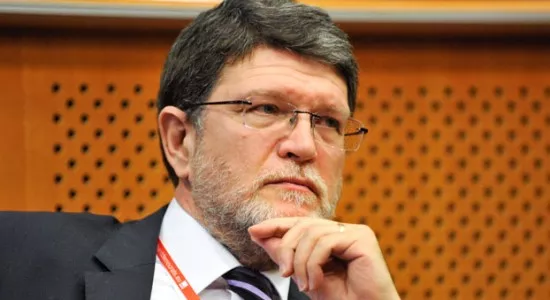
Tonino Picula, a Croatian politician and Member of the European Parliament, speaking today with Aleksandar Stanković on the show “Nedjeljom u 2“ on Croatian Radio Television, said that Dodik's statement that the secession of Crimea is a roadmap for how RS should act in BiH can be interpreted as a continuation of his attempts to keep the issue alive. However, Picula believes that Dodik's caricatured statement will not change anything in the real balance of power, reports the BiH news agency Patria (NAP).
Even according to the Dayton Agreement, Picula says, Republika Srpska cannot hold a referendum on secession from BiH.
Commenting on the overall situation in BiH, Picula said that BiH is the most complex and open issue that can affect the stability of the entire region, and that the international community must help resolve the issue of BiH.
- It is clear that BiH is now in an impossible situation. The Dayton Peace Agreement was a good ceasefire agreement, but it is an extremely poor document on the basis of which you can develop a functional state, a multi-ethnic state, a state of modern institutions, a prosperous economy – Picula believes. He believes that the situation in BiH can only be changed through international mediation, and not by relying solely on domestic politicians.
- If we expect politicians in BiH to initiate things from a standstill on their own initiative, we will be waiting for a long time – said Picula.
When asked by journalist Stanković how it is possible that Kosovo could gain independence, but Crimea cannot, and why the international community has different criteria, Picula said that the cases of Crimea and Kosovo are not at all the same.
- By the 1994 Agreement, the so-called Budapest Memorandum, signed by Great Britain and the USA, the Russian Federation guaranteed the integrity and territorial integrity of Ukraine in exchange for its renunciation of nuclear weapons. Because, at the time of the collapse of the Soviet Union, both Kazakhstan and Ukraine were nuclear powers. But, under pressure from the West, they renounced their nuclear weapons and deposited them back in Russia. And, it seems to me, in 1997, another agreement was signed between Kyiv and Moscow in which the Russian Federation guaranteed Ukraine's right to integrity within its entire territory.
Kosovo is something else entirely. It was, in a way, a semi-republic within the Yugoslav system. The 1974 Constitution, in a way, guaranteed it. After all, based on that 1997 Constitution, Croatia also rightfully received the stamp for its sovereignty – explained Picula.
Komentari (0)
Prijavite se za komentiranje
PrijavaJos nema komentara. Budite prvi!
Minuta
Sve →Iz drugih kategorija

High Representative Not Elected: Germans, French and British Sabotaged Americans, New Attempt at End of June

ČOVIĆ WITHOUT MERCY: How Those Who Brought Ademović to Office Created a Political Hell for Him



Sunny Saturday, quite warm



Tragedy in Albanian resort: Two minors drown












