Written by: Rasim Belko
Sarajevo has again been caught in the same place where history has found it so many times – at the moment when it thinks something has ended, while in fact only the scenery is changing. The verdict against Milorad Dodik has ignited a smoldering, suppressed euphoria in the minds and corridors of official Sarajevo.
The same euphoria that hides behind serious facial expressions at press conferences and analytical grimaces in TV studios. As soon as the verdict became final, Dodik turned from a political phenomenon into a national obsession. From ministers, through political commentators, to every housewife with internet access – everyone has gained the right to speculate whether and how “Mile” will leave the political scene.
And the truth? The truth is that no sane person believed Dodik would leave without a fight. A man who built his political career on permanent confrontation, and who knows that his political existence also means his personal freedom, does not leave peacefully, orderly, and quietly. That is known both by those who love him and those who cannot stand him.
What is concerning is not Dodik’s persistence, but our superficiality. Political Sarajevo behaves as if the verdict is his political execution, rather than just another episode in a series that has several planned seasons ahead.
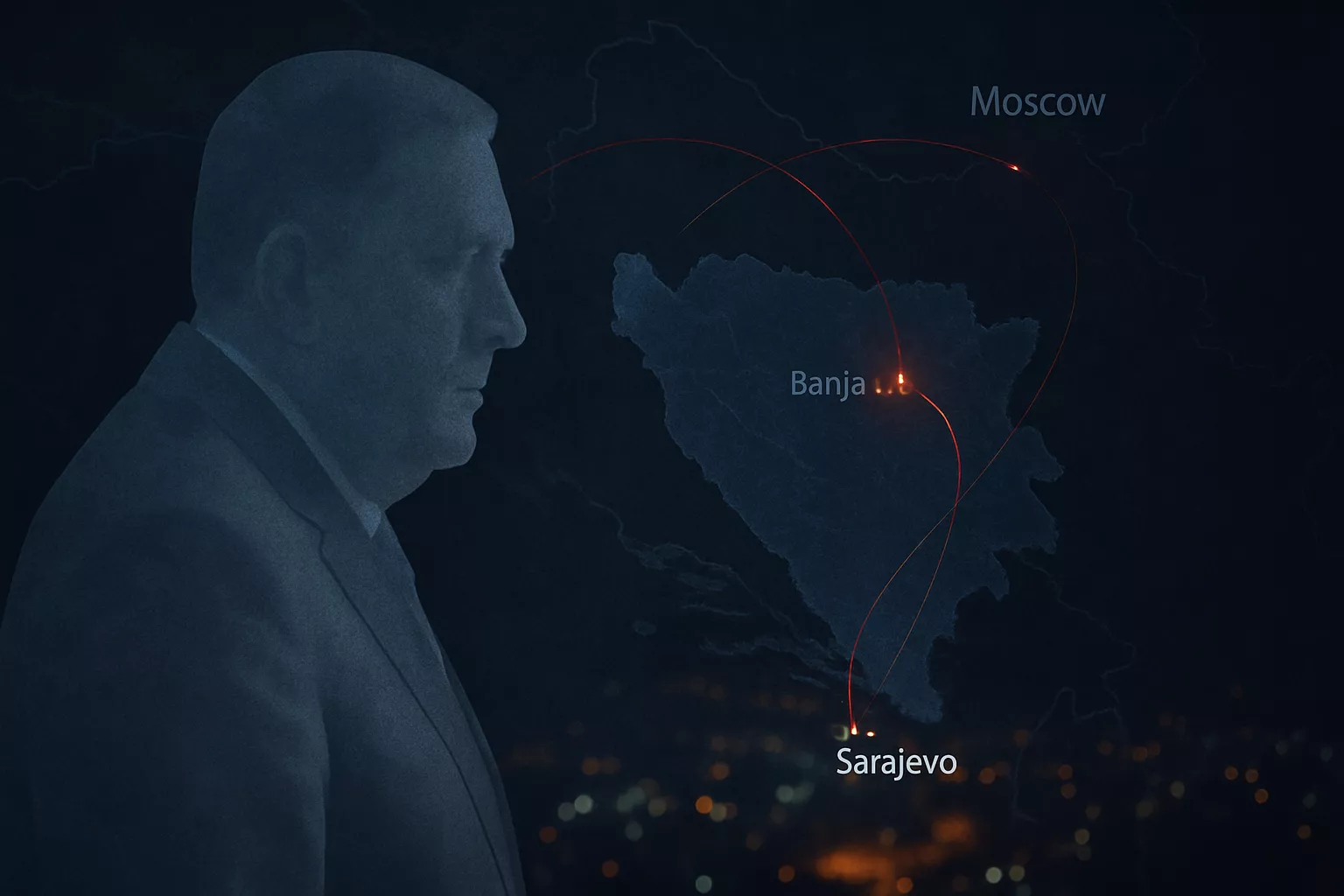
The key thing is being forgotten – Dodik is not the cause, he is only a symptom. One of the phases of a project that has been ongoing for decades and which in political vocabulary bears the name “Serbian world.” He is the face we recognize, but behind him stands an apparatus of ideas, personnel, and centers of power whose roots do not stop at the entity line but lead straight to Belgrade, and partly to Moscow.
And here we come to the essence of the problem: the leaders of the pro-Bosnian political bloc have no plan for the day after Dodik. There are no outlines of an agreement, no red lines, no list of demands that would serve as the basis for political dialogue with those who come after. Instead, they have become commentators on their own destiny, spending energy on questions of “when” and “how” Dodik will leave, as if his departure alone will solve anything.
It will not.
Even when he is no longer on the political scene, those who come after him will be products of the same nationalist workshops, only with different packaging. Perhaps less arrogant in front of cameras, perhaps more polished in language, but equally dedicated to a goal measured in territories, powers, and the weakening of Bosnia and Herzegovina.
Therefore, Dodik’s departure, if and when it happens, is a moment that must not be understood as relief but as an opportunity. Perhaps the last opportunity for pro-Bosnian politics to define what it wants, where its boundaries are, and how it will react when someone tries to cross them. Because right now, political Sarajevo has none of that. Today it wanders between the trivial conclusion that “it doesn’t matter if Dodik remains at the head of the SNSD” and the childish hope that the verdict solves everything.
And the key question hangs in the air: can a political elite be gathered that has real electoral and political legitimacy, and that would sit down at a table marked “the interest of the state of Bosnia and Herzegovina” – to define a unified approach towards those who come after Dodik? Without that point, everything else is mere improvisation.
That approach should imply that every future partner from Banja Luka must accept the full territorial integrity and political sovereignty of Bosnia and Herzegovina, the inviolability of its borders, full respect for the institutions of the state of Bosnia and Herzegovina, recognition of the verdicts of international and domestic judicial instances, the Euro-Atlantic integration of the state... Because these issues should not be part of dialogue, but assumed facts for all who wish to be partners.
One must not be even slightly naive – Belgrade and Moscow will not stop shaping politics in Banja Luka just because one name has been crossed out. They will not. Therefore, Sarajevo must wake up from the role of a obedient housewife to the international community, which here plays the patriarchal master of colonial Bosnia and Herzegovina, and start behaving as a subject, not as an object of events.
If even then, at that moment of change, we do not have a vision, then perhaps we deserve to have our history written by others. Because Dodik is not the end of the film. He is just one scene. And the question is – will we continue to be extras, or will we finally take the leading role.
Komentari (0)
Prijavite se za komentiranje
PrijavaJos nema komentara. Budite prvi!
Minuta
Sve →Iz drugih kategorija

High Representative Not Elected: Germans, French and British Sabotaged Americans, New Attempt at End of June

ČOVIĆ WITHOUT MERCY: How Those Who Brought Ademović to Office Created a Political Hell for Him



Sunny Saturday, quite warm



Tragedy in Albanian resort: Two minors drown












