
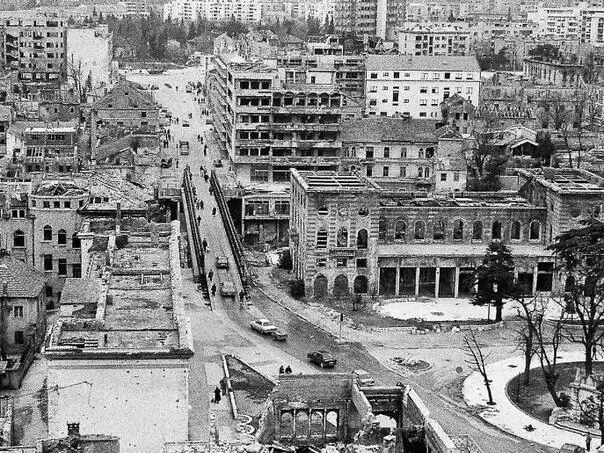
At dawn on May 9, 1993, as the whole world was preparing to mark Victory Day over Fascism, as Europe was preparing to celebrate its day, a general attack by the forces of the Croatian Defence Council (HVO) and the Croatian Army (HV) on Mostar began.
The eastern part of the city and its inhabitants were fired upon with all available means, and a proclamation from the HVO was heard on the radio, calling on members of the Army of the Republic of Bosnia and Herzegovina to surrender, and all citizens of Mostar of Bosniak nationality to hang white sheets.
The city was subjected to a brutal aggression by the forces of the Croatian Defence Council and the Croatian Army. It was a sudden, massive attack on the forces of the Army of RBiH, calculated with the aim of establishing the self-proclaimed para-state entity of “Herceg-Bosna” in the Neretva valley through a swift military solution, and making Mostar the capital city of the envisioned “Croatian province”. On that day, at dawn, the bombing of civilian settlements in the eastern part of the Neretva began from the western outskirts of the city. Simultaneously, before the merciless machine of the Croatian Defence Council members, a systematic campaign of arrests and persecution of entire Bosniak and other non-Croatian families from western settlements towards the eastern quarters of Mostar began.
Many men were killed in front of their homes, and thousands of military-age men ended up in mass concentration camps that day and in the following days, such as Heliodrom, Dretelj, Gabela, Čapljina, Ljubuški, Široki Brijeg, Grude… From those pogromist dungeons, where many left their bones, most of the detainees were practically displaced all over the world.
One of the bloodiest sieges of a city in history began that day.
The few and poorly armed fighters of the Army of RBiH stopped the numerically superior aggressor at the initial positions. The forces of the Army of BiH halted the advance of Croatian units in the very center of Mostar, along the entire main city thoroughfare, Bulevar narodne revolucije. That street became a symbol of the resistance of Mostar residents throughout the entire nine-month merciless Croatian aggression, with a classic military siege accompanied by power outages, telephone traffic disruptions, and the cutting of all supply lines for water, food, medicine, and other necessities. The forces of the Army of BiH had to defend the city simultaneously from Croatian and Serb military forces, while the siege affected at least 60,000 residents of Mostar, including numerous refugee families from eastern Herzegovina.
Attack on Vranica
On May 9, the attack on the command of the 41st Glorious Brigade and the 4th Corps in the “Vranica” building began. After a heroic resistance, on May 10, 1993, members of the HVO captured 13 members of the Army of BiH who were attempting to break out of the surrounded Command. Television footage of their capture and a report by HTV journalist Dijana Čuljak, were seen around the world.
For a full fifteen years, the families of the captured members of the Army of BiH searched for their fate, until their bodies were found in the Rimski bunar pit near the village of Goranci above Mostar, a secondary grave to which they were transferred after torture and murder at the headquarters of the HVO Military Police at the Faculty of Mechanical Engineering in Mostar. On May 9, 2008, a joint funeral and burial was held for 10 members of the Army of the Republic of Bosnia and Herzegovina (ARBiH) from the ‘Vranica 93’ group.
Double Aggression
Although without sufficient weapons and ammunition, with meager rations of food and water, members of the Army of BiH wrote an unimaginable and unforgettable epic of struggle from May 9, 1993, to the middle of winter 1994, for the defense of the freedom of their city, the state of Bosnia and Herzegovina, for the values of dignity and civilizational achievements that all of Europe cherishes. The defense strategy of Mostar, organized in a narrow strip of territory between Croatian forces on the western sides and Serb forces on the eastern slopes of Podveležje and Nevesinje, became an unavoidable topic in the research and studies of foreign military academies.
In impossible conditions of constant artillery fire on civilian objects, the fighters of the Army of BiH and the Ministry of Internal Affairs of RBiH, although poorly equipped and few in number, despite heavy casualties, managed to defend Mostar and the civilian population, as well as the state of Bosnia and Herzegovina in these areas.
Recognition from Anti-Fascist Europe
On May 9, 1995, for the first time in its history, Bosnia and Herzegovina received an invitation to participate in the military parade in Paris on the occasion of Victory Day over Fascism.
The Army of RBiH thus received recognition for the struggle it waged and became part of the European anti-fascist family. The honor of carrying the flag of Bosnia and Herzegovina fell to the celebrated commander of the 41st Glorious and Knightly Brigade of Mostar, Semir Drljević Lovac.
This was recognition for the heroic struggle of the residents of Mostar who, in impossible conditions, defended the statehood of Bosnia and Herzegovina and the principles of coexistence in these areas. On May 9, 1995, in Paris, the entire anti-fascist world applauded a small country that stood up to the awakened specters of fascism.
The flag carried by Semir Drljević Lovac is the flag under which the best sons of Bosnia and Herzegovina died with the same motives as the anti-fascists 50 years earlier.
111 Years of Shame
Mostar received legal satisfaction related to the events of the war in the nineties. First, in 2013, a first-instance verdict was delivered in the case of six political and military leaders of the so-called “Herceg-Bosna”, who were sentenced to a total of 111 years in prison. Five years later, in November 2017, the first-instance prison sentence was confirmed, and within the final verdict, the Hague Tribunal added responsibility for the Joint Criminal Enterprise (JCE), which practically designated the Republic of Croatia as a participant in the international conflict on the territory of the independent and sovereign state of BiH, while the former Croatian president Franjo Tuđman, former Minister of Foreign Affairs Gojko Šušak, and Commander of the Croatian Army Janko Bobetko were designated as protagonists of such an act.
The multi-year court process in The Hague confirmed that the convicted six leaders of the so-called “Herceg-Bosna” were merely executors of the project to expand the Croatian state on the soil of BiH, working for its interests. Individual guilt was assigned to them so that the entire Croatian people would not bear it.
In the collective memory of the citizens of Mostar, May 9, 1993, will be permanently recorded as the time when two irreconcilable ideologies clashed on the banks of the Neretva: fascism from the western side of the city and anti-fascism, which was cherished by the citizens and their defenders in the occupied eastern half of Mostar.
Mostar endured a hellish ordeal for months, but in the end, it survived the bloody aggression and triumphed, thanks to the people who defended their families, their hometown, and the ideas and values of May 9 – Victory Day over Fascism, writes Vijesti.ba.
Komentari (0)
Prijavite se za komentiranje
PrijavaJos nema komentara. Budite prvi!
Minuta
Sve →Iz drugih kategorija

High Representative Not Elected: Germans, French and British Sabotaged Americans, New Attempt at End of June

ČOVIĆ WITHOUT MERCY: How Those Who Brought Ademović to Office Created a Political Hell for Him



Sunny Saturday, quite warm



Tragedy in Albanian resort: Two minors drown












