
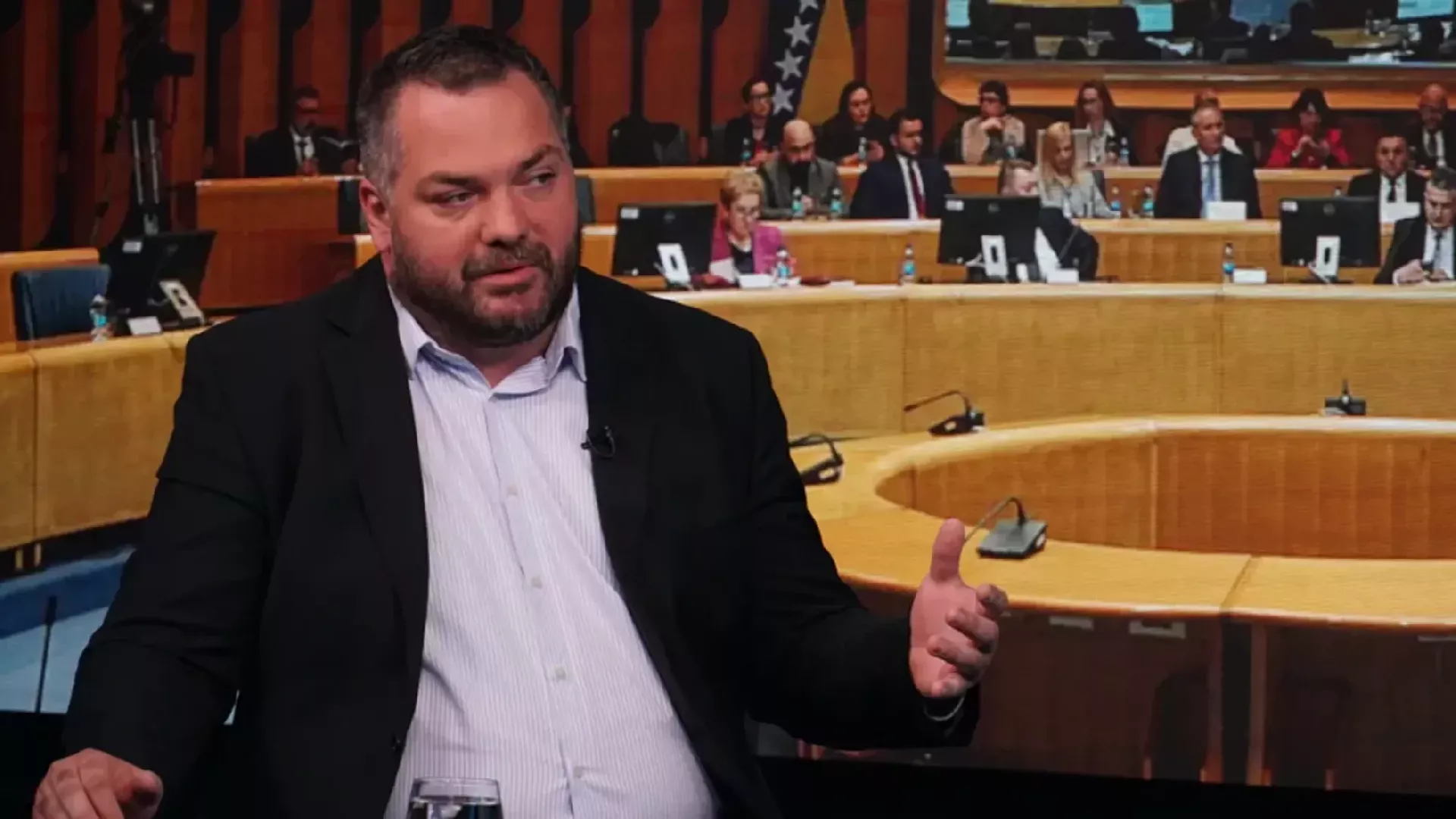
(Patria) - The behavior of High Representative Christian Schmidt is devastating for numerous reasons, one of which is that Bosnia and Herzegovina is no longer in the focus of major world power centers, believes Professor Amel Delić from the Faculty of Administration at the University of Sarajevo.
In an interview with the Patria News Agency (NAP), Professor Delić states that, however counterproductive the current actions of the Office of the High Representative (OHR) may seem for our country, it is still too risky to abandon this institution at this stage.
- Of course, it would be more natural and in line with some contemporary practices in countries around the world not to have, conditionally speaking, a colonial administrator. However, there is a root cause for everything, and that is the very poor attitude of the major world powers towards BiH during the period of aggression, in terms of a certain arms embargo, and unprincipled actions towards those who attacked a sovereign state.
We have ended up in a situation where there was effectively no true victor in the war in BiH, so a certain undefined status remained, with a formal-legal framework that exists nowhere else in the world. More importantly, political parties, and even individuals who committed war crimes and supported the aggression against BiH, were allowed to continue operating within the system – in police bodies, the judiciary, and politics.
Some of them even served as ministers and members of the BiH Presidency, which would be akin to allowing some of Hitler's closest associates to continue operating in Germany after World War II. On top of all this, you don't have the freedom to define your own constitutional and legal framework, and an constitution with many blocking mechanisms is imposed on you. In such an environment, it was entirely natural for a supervisory institution like the OHR to be established - points out Delić.
However, he adds, this also carries a number of risks – from the person appointed to the position, their understanding of the situation in BiH, their competencies, but also, and more importantly, their relationship with key world powers, i.e., the member states of the Peace Implementation Council (PIC).
Our interlocutor emphasizes that what we see in the case of High Representative Christian Schmidt, and some of his predecessors, is that they lacked sufficient capacity, courage, and unilateral support, primarily from world powers like the USA and Russia.
- I am talking about the early years of the High Representative's mandate, when the whole world knew that crimes were committed in BiH and when it was not popular among those world powers to think in a retrograde manner.
The atmosphere has now changed. The transition in Bosnia and Herzegovina has been going on for too long, so even some of those world powers that have positive intentions towards Bosnia and Herzegovina have lost patience.
Some other world powers have become pragmatic, primarily looking at certain economic interests. I am primarily referring to Great Britain and Germany, which are increasingly looking at things from an economic perspective - states Delić.
HDZ BiH Lobbyist
He points out that Russia's and China's positions are different compared to fifteen years ago, so all of this has led to a weakening of the power that the institution of the High Representative held.
- In this mandate, Schmidt has openly positioned himself as a lobbyist for one political structure – HDZ BiH – and carried out certain activities that are not in line with international legal standards and political practices - emphasizes Delić.
He assessed Schmidt's behavior as devastating for numerous reasons, referring to only some of them.
- Unfortunately, the cause is that major world power centers have lost focus on Bosnia and Herzegovina, which has given space for second-rate diplomats, who were susceptible to lobbying by destructive elements in BiH, to play a key role in those power centers.
So, I am not exclusively talking about High Representative Schmidt now, but also about some ambassadors or other international officials. Specifically, Schmidt allowed himself to attend certain (semi)private gatherings of HDZ BiH, and to unprincipledly impose changes to the Constitution and Election Law of BiH.
Nowhere in the world are such things done in an election year, and he did it on election night. Perhaps we are still not fully aware that he has cemented HDZ's position for the next elections.
It is simply impossible to avoid HDZ in future election cycles, given the political reality in Bosnia and Herzegovina, and the existing power structure in the FBiH can, if HDZ wishes, remain in a technical mandate for the next ten years - states Delić.
He points out that citizens of our country may only now begin to feel the real consequences of HDZ's political blackmail, or rather, the actions of High Representative Christian Schmidt.
- Let's not forget that he actively sided against BiH at the European Court of Human Rights in Strasbourg in the case of "Slaven Kovačević v. BiH", when he once again promoted ethnic principles, contrary to the values of the European Convention on Human Rights and Fundamental Freedoms, and contrary to the first-instance judgment of the European Court of Human Rights and six other previous judgments.
So, we see that the latest appeal by Professor Begić goes precisely in this context, that Schmidt consciously acted contrary to the judgments of the European Court of Human Rights, the recommendations of the Venice Commission, contrary to the practice of any developed country in the world, all in favor of HDZ and at the expense of the majority nation and the political will of Bosniaks in the FBiH entity.
Decisions Detrimental to Bosniaks
And what is interesting is that he does not act in any way towards the Republika Srpska entity, except that due to the culmination of the situation caused by Milorad Dodik's behavior, he acted on amendments to the Criminal Code of BiH.
But generally, his mandate remains marked by the fact that he made all decisions to the detriment of the majority Bosniak political body and in favor of the Croatian political corpus, while simultaneously observing neutrally or favorably the separatist activities of the authorities in the Republika Srpska entity.
Definitely, he will not be remembered as a positive figure in the history of this country because he prevented any substantial development. We see that he favored the political power structure that has halted the European integration of Bosnia and Herzegovina.
For a larger part of this mandate, more or less all significant activities in terms of cooperation with NATO have been halted, all thanks to the political climate and legal violence that Schmidt enabled - says Delić.
He reminds that the OHR is defined through an international agreement and certain annexes and agreements that followed as a consequence of that agreement. Therefore, he believes that this institution could not be abolished by decisions of domestic political actors or institutions.
- However, much more important than the person of the High Representative is the support or guidelines they have in key world power centers and the level of seriousness in those discussions.
We will remember Schmidt's predecessor; we said he could be the last High Representative, that he was passive, that he did not react to certain important social situations. And then we essentially got someone worse. Something similar could happen in the case of Max Primorac or a similar candidate.
What is a particular problem is that through skillful strategies and lobbying in important world power centers, the narrative is being imposed that this country is impossible, that Islamic fundamentalism dominates here, that the rights of certain peoples are threatened here.
And then, for example, through the American lobbyists that Dodik has, or through the actions of HDZ Croatia and the entire state of Croatia in European institutions, and even through certain foundations or other organizations, a different picture of the situation in BiH is simply presented in key positions compared to the real situation.
At the same time, there is no adequate institutional response, either from our Minister of Foreign Affairs or the Presidency of Bosnia and Herzegovina, or any lobbying or other strategic action that would present this information correctly.
Even the academic community should be criticized here for being insufficiently active, especially outside of Bosnia and Herzegovina, in presenting arguments about the aggression, the Dayton period, and the current moment. This gives space to certain groups to exploit it and present the situation in a way that is detrimental to our country, Bosnia and Herzegovina - concludes Delić in an interview with NAP.
(D.K.)
Komentari (0)
Prijavite se za komentiranje
PrijavaJos nema komentara. Budite prvi!
Minuta
Sve →Iz drugih kategorija

High Representative Not Elected: Germans, French and British Sabotaged Americans, New Attempt at End of June

ČOVIĆ WITHOUT MERCY: How Those Who Brought Ademović to Office Created a Political Hell for Him



Sunny Saturday, quite warm



Tragedy in Albanian resort: Two minors drown












