
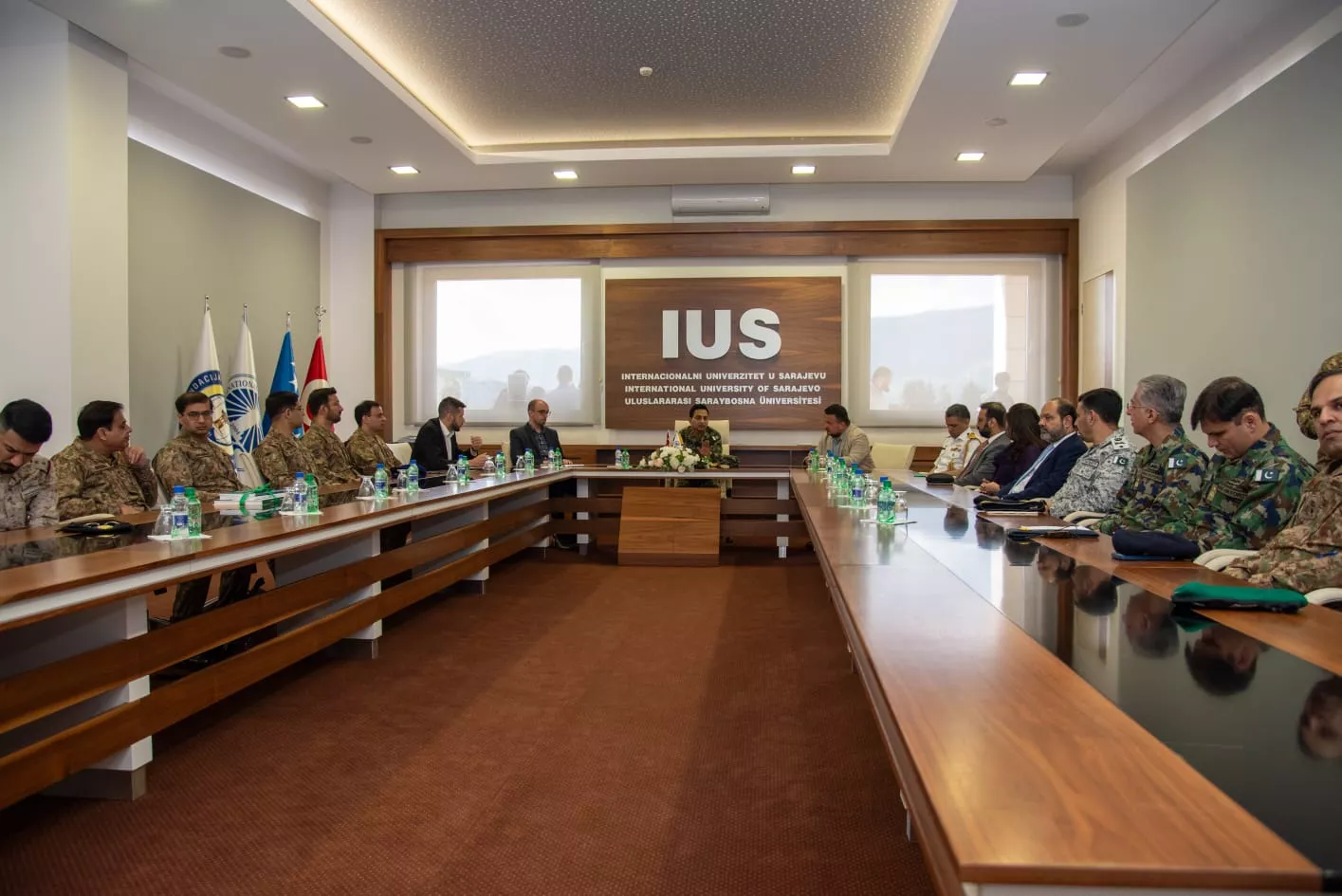
(Patria) - A delegation from Pakistan's National Defence University (NDU) visited the International University of Sarajevo on May 9, 2025.
The delegation was led by Brigadier General Bakhti Baidar Wali Lone of the Pakistan Army.
The hosts of the visit were IUS Vice-Rector Tarik Namas and Assistant Professor Dr. Hamza Preljević, Coordinator of the Political Science and International Relations study program and Director of the Center for Balkan Studies.
In his welcoming speech, Dr. Preljević expressed sincere gratitude to Pakistan, recalling its consistent support for Bosnia and Herzegovina during and after the war in the 1990s.
"Pakistan, as a brotherly country, holds a special place in our hearts. We will never forget the support you provided to Bosnia and its citizens in our most difficult moments," he said.
Moderating the session, Dr. Preljević also drew parallels between the geopolitical challenges facing both countries, condemning the aggression against Pakistan and highlighting the shared experience of facing external pressures despite efforts to normalize regional relations.
In his presentation, he gave a brief historical overview of Bosnia and Herzegovina's post-war trajectory, recalling the devastating war that followed the declaration of independence and accession to the United Nations in 1992. He emphasized the atrocities committed during the war and the challenges that continue to arise from the highly complex and decentralized political structure established by the Dayton Peace Agreement. Speaking about Bosnia and Herzegovina's foreign policy priorities, Dr. Preljević highlighted the importance of NATO membership, emphasizing that "it provides much-needed security guarantees in a fragile and unpredictable regional context".
The academic presentation continued with a series of expert lectures by IUS professors, who offered deeper insights into Bosnia and Herzegovina's internal and foreign policy challenges.
Prof. Dr. Mirsad Karić presented a detailed overview of Bosnia and Herzegovina's political and constitutional system, emphasizing the complexity and challenges of the current institutional framework. He explained how the Dayton Peace Agreement established a decentralized structure consisting of two entities, ten cantons, and the Brčko District. Karić pointed out the difficulties such a system presents for effective governance, decision-making, and reform implementation. He also spoke about the role of the Constitutional Court and the frequent political blockades caused by ethno-national vetos, which hinder the country's Euro-Atlantic integration.
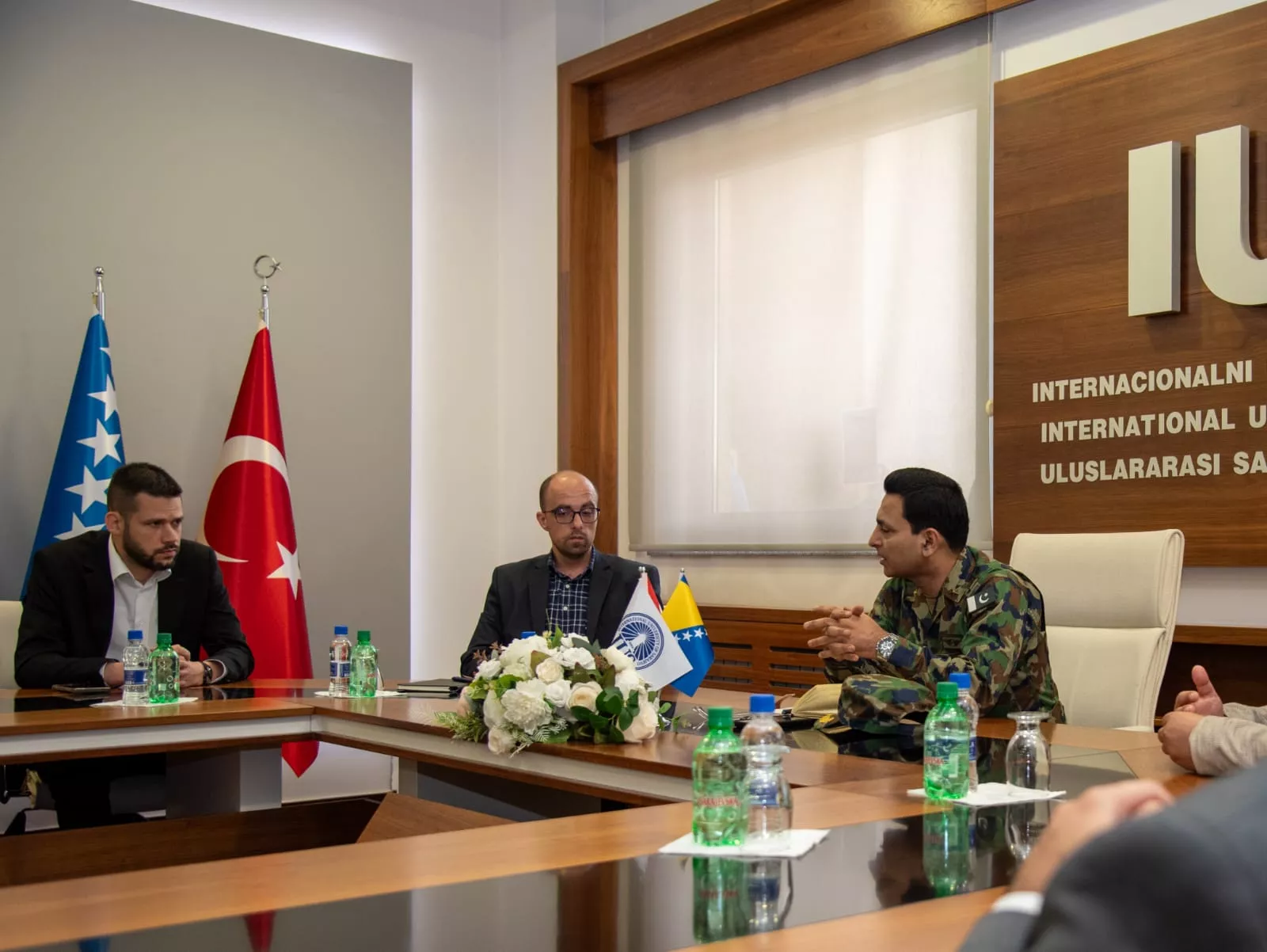
Assistant Professor Dr. Mirza Ljubović focused on the issue of secessionism and the contested nature of the right to self-determination within Bosnia and Herzegovina's constitutional framework. He critically analyzed the legal and political implications of secessionist rhetoric, particularly that emanating from Republika Srpska. Ljubović emphasized that such discourse poses a threat to the state's sovereignty and territorial integrity and undermines the spirit of the Dayton Agreement. He also pointed out the tension between international legal norms and domestic constitutional law when interpreting the right to self-determination in post-conflict states.
Assistant Professor Dr. Jahja Muhasilović analyzed the broader geopolitical context of the Western Balkans, with a particular focus on the growing influence of Russia and China in the region. He explained how both powers use economic tools, soft power, and political narratives to expand their presence and undermine Western integration processes. Muhasilović stressed that Bosnia and Herzegovina, due to its internal fragmentation and fragile institutions, is particularly vulnerable to foreign influences. He highlighted the need for stronger strategic alignment with NATO and the EU to resist destabilizing influences and preserve regional stability, and the need to build a multi-vector foreign policy for BiH, which inevitably means stronger relations with friendly Pakistan, which has proven to be a friend of our country during its aggression.
Prof. Dr. Mehmed Ganić provided an overview of Bosnia and Herzegovina's economic situation, discussing its structural weaknesses but also areas with growth potential. He touched upon high unemployment, a stagnant labor market, and the brain drain affecting the country's long-term development. Ganić also pointed to sectors with promising prospects, including tourism, energy, and digital innovation. He emphasized the importance of strengthening economic resilience and creating conditions for sustainable development, especially in light of regional security and political uncertainties.
Komentari (0)
Prijavite se za komentiranje
PrijavaJos nema komentara. Budite prvi!
Minuta
Sve →Iz drugih kategorija

High Representative Not Elected: Germans, French and British Sabotaged Americans, New Attempt at End of June

ČOVIĆ WITHOUT MERCY: How Those Who Brought Ademović to Office Created a Political Hell for Him



Sunny Saturday, quite warm



Tragedy in Albanian resort: Two minors drown












