
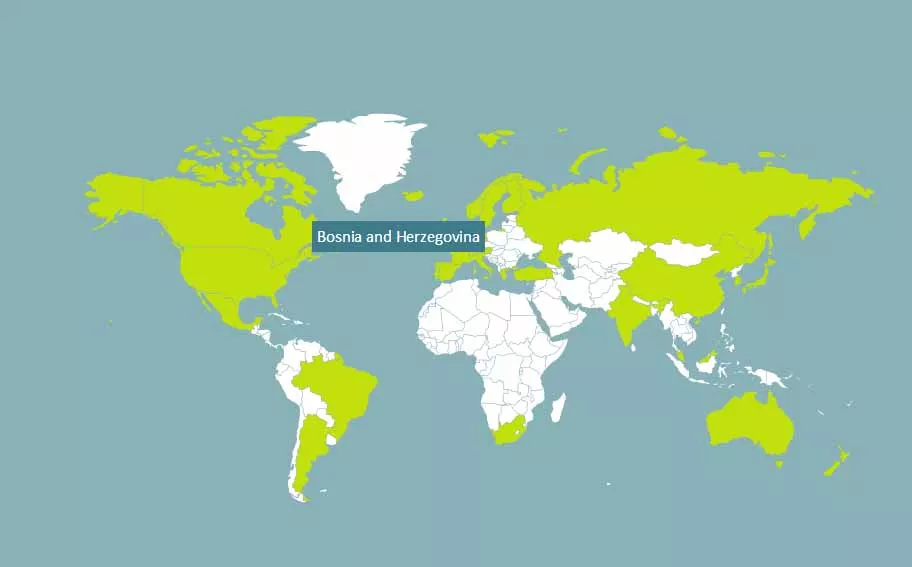
The Banking Association of BiH stated in mid-November that BiH had ended up on the European Union's "black list", which, they stated, has slowed down or completely prevented business between companies and banks in BiH and other countries.
The Council of Ministers of BiH denied the Banking Association's claims. The state government announced that BiH is on the grey list, not the black list, of the EU, which they claim is a huge difference. Furthermore, if BiH continues to fulfill its obligations, it could soon be removed from the grey list as well, the Council of Ministers is optimistic.
- In the coming period, the remaining recommendations of FATF (the intergovernmental body for combating money laundering) set before BiH will be adopted, especially those recommendations that involve amendments to the Criminal Codes in Republika Srpska and the establishment of a state, unified register of all associations and foundations operating in BiH – the Council of Ministers announced.
It is very important for the EU that BiH has a unified database of non-governmental organizations, associations, and foundations, and insight into their work, in order to reduce the possibility of some of them being used to finance terrorist organizations.
After fulfilling these obligations, Bosnia and Herzegovina should no longer be on the grey list.
BiH committed to fulfilling these two obligations by the end of 2016. The Council of Ministers claims that BiH will fulfill its obligations within the set deadline.
How Bosnia and Herzegovina ended up on the EU's grey list, and what that specifically means for companies and banks in the country, was explained to the news agency Patria by Damirka Mioč, head of the BiH delegation to the MONEYVAL committee.
- Bosnia and Herzegovina is on the so-called FATF "grey list", not the black list as has been speculated in the public in recent days – explains Mioč.
FATF and MONEYVAL are key organizations that oversee and monitor the compliance of member states and other jurisdictions in the fight against money laundering and terrorist financing. FATF has greater authority than MONEYVAL.
- The FATF grey list, on which BiH is located, represents a public announcement from June 26, 2015, on the FATF website – explains Mioč, and continues:
- The path to this "FATF grey list" for Bosnia and Herzegovina was significantly longer, actually several years long, and dates back to the identified deficiencies and unfulfilled recommendations from the 3rd round of MONEYVAL evaluations for Bosnia and Herzegovina (measures for harmonization from the period 2009-2014).
Before being placed on the "FATF grey list", MONEYVAL had already placed Bosnia and Herzegovina on its "grey list" on June 1, 2014, for the same reasons.
As the situation did not improve, meaning there was no progress on strategic issues that MONEYVAL dealt with, they nominated Bosnia and Herzegovina to FATF for harmonization at their 47th Plenary Session held in April 2015.
The result of this was the creation of an Action Plan for Bosnia and Herzegovina by FATF, and a high-level political commitment from BiH to work with FATF and MONEYVAL to resolve strategic deficiencies in the area of money laundering and terrorist financing, and the consequence is the public announcement by FATF regarding the aforementioned, i.e., the FATF "grey list".
In order to implement the FATF Action Plan, the Council of Ministers of BiH formed a Working Group that actively monitors the fulfillment of the Action Plan according to the set deadlines, and which includes representatives from all institutions at all levels of government in Bosnia and Herzegovina to which these deficiencies relate.
Also, before each FATF Plenary Session, which are held three times a year, BiH representatives inform the FATF-ICRG group, which monitors the implementation of the FATF Action Plan for BiH, in writing and orally at working meetings about the activities carried out and progress made.
After that, at the FATF Plenary Session, a public announcement is made about the status of the country, especially if there have been changes in the status.
Bosnia and Herzegovina has not experienced any deterioration in its status since the first public announcement in June 2015 until today.
The next working meeting is scheduled for the end of January, and the FATF Plenary Session will be held in February 2017.
In the period from the adoption of the FATF Action Plan until today, the authorities of Bosnia and Herzegovina have implemented a large number of measures foreseen in the Action Plan. We can talk about amendments to about 15 legal and sub-legal acts related to fulfilling the obligations under this Action Plan.
One of the latest activities was the adoption of the Decision on the Implementation of UN Security Council Resolution 1373 (2001) on the prevention and suppression of the financing of terrorist acts, which the Council of Ministers of BiH adopted at its session on September 28, 2016, followed by the session of the House of Peoples of BiH held on November 22, 2016, when the Law on Amendments to the Law on Associations and Foundations of BiH was adopted.
The banking sector is not directly covered by any measure in the FATF Action Plan.
Damirka Mioč explains that the EU list does not currently entail any type of sanctions, termination of business relationships, trade restrictions, or limitations on EU development aid. Its sole purpose is the application of enhanced due diligence measures in these cases, and as representatives of the European Commission in Bosnia and Herzegovina emphasize, the EU will continue to work with countries on the list in all relevant policy areas and through development cooperation, with the ultimate goal of achieving their compliance and removal from the list of countries with certain non-compliance issues.
- From the perspective of financial operations in international payment transactions, in terms of rejecting or terminating business relationships and non-realization of monetary transactions, it is not excluded that individual countries, or their banking institutions, have taken enhanced supervisory measures towards transactions in/from Bosnia and Herzegovina due to the public announcement by FATF, but we cannot speak of systemic interruptions or termination of business relationships in this context. If it occurred in individual cases, it was due to other irregularities or non-compliance with standards in international payment transactions – Mioč believes.
She adds that concrete indicators and analyses of these cases, if any, should be provided by the competent financial institutions in Bosnia and Herzegovina (Central Bank of BiH and entity banking agencies).
It is also important to note that in September 2015, at the 48th Plenary Session of MONEYVAL, the report for the 4th evaluation round for Bosnia and Herzegovina was adopted, and based on the achieved results, i.e., significant progress made in the area of preventing money laundering and terrorist financing, the public announcement for Bosnia and Herzegovina was revised, removing Bosnia and Herzegovina from the so-called "grey list" of MONEYVAL (where it had been since 01.06.2014). This progress was also confirmed at the MONEYVAL Plenary Session in September of this year, so Bosnia and Herzegovina is in the regular reporting procedure regarding MONEYVAL.
In the context of global developments in the fight against money laundering and terrorist financing, Mioč explains that international standards are being raised to a higher level, especially after the terrorist attacks in Brussels and Paris, so significantly more rigorous measures and procedures can be expected towards countries that do not align their legislation or its application in the fight against money laundering and terrorist financing, writes Patria.
Komentari (0)
Prijavite se za komentiranje
PrijavaJos nema komentara. Budite prvi!
Minuta
Sve →Iz drugih kategorija

High Representative Not Elected: Germans, French and British Sabotaged Americans, New Attempt at End of June

ČOVIĆ WITHOUT MERCY: How Those Who Brought Ademović to Office Created a Political Hell for Him



Sunny Saturday, quite warm



Tragedy in Albanian resort: Two minors drown












