
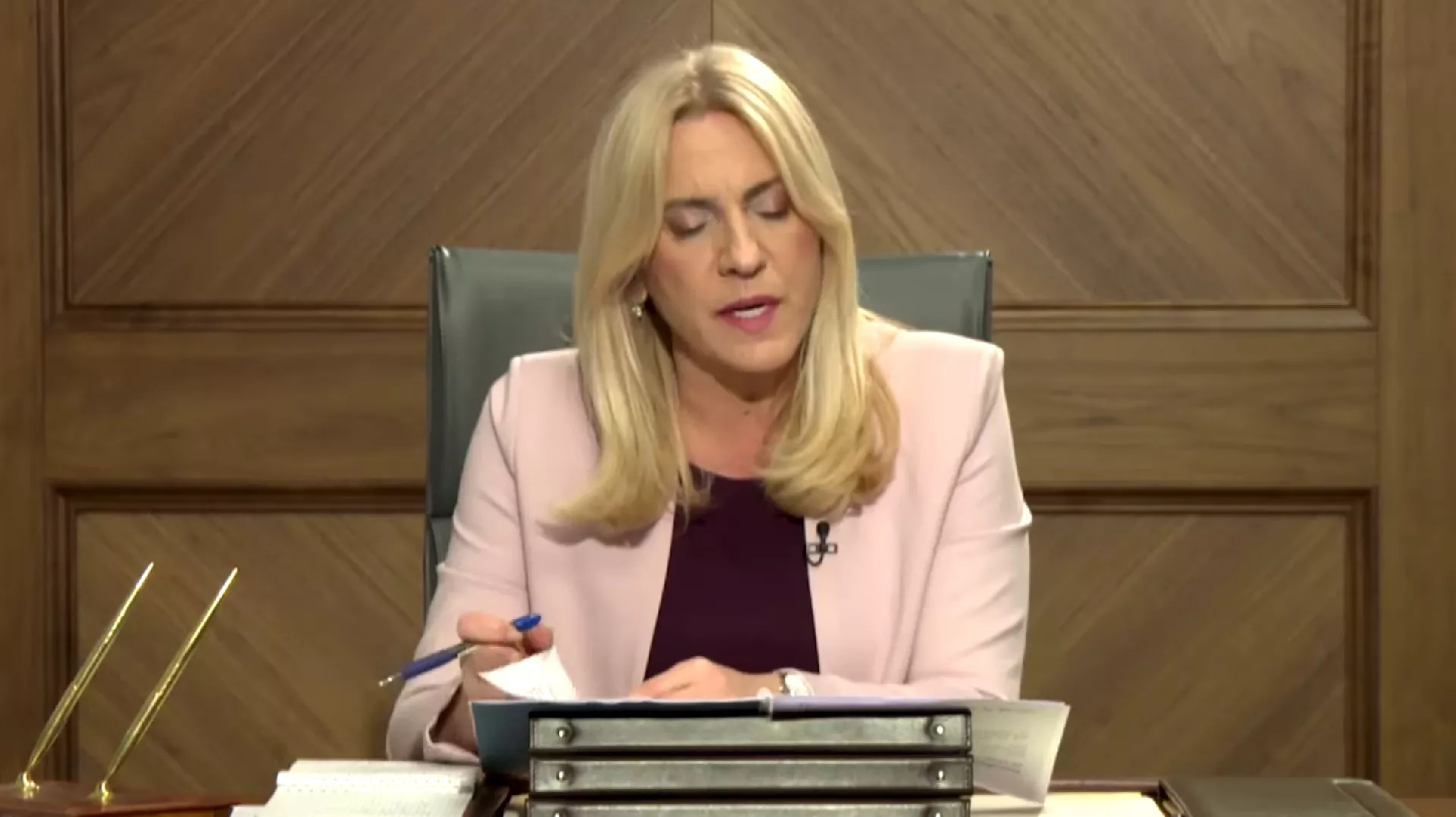
(Patria) - An emergency session began late tonight in New York, where the United Nations Security Council, at the request of Russia, is considering the situation in Bosnia and Herzegovina.
Member of the Presidency of BiH Željka Cvijanović, in her address via video link, stated that Republika Srpska (RS) is not violating the Dayton Peace Agreement or international law.
"BiH is not one electoral unit"
On the contrary, Cvijanović stated, RS is "advocating for strict adherence to the BiH Constitution, as part of the treaty, which leaves most competencies in the hands of the two entities and ensures mechanisms for the protection of their rights for each of the three constituent peoples".
- Also, respect for international law means that High Representatives must be appointed in accordance with the procedures established by Annex 10 of the Dayton Agreement and act within their prescribed mandate - said Cvijanović.
She emphasized that RS advocates for respect for the constitution and the procedures it prescribes.
- It opposes the abuse and circumvention of our institutions and constitutional provisions, as is the case, for example, with the current resolution on the day of remembrance of Srebrenica.
The preparation of this resolution for a vote in the UN General Assembly is being done without any prior consultations and approval from the relevant and competent institutions of BiH - said Cvijanović.
She thanked them for the opportunity to address the Security Council and share her views and perspective on the situation in the country.
- The Presidency of Bosnia and Herzegovina acts as a collective tripartite head of state, and I was elected to that body from RS, one of the two entities that make up Bosnia and Herzegovina - Cvijanović points out.
She reminds that the other two members of the BiH Presidency are elected from the other entity - the Federation of BiH.
- This clearly shows that Bosnia and Herzegovina is not one electoral unit when it comes to the election of common institutions at the BiH level.
The main guardian of peace
This also indicates that the BiH Constitution, i.e., Annex 4 of the Dayton Agreement, was carefully designed to establish a system with two entities with a high degree of autonomy and three constituent peoples, as well as with important mechanisms of power sharing.
These mechanisms guarantee all constituent peoples protection from majorization and equal participation in the governance of the country - stated Cvijanović.
And it is precisely this principle of equality, she adds, that is "the main guardian of peace and stability in our country, not repression, tutelage, or international interventions, as is often wrongly and unreasonably claimed by those who want to justify such international interventionism and their colonial behavior".
- Here, I would like to highlight several critical issues that burden Bosnia and Herzegovina and hinder its progress.
But, allow me to first say a few words about RS and the positions of its institutions, which many often misrepresent in a rather tendentious manner, inside and outside of BiH - Cvijanović conveyed.
She added that RS does not violate the rule of law, nor does it undermine democracy.
- On the contrary, RS is firm in its position that only our democratically elected institutions have the right to pass laws, and that laws cannot and must not be imposed by unelected foreign citizens.
Republika Srpska is committed to peace and stability and wants to see BiH as a truly democratic and sovereign state capable of promoting internal dialogue in search of balanced, constitutionally-based solutions that would suit everyone in BiH.
Unfortunately, the challenges we have faced in recent years threaten to jeopardize not only the BiH Constitution but also the security and stability of the country, and even the entire Western Balkans region.
These threats are directly contributed to by those who persistently keep Bosnia and Herzegovina in a quasi-protectorate status, where the rule of law and democratic governance are bypassed, and autocratic/colonial foreign interventions prevent reconciliation among our peoples - Cvijanović added.
Challenges to peace and stability in BiH
She stated that there are currently several major challenges to peace and stability in BiH, and "most of them are used, in various manipulations, and initiated by foreign and domestic political actors who seek to rewrite the Dayton Agreement, the BiH Constitution, BiH laws, and international law".
These threats to peace and stability, Cvijanović stated, can be divided into the following categories:
1. interference in internal political and democratic processes;
2. resorting to threats of force/violence;
3. disrespect for the rule of law and violation of international law;
4. interference in elections and disenfranchisement of voters.
- At the heart of every dispute within BiH lies a fundamentally contentious issue concerning the nature of the common state. According to Dayton, as well as historically, BiH could only function through consensus-based decision-making, where each people would be protected from being outvoted by representatives of the other two peoples.
Unfortunately, while the Serb and Croat peoples and their elected representatives consistently fight for respect for the Dayton Agreement as it was written and signed, Bosniaks and their elected representatives advocate for a unitary and centralized state - Cvijanović claims.
She points out that "the Bosniak political goal of centralizing BiH is often supported and propagated by foreign actors in BiH".
- Through illegal decisions and coercion, which successive High Representatives have resorted to for years, the constitutional structure of BiH established by the Dayton Agreement has been significantly altered.
In fact, High Representatives, through their actions, have interfered in internal democratic processes and agreements reached by elected and legitimate representatives of the constituent peoples and entities of BiH.
High Representatives, largely on the side of Bosniak aspirations for a centralized state, have violated essential provisions of the Dayton Agreement that provide for the protection and equality of constituent peoples, thereby endangering peace and security in BiH - Cvijanović assesses.
Every sovereign state, she adds, and all democratically elected officials enjoy protection from foreign interference in internal affairs, according to the UN Charter and numerous international treaties and regulations.
- Unfortunately, certain foreign diplomats in BiH and Christian Schmidt, who poses as some hybrid of a "colonial governor" and a typical despot, continuously and with increasingly destructive tendencies interfere in the internal democratic processes and decision-making processes within BiH.
This interference has undermined the political consensus at the common BiH level, which has guided and encouraged BiH's progress on its path to EU membership. Consensus on BiH's EU membership is the only important issue that enables difficult compromises and agreements among all BiH political forces and elected leaders.
Foreign interference
As such, it is of essential importance for maintaining peace and stability within our common state - says Cvijanović.
She points out that other foreign actors, such as the Peace Implementation Council, "which is not part of international law because it is not foreseen by the Dayton Agreement, and individual diplomats accredited in BiH, have similarly interfered in internal affairs and thus assisted the OHR in their illegal actions, and now Schmidt".
- Even the resolution on the day of remembrance of Srebrenica, which is being proposed to the UN General Assembly, is a blatant example of how foreign interference and disrespect for the BiH Constitution undermine peace and stability.
The draft resolution, authored by certain countries and the BiH Ambassador to the UN Zlatko Lagumdžija, reflects a complete disregard for the BiH Constitution and the BiH Presidency, which is exclusively responsible for formulating BiH's foreign policy.
The Presidency has not discussed or adopted this draft resolution; moreover, there is no consensus among our peoples or at any level of government on the text of the resolution, which has been deliberately withheld and hidden from the public.
Most of your countries know that this activity is being conducted in contravention of the Dayton Agreement, but you have simply decided to ignore that fact - Cvijanović told the UN.
She also pointed out that some UN member states consider this resolution to be benign and an act of human compassion.
- However, it is clear that the intention behind it is anything but benign. Professor Francis Boyle, legal advisor to Bosniak political leaders, stated last Friday, April 26, in an interview with a Sarajevo TV network, that after the resolution is adopted by the UN General Assembly, all so-called "pro-Bosnian forces" must unite to use it to abolish RS.
This dangerous statement, unfortunately, reflects the prevailing intention of many Bosniak political leaders and clearly shows that the proposed resolution is destabilizing for peace and stability in BiH - Cvijanović believes.
According to her, it is not surprising that "this type of foreign interference undermines negotiations and compromise within BiH, as it always favors one side - the Bosniak side".
- And while RS officials speak about the necessity of preserving peace and stability and resolving all open political issues within democratic institutions, with certain threats and militaristic statements, Western ambassadors in Sarajevo are trying to instill fear in Serbs, while at the same time giving hope to some radical forces in the Bosniak political leadership that NATO will "solve the problematic" RS by abolishing it.
Helez and Isak threaten violence and war
At the same time, Bosniak officials, such as the BiH Minister of Defense Zukan Helez and the FBiH Minister of Security Ram Isak, are openly threatening violence and war.
Among the numerous inflammatory statements by Minister Helez, two are the most dangerous: that he is creating "reserve" military forces in BiH, and the call to introduce "military training" in BiH schools.
Minister Isak, on the other hand, stated that he will "lead 10 corps" when Republika Srpska is abolished - Cvijanović said.
She points out that Schmidt and foreign ambassadors rarely condemn such threats and calls for violence.
- It should also be noted that the current threat from radical Islamic terrorist cells poses a danger not only to peace in BiH and the Western Balkans but also to the whole of Europe.
Just two weeks ago, police forces in Zenica arrested a person suspected of belonging to a radical Islamic group in FBiH. Local media in BiH also recently reported that Minister Helez allowed foreign nationals and some locals connected to the radical Wahhabi movement to use the Armed Forces of BiH training grounds in Mostar - said Cvijanović.
She believes this is particularly dangerous and irresponsible "because for many years BiH has been identified in foreign media and international security reports as the most dangerous source of jihadist terrorism in Europe".
- Concerns about terrorist threats coming from BiH have been noted by many Western governments and other sources. For example, the US State Department wrote last year: "Terrorist groups continue to plan possible attacks in BiH".
French President Emmanuel Macron, in 2021, speaking about the presence of jihadists in BiH, called the country a "ticking time bomb".
According to data published by the Wilson Center in Washington, BiH had the highest number of citizens among European countries who went to wage jihad in Syria and Iraq.
As we all know, the rule of law is one of the fundamental conditions for peace and democratic governance. Unfortunately, it is persistently violated and ignored in BiH, and this is particularly done by Schmidt and his assistants and accomplices from certain foreign embassies - Cvijanović added.
Komentari (0)
Prijavite se za komentiranje
PrijavaJos nema komentara. Budite prvi!
Minuta
Sve →Iz drugih kategorija

High Representative Not Elected: Germans, French and British Against Americans, New Attempt at End of June

ČOVIĆ WITHOUT MERCY: How Those Who Brought Ademović to Office Created a Political Hell for Him



Sunny Saturday, quite warm



Tragedy in Albanian resort: Two minors drown












