
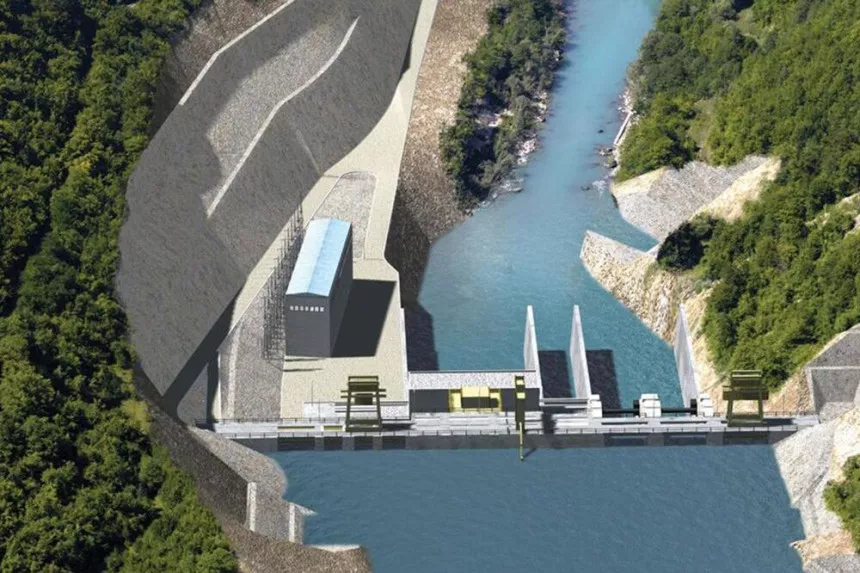
For the Ministry of Energy and Mining, the issue of constructing the "Buk Bijela" hydroelectric power plant was concluded in 2004 with the parliamentary Declaration on the Protection of the Tara River, as well as a 2005 UNESCO report, putting an end to ideas about building hydroelectric power plants in this area that could affect the "Tear of Europe," the ministry stated to "Vijesti" in response to a question about Montenegro's potential participation in the construction of this hydroelectric power plant, for which an invitation was extended last week by the President of Republika Srpska, Milorad Dodik.
"Vijesti" asked the ministry, headed by Saša Mujović, whether Montenegro - EPCG could participate in this project if, according to announcements, the dam height were lower, meaning the reservoir would not extend into Montenegrin territory and would not affect the protected area of the Tara River.
"In Montenegro's strategic documents, this area is not treated in terms of energy, nor in EPCG's business plans. The Ministry of Energy and Mining will not deal with hypothetical situations, but with relevant indicators and documents, and the current legislation of Montenegro which prohibits construction in this area. As for environmental impact assessments, the competent ministry is the one responsible for ecology," the Ministry's response stated.
Last week, at a meeting with the Speaker of Parliament, Andrija Mandić, Dodik invited Montenegro to join the project of constructing the "Buk Bijela" hydroelectric power plant on the Drina River near Foča and to stop blocking it.
A statement from Dodik's office at the time stated that "if there are efforts for Montenegro to return to this project, President Milorad Dodik has expressed his readiness to accept it".
"We are offering Montenegro to join this megaproject. If they don't want to, then they should not block us," Dodik's words were quoted in the statement.
He said that the project does not encroach on or flood waters in Montenegro anymore. He also stated that Montenegro has been posing a problem for Bilećko Lake for a long time, and that they had requested "a meeting to be held in Trebinje with the participation of energy ministers and directors of Elektroprivreda, as well as other important individuals, to resolve this through an agreement".
Đukanović's Agreement, then the Declaration
The Government of Montenegro, chaired by Milo Đukanović, gave its principled consent in April 2004 to build the "Buk Bijela" HE with Republika Srpska. At that time, a high dam was planned, and its reservoir would reach the confluence of the Tara and Piva rivers on Montenegrin territory.
Following this, there were protests from environmental organizations and citizens, who collected over 11,000 signatures against the construction and submitted a petition to the Parliament. In December of the same year, the Parliament, with the votes of the opposition, some minority parties, and the SDP, adopted the Declaration on the Protection of the Tara River.
After that, a new project was developed in RS, which envisioned a lower dam height, and another hydroelectric power plant was added on the Drina River, downstream near Foča. Then, RS and Serbia began the project for their construction, signing an agreement on this in 2020. The financiers would be Elektroprivreda Srbije and Elektroprivreda Republike Srpske through the joint venture "Gornja Drina Hydroelectric Power System".
A tender for contractors was announced, and three Chinese bids were submitted last summer. However, everything was postponed because, in the meantime, two lawsuits were filed – the first before the Constitutional Court of Bosnia and Herzegovina regarding concessions, as the state authorities of BiH believe that property in the border area belongs to the state of BiH and not to the entities, and the second before UNESCO, initiated by Montenegro due to the potential negative impact on the Tara River, i.e., the Tara River National Park.
ERS, EBiH, and Serbia Reached an Agreement
EPCG states that they are monitoring developments regarding these disputes, and that they are aware that the first dispute was recently resolved, as the two power companies, ERS and EBiH, reached an agreement to each receive a 25% stake in this facility, with the Republic of Serbia receiving the remaining 50%.
"Regarding the second dispute, in July 2021, the ministries of ecology of Montenegro and Republika Srpska agreed to form an expert team to examine the potential impact of the 'Buk Bijela' HE on the Tara River in Montenegro. In July 2023, BiH and Montenegro established a joint working group to resolve issues related to the 'Buk Bijela' HE project. The Secretariat of the Energy Community mediated the agreement at that time. The Government of Republika Srpska announced that it would conduct an additional environmental study to analyze the effects of the hydroelectric power plant's construction on the 'Durmitor' National Park in Montenegro, which is protected by UNESCO. The decision of the World Heritage Committee emphasized that BiH must assess the potential environmental impact of the 'Buk Bijela' HE project, planned on the Drina River in BiH, on the high natural values of Durmitor and the Tara River. BiH, Montenegro, and Serbia were asked to maintain the continuity of the river ecosystem and the unimpeded flow of the river, and that BiH and Serbia must also ensure an assessment of potential impacts through a strategic environmental impact assessment, in cooperation with Montenegro," EPCG stated.
According to the Old Plan, Montenegro Was Entitled to a Third
Montenegrin hydrologist Slavko Hrvačević told "Vijesti" that Montenegro's participation in the construction of the future "Buk Bijela" HE is "a matter of agreement between states, respecting all aspects in accordance with the relevant water legislation as well as all other international rules and norms".
"The upper basin of the Drina River has great hydropower potential. The 'Buk Bijela' HE has emerged as the most attractive solution for utilizing this potential, which, as a head power plant, will be the largest power plant on the Drina River in terms of reservoir size, installed capacity, and average production. The location for the construction of the dam and hydroelectric power plant is nine kilometers upstream from the town of Foča, with a backwater level of 500 meters above sea level," said Hrvačević.
He states that according to the old plan from SFRY, its reservoir was planned to be located in the territories of BiH and Montenegro.
"Through mutual agreement, the hydropower potential was divided at that time, so that Montenegro would receive one-third, and BiH two-thirds of the potential. One-third of the reservoir would be located on Montenegrin territory. According to the agreement at that time, Montenegro's participation in financing was not planned. At that time, all analyses indicated that Montenegro should receive 37% of the production. From this, it can be concluded that even though Montenegro's participation in financing was not planned, and thus Montenegro 'contributes' a part of its territory, it acquires rights based on hydropower potential. The events of the 1990s interrupted all activities related to the realization of the planned 'Buk Bijela' HE," said Hrvačević.
Lower Dam, New Study Needed
He states that this project was re-actualized in the early 2000s, but was interrupted in 2004 after strong reactions from the Montenegrin public and the adoption of the Declaration on the Protection of the Tara River.
"Then the authorities of the neighboring country undertook certain activities on a new project for the 'Buk Bijela' HE with a lower maximum backwater level that would reach the border with Montenegro. Regarding the Tara River canyon, it is a unique, protected canyon national park, which is not only formally protected by UNESCO but is also under the most careful scrutiny of the world public, especially very active environmental organizations. At the 45th session of the UNESCO World Heritage Committee, a decision was adopted obliging BiH to assess the potential impact of the 'Buk Bijela' HE project on the high natural values of Durmitor and the Tara River, through an updated environmental impact assessment in close consultation with the state of Montenegro," said Hrvačević.
He states that the Drina River basin and the use of water resources must be viewed through integrated management, meaning that the only correct path is to treat the entire area as a single entity, in order to ensure maximum benefits from the multi-purpose use of water, which is in line with the objectives of the EU Water Framework Directive.
Kreševljaković: BiH Violated Conventions, We Await the Publication of the Decision
Nina Kreševljaković, legal advisor at the Aarhus Center in BiH, who deals with the protection of citizens' rights under the international Aarhus Convention – public participation in decision-making and the right to legal protection in environmental matters, told "Vijesti" that they expect the dispute regarding "Buk Bijela" to be resolved in accordance with international conventions binding on both countries.
"In June 2020, we officially submitted information to the Committee for the Implementation of the Espoo Convention, which relates to the transboundary environmental impact assessment of projects. According to the Espoo Convention, non-governmental organizations can only submit information to the Committee, while only member states can file an official complaint, which Montenegro has done in this case. The reasons in the submitted information related to the fact that Montenegro was not properly included in the transboundary impact assessment procedure during the issuance of environmental permits in 2011 and 2013, as well as during the renewal of the permit in 2019," said Kreševljaković.
She states that an improper assessment of the possible negative impacts of the planned hydroelectric projects on Montenegro and the potential impact on the UNESCO-protected Tara area and the protected huchen fish was carried out.
She also said that Montenegro was not informed about the planned projects during 2012 and 2019, and that the transboundary environmental impact assessment procedure was not carried out in accordance with the Convention.
"In December 2023, the Committee adopted a draft decision determining that BiH had violated the provisions of the Espoo Convention and called on it to conduct a renewed transboundary environmental impact assessment procedure, which would include Montenegro, as well as other countries that could be affected by the project. The publication of the official decision is expected soon," said Kreševljaković.
Komentari (0)
Prijavite se za komentiranje
PrijavaJos nema komentara. Budite prvi!
Minuta
Sve →Iz drugih kategorija

High Representative Not Elected: Germans, French and British Sabotaged Americans, New Attempt at End of June

ČOVIĆ WITHOUT MERCY: How Those Who Brought Ademović to Office Created a Political Hell for Him



Sunny Saturday, quite warm



Tragedy in Albanian resort: Two minors drown












