
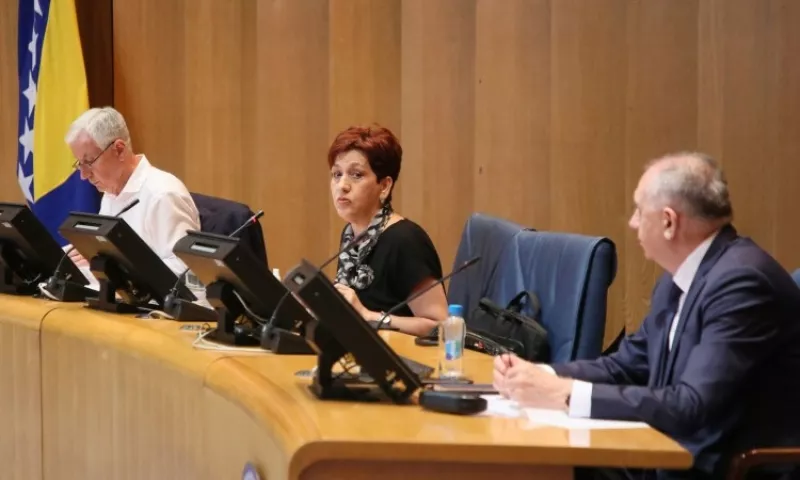
SARAJEVO, (Patria) - Alma Čolo was part of the SDA team participating in negotiations on amendments to the Election Law in Neum. She revealed to N1 how the three-day negotiations went and what she expects after them. She pointed out that she doubts there will be an agreement because, according to her, there is a lack of will on the Croatian side.
Čolo emphasized that after the negotiations in Neum, a meeting was held with political leaders and members of the international community.
"They also came out with a statement that a new meeting should be organized in the next seven to ten days, where we ourselves, without them, should come to a solution. I am skeptical about that," said Čolo.
She stressed that there were moments when it seemed that an agreement would be reached, specifically in the part concerning the integrity of the electoral process.
"We worked in panels, and when it comes to the integrity of the electoral process, it means technological improvement of elections, transparency, etc. The opposition in the Federation of BiH, as well as in Republika Srpska, was also interested in this, and we did quite a lot of work there. The second part was with political leaders, and it primarily concerned the judgments of the Court of Strasbourg and their implementation, i.e., the House of Peoples and the Presidency of BiH, and this involved the implementation of Constitutional Court rulings – Božo Ljubić, which HDZ insists on the most, and there are misunderstandings whether this ruling has been implemented or if the number of delegates in the House of Peoples coming from certain cantons needs to be changed. HDZ has a very firm stance on this, and they believe that these 17 delegates in the federal House of Peoples should only come from cantons where Croats make up at least five percent. This would be something that is not in line with the Constitution of FBiH, which guarantees at least one delegate from each canton if they are elected. They understand the ruling in that way, we understand it differently, and that's where the agreement fails," stated Čolo.
She emphasized that discriminatory provisions must be removed, which relate to having one Bosniak, one Serb, and one Croat in the Presidency of BiH.
"What about the others then? The Venice Commission has instructed us to do so, as well as to remove discriminatory features from the House of Peoples. I think that is clear, but it is not clear to some, and it is difficult for them to erase the ethnic prefix. So, Ilija Cvitanović, who is not from HDZ, came out and said that the Croatian people will never agree to the deletion and removal of Croats from the Constitution. Then there is no implementation of the rulings without that. If you do not agree to that, you cannot implement the rulings. So, these are very firm stances on the other side, and you have international standards that you must respect. I don't know how to convince the other side that we have to do this?" asked Čolo.
Čolo emphasizes that politicians want to reach an agreement, but it is impossible if something is not in line with democratic standards.
"How can we reach an agreement if someone insists that the prefix must remain in the Constitution, whether it is an adjective or a noun?" she added.
She says she doesn't know if there is a possibility of an agreement.
"When we couldn't with so many representatives of the international community. Believe me, I haven't seen more international legal experts at any gathering, from the OSCE, the Venice Commission, many were there. They told us in previous negotiations that there should be no ethnic prefix in the Constitution or in the Election Law. This must be deleted for both the Presidency and the state House of Peoples. The federal House of Peoples remains with these ethnic determinants because it was not the subject of challenge before the court in Strasbourg. And for now, it remains that way, but there is no goodwill on the Croatian side because they are a people who make up 15 percent of BiH, and they do not want the word Croat or Croatian to be eliminated from the Constitution or the Election Law," she explained.
She said that progress cannot be made on something that is a prerequisite for BiH's path to the EU.
"In the European Commission's opinion, we have been given the priority to remove discrimination from the constitutional and electoral system in BiH. This discrimination is clear to everyone, and I don't know what kind of agreement can be reached there and how we can make any concessions," stated Čolo.
She adds that there is no agreement on the election of the member of the Presidency of BiH either, given that, as she points out, Milorad Dodik does not want it to be through indirect election in the BiH Parliament.
"And then no one is forcing him to talk about it, so he says, 'You in the Federation of BiH solve it, that's your problem.' Well, it's not the problem of the FBiH, the implementation of rulings from the court in Strasbourg concerns BiH because it is the sued party, and as far as I know, RS is part of BiH, and Dodik is a member of the collective head of state," Čolo points out.
She stressed that technical amendments to the Election Law must be adopted in order to preserve the integrity of the electoral process and thereby restore citizens' trust.
"There is no political will from that side, especially from HDZ, and probably from SNSD as well. Opposition parties advocate for it, we from SDA are for it and will support any model. I have been actively working on amendments in that direction in the past few days, and our eight deputies in the House of Representatives will certainly support it," Čolo announced.
Komentari (0)
Prijavite se za komentiranje
PrijavaJos nema komentara. Budite prvi!
Minuta
Sve →Iz drugih kategorija

High Representative Not Elected: Germans, French and British Sabotaged Americans, New Attempt at End of June

ČOVIĆ WITHOUT MERCY: How Those Who Brought Ademović to Office Created a Political Hell for Him



Sunny Saturday, quite warm



Tragedy in Albanian resort: Two minors drown












