
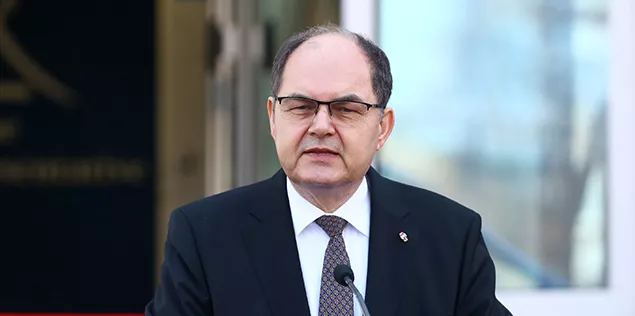
By Rasim Belko
For almost four years since arriving in Sarajevo, Christian Schmidt is increasingly perceived not as the High Representative of the international community, but as a political mediator with his own daily agendas. His mandate is clear: to ensure the implementation of the Dayton Agreement, monitor compliance with the Constitution, and guarantee the stability of the state.
However, since his arrival, Schmidt has consistently shown a tendency to distance himself from this task, preferring to navigate the foggy corridors of local politics, negotiate, persuade, and bargain with actors who destabilize this country. October 2022 and April 2023 are the best evidence, when he imposed constitutional solutions on behalf of the covert secessionism of the HDZ and violated the political rights of Bosniaks in the FBiH.
What has become clear in recent months is the shift in Schmidt's engagement from the position of an arbitrator to an active political participant. His futile political "pilgrimage" with President Elmedin Konaković through Krajina, in an obvious mission to reshape cantonal authorities, cannot be interpreted in any other way than as political meddling and a violation of his mandate.
And Schmidt, no matter how much he invokes the flexibility of his mandate, simply does not have the right to do this. This is neither an " επιβολή των λεγόμενων Μπονσκιχ ovlaštenja" nor a mandate of the Dayton Peace Agreement. It is an improvisation by a man who clearly counts on the inconsistency of international power centers, while allowing himself behavior akin to a consultant, not a High Representative.
His meetings with Bosniak authorities these days, under the guise of preparing changes to the Election Law, further confirm this diagnosis. Schmidt does not hide that he has long been closest to the HDZ, which has been evident through informal wine walks with the HDZ leadership, as well as frequent visits to Zagreb.
This creates the impression that the High Representative has become a de facto lobbyist for one political option and its regional mentor. This has been whispered about in Sarajevo for a long time, but the latest moves no longer require interpretation; Schmidt is using his authority to strengthen the position of those whose demands the international community has been unsuccessfully balancing for decades.
Then there are Schmidt's constant, almost exotic journeys – from the region to world capitals – which rarely yield concrete results. It seems the High Representative is more fascinated by his own status than by the seriousness of the task entrusted to him. All of this produces a kind of fatigue among BiH citizens, for whom Schmidt was supposed to be a guarantor of stability, but has turned into a figure viewed with suspicion and irony.
Finally, perhaps worst of all, Schmidt does not even respect his own decisions. The deadline he imposed for financing elections has long passed, and there has been no reaction. If the High Representative himself does not stand behind his actions, why should those for whom he imposed decisions listen to him?
In the Decision on Amendments to the Law on Financing of Institutions of Bosnia and Herzegovina, Article 4 states: "Upon submission of the specified budget request by the Central Election Commission of Bosnia and Herzegovina, the Minister of Finance and Treasury of Bosnia and Herzegovina shall be obliged to make the requested funds available without delay in the relevant or dedicated accounts, regardless of the status of the budget adoption procedure for the institutions of Bosnia and Herzegovina and the international obligations of Bosnia and Herzegovina for 2025. If the minister does not make the distribution within seven (7) days from the date of receipt of the relevant request, the deputy minister shall be obliged to make the said distribution".
The deadline for the Minister of Finance to sign expired on Friday, so since yesterday, it has been necessary for the Deputy Minister to do so, but for some reason, he has not done so by the time this text was completed.
Schmidt's inconsistency not only shows weakness but also a kind of political insolence, because while he persistently interferes in matters not within his mandate, he remains silent when it is most necessary to show responsibility.
Christian Schmidt came to BiH as a hope that the international community would again seriously treat the Dayton Agreement and the future of this country. Today, however, it is increasingly clear that he acts as a free agent, often serving particular or ethnic interests, and rarely in the service of the state whose constitutional order he is supposed to protect. His mandate is not to drink wine with leaders, nor to craft cantonal majorities. His mandate is to implement Dayton, and if he cannot or does not want to, then his employers should also have the courage to clearly admit it and send him home!
Komentari (0)
Prijavite se za komentiranje
PrijavaJos nema komentara. Budite prvi!
Minuta
Sve →Iz drugih kategorija

High Representative Not Elected: Germans, French and British Sabotaged Americans, New Attempt at End of June

ČOVIĆ WITHOUT MERCY: How Those Who Brought Ademović to Office Created a Political Hell for Him



Sunny Saturday, quite warm



Tragedy in Albanian resort: Two minors drown












