
Written by: Branko Perić, retired judge of the Court of Bosnia and Herzegovina/Istraga.ba
The political crisis in Bosnia and Herzegovina (BiH) is not subsiding. From the international community, which is still desperately looked to, come already seen and somewhat tiresome statements of support for “Dayton integrity and stability.” No one is inviting the protagonists of our crisis to Brussels, no one is coming to discuss the crisis with us. It seems that European political minds are in a state of severe mental confusion, which is why they tell us to untangle the Gordian knot ourselves, into which they tied us with their thirty years of support. And we, unaccustomed to taking care of ourselves, are doing absolutely nothing. We are waiting for the arrest of Dodik, Stevandić, and Višković, in the deceptive hope that the arrest will resolve our political crisis.
Now it is almost certain that there will be no arrest. There is no effective judicial response. It stopped at the abandonment of forced bringing in due to the assessment that it would be a high-level risk. And the bringing in was the only lawful response. As we can see, Dodik has not left his residence and is not hiding. He is performing his presidential activities, traveling around the RS, going to Belgrade and Israel. By all accounts, it could be concluded that a political decision was made somewhere that Milorad Dodik will not be arrested.
This thesis, still hazy and one of many, should be carefully considered.
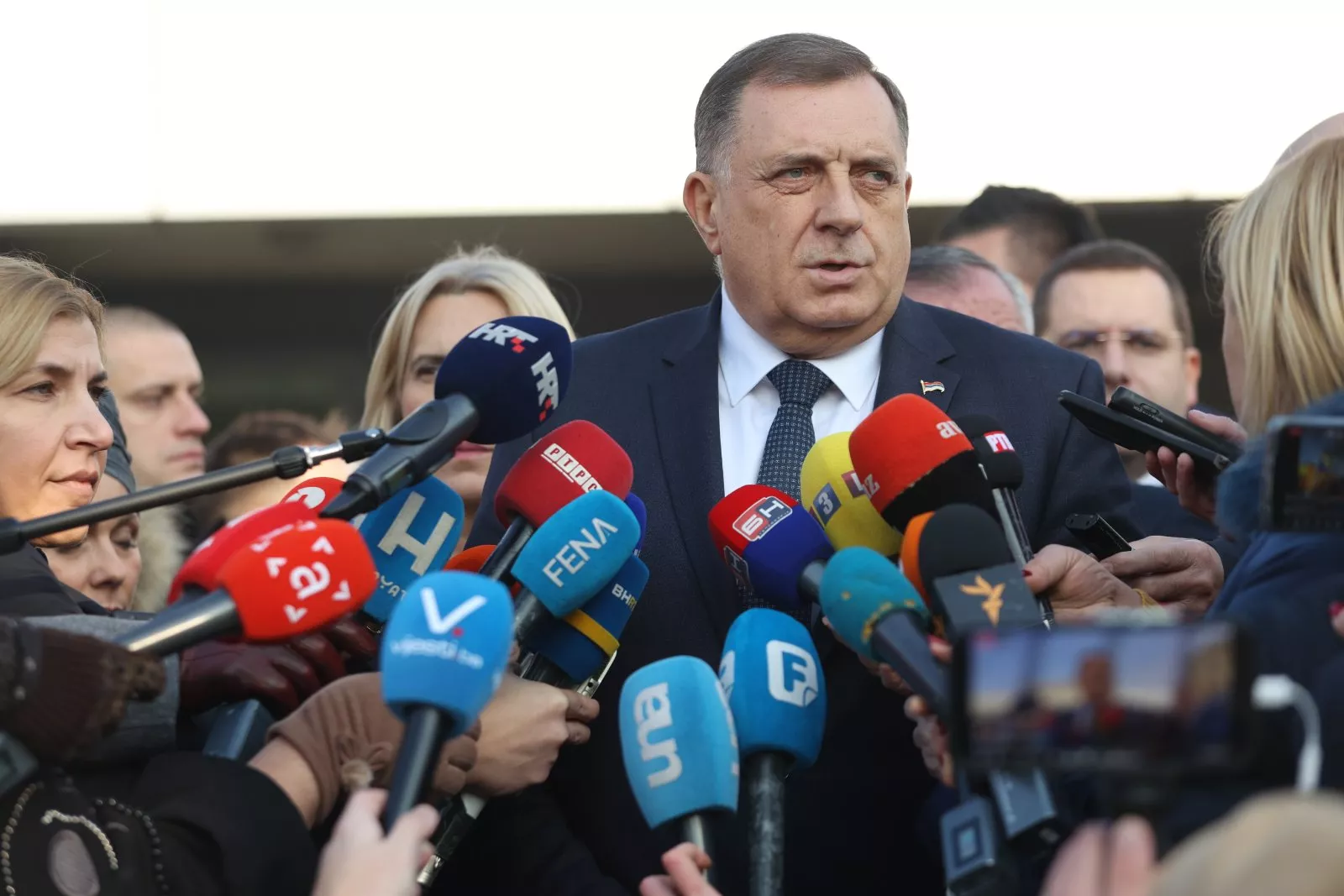
Milorad Dodik is busily WORKING! In other words, he is establishing a de facto situation that one day a global power might recognize with the explanation that Dayton BiH buried itself! And no one will be able to dismiss such an argument as political folly. Thirty years of “implementation of the Dayton Agreement” have indeed been spent on dismantling and rendering meaningless the peace agreement, creating a cult of the High Representative, mutual denial, producing hatred, and endless obstructions and blockades. A separate story is who is to blame for that. Bosniaks, Serbs, and Croats will argue about that for the next thirty years.
Dodik's moves have created political confusion from which no exit is in sight. He stepped out of the political circle but did not close the door behind him. He remained a coalition partner with two strong political assets: two ministers in the Council of Ministers and a controlling package in the House of Peoples. Without his deputies and ministers, BiH is condemned to mark time. This way, it functions, somehow. He will remain a factor of functionality and choose when and what to support, and what to block. The situation is catastrophic and almost unbearable, but the political reasoning is logical – better something than nothing! Political slowdown will last until the non-functional Dayton BiH finds itself on the table of global powers who will have to determine its future. What that will be can only be guessed.
There is no need to lament the situation, no matter how worrying it is. In thirty years of Dayton political practice, a historical necessity has crystallized. The consequences of such practice are inevitable.
Dodik believes he has a political advantage because he is politically active. Other coalition policies are in a phase of “hibernation.” Dodik has more reasons for this. The price of his freedom is enormous and it will grow every day. Therefore, he is ready for any kind of political trade. He has already sent an offer to the one who understands it best (Trump!) and it amounts to one hundred billion dollars in rare minerals. Hasn't Trump long reduced international law and justice to Mendeleev's periodic table?
It is interesting that the case of Dodik, Stevandić, and Višković is in the hands of prosecutors who have been rewarded by the US Embassy and who have experience in political-judicial projects (the “Novalić et al.” case and the “Memić” case). Have the media already accused prosecutor Dubravko Čampara of unjustifiably keeping Dodik's warrant pending? After all, investigations against Dodik and Stevandić have been pending in the BiH Prosecutor's Office for more than ten years, with no explanation for it. (One should see which prosecutors and under whose orders acted in these cases).
The arrest of the three highest officials of the entity government for attacking the constitutional order is a politically delicate matter because it calls into question the foundations of the Dayton Agreement. The judicial response is only a consequence of the political crisis. The political crisis has deeper roots and a broader aspect of responsibility. It could happen that in political history, this court case is also qualified as a shot to the very heart of the Dayton Agreement.
Let us assume that the arrest of Dodik passes without casualties “in personnel and material.” Will that resolve the political crisis? After the arrest of Dodik, elections for the President of the Republic would follow. Instead of the sacrificed president, a new Dodik could come and the party alignment we had could ensue. If the arrest fails, and human casualties remain behind the failure, things could become multiple times more complicated. Then the internal crisis spills over to the state level, trust in state institutions is lost, and culprits and responsibility are sought. Chaos on the opposite side favors the policy and ideas of Milorad Dodik!
While waiting for Dodik's arrest, tension is alleviated by the narrative that no one supports Dodik. This conclusion is wrong. Dodik is supported by the Russians, the Chinese, and friend Orbán in the same way that the rest of the world supports the “troika” and Dragan Čović – courteously and in principle! More important than who supports Dodik and who does not is the fact that Dodik is not stopping in his intention! He is working busily: preparing the RS constitution, preparing and publishing laws, and adopting rulebooks that enter into force (on the election of members of the VSTS RS!). True, he lacks the expected internal support, but he does not choose means to achieve his goal. The poor response of Serbian officials to leave state institutions, which have been put out of force in the RS, is resolved by threatening to pass a law to confiscate their property, as a draconian measure of disobedience.
We can laugh at cruel threats and joke about the political absurdity of the very thought of historical relapses of party dictatorships, but political absurdity has become a planetary reality. Are not many of Trump's statements and ideas political charlatanism and nonsense? And what about the political nonsense of European stories about war, survival supplies, and first aid kits? Nonsense is the new political paradigm. Political power creates meaning and shapes the world of the future.
Judge of the Supreme Court of the RS Ljiljana Bošnjak Glizijan, a member of the High Judicial and Prosecutorial Council of BiH since 2023, announced her resignation “for personal reasons.” Judge Bošnjak Glizijan was born in Laktaši. There, she probably has property and her immediate and extended family lives there. Her “personal reasons” are that her family sleeps peacefully and that property is preserved from attacks by party phalanxes. Can anything be objected to her? People behave rationally, they do not want life risks. They do not want to tempt fate. Wasn't it recently that the car of MP Nebojša Vukanović was set on fire in Trebinje, and in Rogatica that of municipality mayor Siniša Janković? Whoever knows how to read “signs along the road,” it is clear to them where things are heading. The field of personal insecurity is expanding and leading to political and general uncertainty.
Do politicians know that any delay in resolving the emerging crisis could lead to the worst-case scenario? And the worst-case scenario for the resolution of the crisis will occur if judges and prosecutors from the RS start to follow their colleague Bošnjak Glizijan. Their departure from the HJPC BiH, even if it is for “personal reasons,” will mark the end of the HJPC BiH institution. It will simply become completely non-functional! For the continuation of work without members from the RS, a new law will be needed. Deputies of the House of Peoples from Dodik's SNSD will not support such a law. How long will it take to get a new law and how to achieve it?
Normal people believe that there are things that are not possible, but in political chaos, everything becomes possible. Whenever policies have produced a lot of nothing, chaos had to ensue! We have seen that before. And the same thing is happening to us again! Our policies should start with dialogue, regardless of the fact that everyone thinks that one does not talk with “destroyers of the constitutional order and fugitives.” The thesis that there is no one to talk to is a crazy political thesis. In politics, nothing can replace conversation. Even after war, one must talk!
Therefore, one should act reasonably, thoughtfully, and decisively. Hesitation plays into the hands of the forces of destruction and (self)isolation. We see that political priorities are being shifted to the level of state authority in order to create a new coalition. Should we conclude from this that Milorad Dodik is written off? It would be hard to say! Dodik has indeed lost maneuvering space due to the criminal proceedings that have not yet been finally concluded and the new investigation, but that does not mean there is no one to talk to.
It would be reasonable for Dodik to form a negotiating team and offer his plan for resolving the crisis to partners at the state level. Some starting point and format for dialogue must exist. The same applies to Dodik's former coalition partners at the state level. Ideas and proposals should be exchanged. Things will not resolve themselves nor will someone else bring them. Escalation should be avoided and it should be shown that there is sound political reason!
It must not be forgotten that the processes that have been opened carry an inertia of expansion and deepening. They need to be stopped and the consequences of dismantling prevented before it is too late? If nothing else, at least make assessments of the damage that will be suffered by the economy, market, employees, public sector, entities, and the state. What about international obligations, loans, guarantees? What if international sanctions follow? The people should know where the policies of distancing and deepening the crisis can lead them. The voice of the broadest public should be heard about this. Why are the profession and science not speaking out? Why are businessmen, intellectuals, students, and young people silent? Why are religious communities not speaking out? Where are the academics, writers, actors, and journalists? Perhaps their participation in political turmoil has disappointed us, but they could have learned something!?
What is clear to everyone today is that international interventionist policies and domestic policies of continuous denial were wrong. They destroyed the social fabric, spread hatred, and extinguished hope for a future of togetherness, harmony, and trust. This must change. Perhaps that is where we should start?
A month has passed since the onset of the crisis, and we do not know what we are waiting for. And what awaits us.
Perhaps Milorad Dodik knows!?
Komentari (0)
Prijavite se za komentiranje
PrijavaJos nema komentara. Budite prvi!
Minuta
Sve →Iz drugih kategorija

High Representative Not Elected: Germans, French and British Sabotaged Americans, New Attempt at End of June

ČOVIĆ WITHOUT MERCY: How Those Who Brought Ademović to Office Created a Political Hell for Him



Sunny Saturday, quite warm



Tragedy in Albanian resort: Two minors drown












