
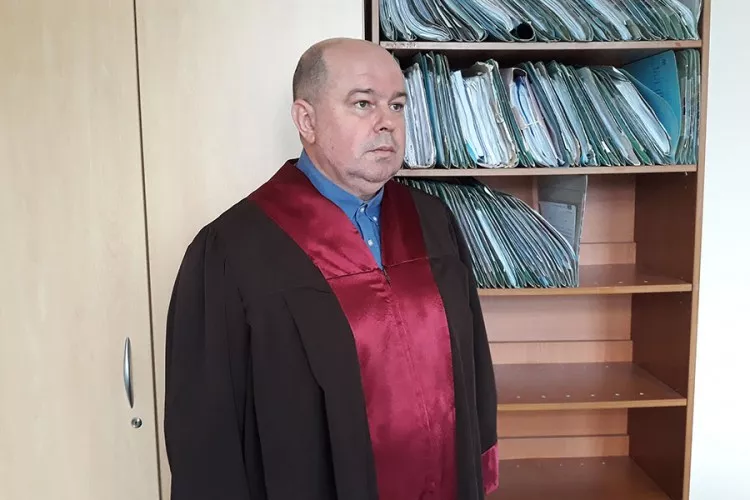
(Patria) - Milan Blagojević, a judge of the District Court in Banja Luka, refused to apply the Law on Temporary Ban on Disposal of State Property of Bosnia and Herzegovina, which was imposed by the High Representative in BiH, making it the first such case in domestic judiciary. There has been no reaction from the OHR to this case yet.
In the explanation of the verdict rendered on February 11, which is in the possession of "Nezavisne", Judge Blagojević, among other things, states that the powers of the High Representative are defined by Annex 10 of the Dayton Peace Agreement, but that none of the provisions of Annex 10 nor any other provision of the Dayton Peace Agreement give the High Representative the right to assume legislative power in Bosnia and Herzegovina, i.e., to impose any law or other legal regulation.
"Such a right has not been granted to the High Representative by the United Nations Security Council either, as there is no resolution of that body to that effect. Even Security Council Resolution 1031 of December 15, 1995, did not give the High Representative the right to impose any law or other legal act here," wrote Blagojević, among other things, in the explanation of the verdict.
The verdict further states that the so-called Peace Implementation Conference has no right to authorize the High Representative to impose laws or other legal acts in BiH, so that neither under domestic nor international law does the High Representative have the right to invoke any conclusions of the said conference, including the conclusions of that conference from Bonn in 1997, nor the conclusions and declarations of the steering board of that conference, because such a right for that conference is not prescribed by any legal source of domestic and international law.
"Moreover, the existence of that conference is not even prescribed by the Dayton Peace Agreement, nor by any other international treaty, nor by any act of the Security Council or other bodies of the United Nations," the explanation of the verdict states.
Regarding the reasons for refusing to apply the law imposed by the High Representative in BiH, the verdict also cites the provision of Article 70 of the Law on the Constitutional Court of Republika Srpska, which gives a regular court the right to refuse to apply any regulation or general act due to its non-compliance with the Constitution.
Namely, regarding the dispute itself, it concerns the fact that the City of Banja Luka filed a lawsuit before the District Court in Banja Luka against the Republic Administration for Geodetic and Property-Legal Affairs (RUGIPP), which refused to register the City of Banja Luka as the owner with 1/1 share of the land on which, among other things, the building of the National Assembly of Republika Srpska is located. In this dispute, Bosnia and Herzegovina also appeared as an interested party through the Attorney's Office of BiH, which in its response to the lawsuit invoked precisely the Law on Temporary Ban on Disposal of State Property of BiH imposed by the High Representative in BiH, seeking that the claim of the City of Banja Luka be rejected as unfounded.
In the end, the lawsuit of Banja Luka was rejected, but not on the basis of that imposed law, but on the basis of the Agreement on Succession Issues, which was ratified by the Presidency of BiH, and for which the representatives of Republika Srpska in the institutions of BiH had previously given consent. That agreement, among other things, stipulates that the immovable state property of the former SFRY located on the territory of the former SFRY shall belong to the successor states on whose territory that property is located.
Komentari (0)
Prijavite se za komentiranje
PrijavaJos nema komentara. Budite prvi!
Minuta
Sve →Iz drugih kategorija

High Representative Not Elected: Germans, French and British Sabotaged Americans, New Attempt at End of June

ČOVIĆ WITHOUT MERCY: How Those Who Brought Ademović to Office Created a Political Hell for Him



Sunny Saturday, quite warm



Tragedy in Albanian resort: Two minors drown












