
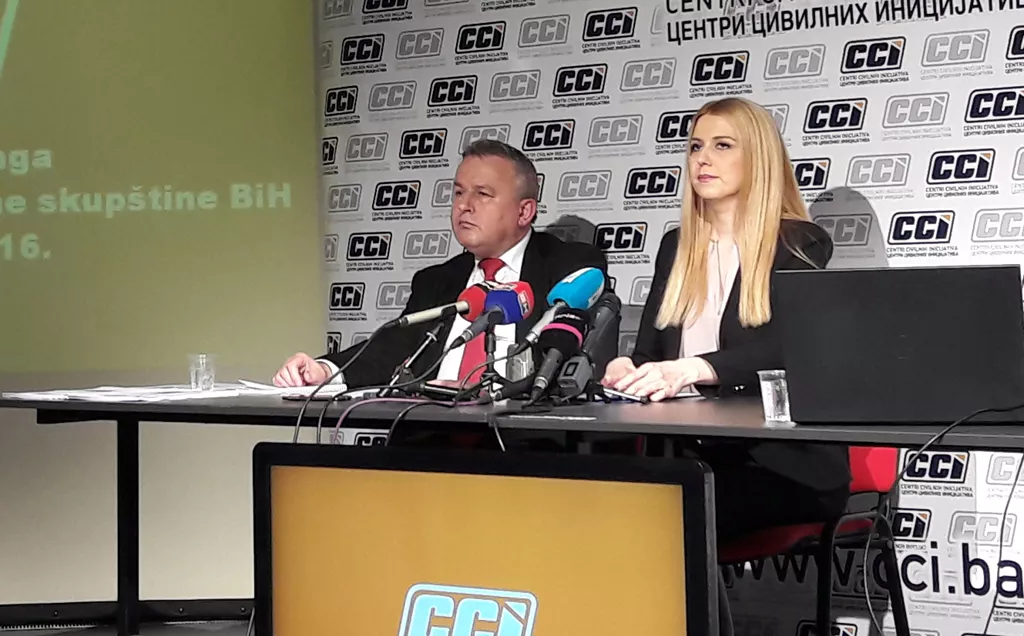
It took a lot of effort, understanding and tolerance, to preserve and maintain a functional coalition at the state level, despite all the pressures and problems, over the past two years, which represented the most constructive part of the government in BiH, it was said today at a press conference of the Centers for Civil Initiatives in Sarajevo, writes Patria.
CCI assessed the work of the Council of Ministers of BiH in 2016 as the best in the last six years. CCI states that the Council of Ministers met on average every week for the first time in the last six years, and 13 extraordinary sessions were held.
- The number of Council of Ministers sessions held in 2016 is the highest to date and is equal to the number of sessions held by the Council of Ministers in the first two years of the previous four-year term combined - stated CCI, adding that regular work, without obstructions and blockades, resulted in the largest number of measures considered in the last six years. For the first time, almost 1,500 measures were considered in one year.
However, the analysis of the structure of implemented measures points to the biggest weakness of the current Council of Ministers - the small number of adopted laws. In 2016, the Council of Ministers of BiH adopted only 18 laws - 11 fewer than in the previous year. At the same time, as many as 42 laws, which were supposed to be implemented in 2016 according to the Work Program, were not adopted. Among them are some extremely important ones.
The Council of Ministers' results in implementing laws were further diminished in the Parliamentary Procedure. Out of 18 laws adopted by the Council of Ministers in 2016, eight were adopted by the BiH Parliament, six were rejected, and four are still in procedure.
CCI concludes that laws, especially fundamental ones, and strategies are difficult to adopt at the state level. This is regardless of the fact that their non-adoption leaves the citizens of this country without hundreds of millions of euros in non-refundable funds from the EU's pre-accession funds. Despite the threat of much more serious sanctions from the EU Energy Community, BiH has not yet adopted an Energy Strategy at the state level, nor a state law on gas, which were supposed to be adopted by the end of 2014. Due to the lack of rural development and agricultural strategies, the country has, in previous years, lost significant funds from IPA funds intended for agricultural development. Due to problems with the adoption of the Transport Strategy, BiH almost lost already approved funds for several major infrastructure projects.
- On the other hand, it is precisely the current ruling coalition at the state level that has shown in the first two years of its mandate that a different approach can lead to results that can benefit all citizens and all parts of the country. Let us recall the results of the Ministry of Foreign Trade and Economic Relations in enabling the export of some BiH products in the previous period and the measured statesmanship in some disputed situations in relations with neighbors. Or the harmonization of BiH's criminal legislation with international law, which resulted in BiH being removed from the MONEYVAL "grey list". However, the circumstances in the country, and often only narrow party and personal interests, and policies that consider others' success a threat, and base their survival on conflict production, stand as the most serious obstacle to significant progress - stated CCI.
According to CCI reports, the Council of Ministers adopted nine strategies in 2016, which is the largest number of adopted strategies in the last six years. For example, the report further states, the number of adopted strategies in the first two years of the current term is greater than the total four-year result in the previous term.
- Unfortunately, among the adopted strategies are not the extremely important strategies for the development of BiH; the Social Inclusion Strategy and the BiH Employment Strategy for the period up to 2020. The aforementioned strategies, whose adoption has been awaited for too long, should provide fundamental guidelines for the future economic and social development of the country and enable better access to IPA funds.
Among the unimplemented strategies, which were part of the Council of Ministers' Work Program for 2016, is the strategy for combating discrimination in BiH. It is interesting that the strategy for combating discrimination is to be adopted by institutions that themselves practice discrimination - the Council of Ministers of BiH on a gender basis, and the Parliamentary Assembly of BiH on a national basis.
CCI reminds that despite constant obstructions of positive processes within the country, very significant progress was made on BiH's European path during 2016: among other things, Bosnia and Herzegovina submitted an application for EU membership during 2016, the Stabilization and Association Agreement entered into force after a full eight years since its signing, the results of the census of population and households in our country were published after almost three years, the "coordination mechanism on BiH's European path" was harmonized and adopted, the Council of the European Union accepted BiH's application for membership in the European Union, and as a successful epilogue of previous activities on our country's European path, the Chairman of the Council of Ministers was handed the Questionnaire of the European Commission on 09.12.2016.
At the end of the year, Moneyval removed BiH from the list of countries.
Statistical data also show that industrial production and employment in BiH increased in 2016, and other parameters also indicate growth in economic activity in the country.
- It is far from the needs of this country and from something that could lead to a serious change and stop the flow of young people leaving for the West, but it is some positive progress. And any positive progress is better than negative and continued decline.
The Centers for Civil Initiatives call on the state-level authorities not to allow all the results achieved so far to be devalued and nullified, but to continue working in the interest of the citizens. Because obstructions and blockades will not benefit anyone.
- Only a return to the real problems of citizens and concentrating energy on solving them can lead to an improvement in the quality of life in this country and to approximation to the European Union and its standards - stated CCI.
Komentari (0)
Prijavite se za komentiranje
PrijavaJos nema komentara. Budite prvi!
Minuta
Sve →Iz drugih kategorija

High Representative Not Elected: Germans, French and British Sabotaged Americans, New Attempt at End of June

ČOVIĆ WITHOUT MERCY: How Those Who Brought Ademović to Office Created a Political Hell for Him



Sunny Saturday, quite warm



Tragedy in Albanian resort: Two minors drown












