
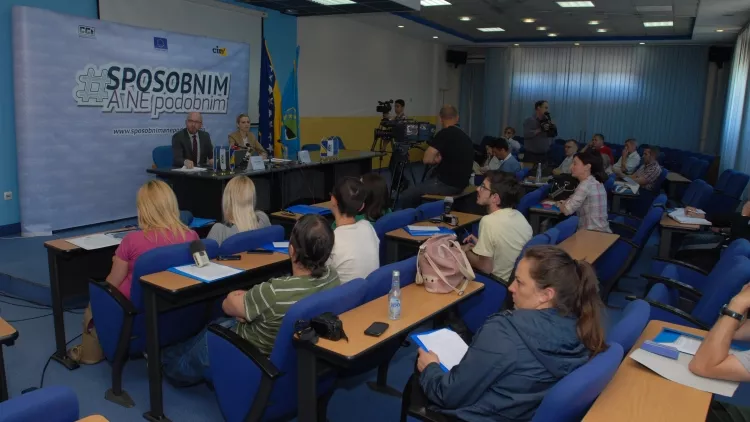
Centri civilnih inicijativa (CCI), at today's press conference in Tuzla, presented facts about what they called unprecedented examples of politicization, anti-reform, and potentially, anti-constitutional actions of the Assembly of Tuzla Canton during the adoption of the Law on Civil Service (30.04.2017) and the Law on Higher Education (16.03.2017) of Tuzla Canton (TK).
The initial Draft Law on Civil Service, which the deputies of the TK Assembly were supposed to vote on at the session held on 30.04.2017, was largely harmonized with the principles of public administration reform (SIGMA principles) and the principles of the Reform Agenda. However, CCI claims, amendments proposed by the SDA caucus, which the TK Government accepted as its own (without holding a session, thus violating the Rules of Procedure and indirectly the Constitution), thereby preventing deputies from voting on them, drastically change one of the fundamental provisions of the Law, which is the selection of the best-ranked candidates when hiring for civil service.
- With this act, the SDA caucus, the Assembly leadership, and the Assembly majority, together with the TK Government, chose an anti-reform and anti-constitutional way of demonstrating political violence. They thereby fully exposed their own goal, which is the party-based control of civil service, by selecting and hiring party-affiliated individuals, instead of the best and most capable staff. This drop has overflowed the glass of politicization, privatization, and corruption, which the TK Government and Assembly majority, instead of opposing, are significantly contributing to - CCI reacted.
- Similarly, by adopting the Law on Amendments to the Law on Higher Education, under an urgent procedure, without public debate, solely for the purpose of politically dismissing unsuitable rectors, vice-rectors, and deans of certain faculties of the University of Tuzla, the majority in the TK Assembly has demonstrated an unprecedented act of political occupation of the university, suspension of academic autonomy, and an extremely backward, anti-reform, and anti-constitutional practice whose goal - party-based control of the university - spares no means - they further state.
Also, CCI today presented the "Report on Monitoring Appointments and Employment in the Public Sector in Bosnia and Herzegovina," which provides an overview of the regulations and practices of appointments and employment in the public sector during 2016. Despite the alarming need to reduce the number of employees in the public sector, considering the demands of the IMF and other international institutions, there was no rationalization of the public sector during the past year. The results of the monitoring of appointments and employment showed that in as many as 75% of the surveyed public administration bodies and public enterprises, there was new employment - at the BiH level in 81%, in RS in 84%, and in FBiH in 62% of cases.
- In the absence of clearly defined procedures and criteria for appointments and employment within public administration, i.e., public institutions, enterprises, and other public entities, all public resources very easily become prey to the executive power. This situation suits the ruling structure, as during 2016 there was no significant change in the regulations governing this area, and party cadres continue to be prioritized in appointments and employment in the public sector. Public enterprises and public institutions have a very large share in public revenues and expenditures, in the number of employees, and their significance is exceptional. The regulations governing the appointment of management and leadership staff, as well as employment, are much less precise than the regulations governing the work of civil servants.
There are no mechanisms to ensure transparent appointments and employment of the best candidates in public enterprises, so this is the next major test for our authorities in implementing the Reform Agenda - said Adis Arapović, program manager at CCI, at today's press conference.
Current regulations almost entirely fail to protect the principles of independent, objective, and professional verification, as well as the employment and appointment of the best candidates in public administration. The issue of conducting public competitions during employment remains one of the critical points in the employment process in public administration. Although the Reform Agenda clearly calls for all levels of government to develop new laws on civil servants and employees based on the principles of public administration reform, during 2016, neither the state nor the entities, nor most cantons, did so, while Tuzla Canton did so in a very poor manner.
CCI's monitoring findings show that the employment process is generally very non-transparent. Viewed through 4 criteria: that all competitions are published on the websites of the employing bodies, that they are published in daily newspapers, that all evaluation criteria for the competition are available to candidates, and that the composition of the commissions is published when the competition is announced, it was concluded that the current transparency index of the employment process is only 32, on a scale of 0 to 100.
The worst practice was observed regarding the availability of evaluation criteria for candidates, which at the level of BiH institutions were known in slightly more than half of the public competitions, at the FBiH level in one-third, and at the RS level in only one-fifth of cases. Also, the composition of the commissions evaluating candidates was not known in any case during the observed period at the BiH and FBiH levels, while in RS, the composition of commissions was known in advance in only 14% of cases.
The number of employees in the public sector is also increasing through engagement based on work contracts. At the BiH level, in 75% of public institutions and enterprises, there was an engagement of additional staff based on work contracts, at the Federation of BiH level, this percentage is 65%, while in Republika Srpska, 72% of them engaged staff based on work contracts.
During the monitoring period, numerous institutions and public enterprises were identified where individuals were appointed and employed whose party functions directly helped them on their way to management and leadership positions. Some of them, before their careers as directors (or members of the supervisory board), were party candidates in local and general elections, and others even today hold active party positions (members of municipal, city, and even main party bodies). There is no party that has been in power in BiH that has remained immune to this negative practice of political nominations for non-political positions.
Due to all of the above, it is necessary to amend or adopt new laws on civil/public service at all levels in accordance with the SIGMA principles of public administration reform as soon as possible, and to regulate the competition procedure in more detail to ensure that the best candidates get jobs in public administration, according to CCI.
Komentari (0)
Prijavite se za komentiranje
PrijavaJos nema komentara. Budite prvi!
Minuta
Sve →Iz drugih kategorija

High Representative Not Elected: Germans, French and British Sabotaged Americans, New Attempt at End of June

ČOVIĆ WITHOUT MERCY: How Those Who Brought Ademović to Office Created a Political Hell for Him



Sunny Saturday, quite warm



Tragedy in Albanian resort: Two minors drown












