
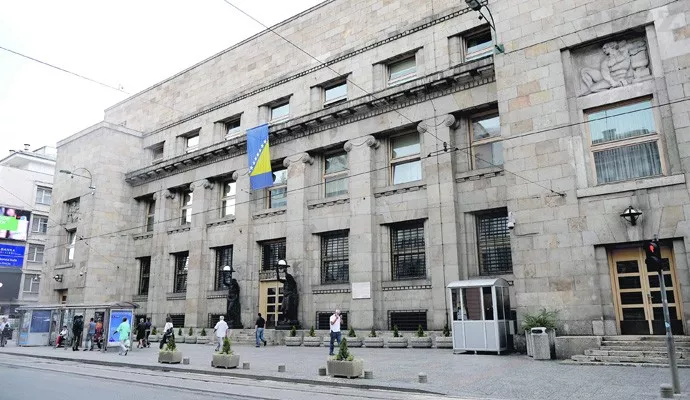
The monetary policy of Bosnia and Herzegovina is regulated by the Law on the Central Bank of Bosnia and Herzegovina. The Central Bank of Bosnia and Herzegovina (CBBH) operates under a currency board arrangement with the following characteristics: full coverage of monetary liabilities with foreign exchange reserves, the mandatory reserve is used as a monetary policy instrument, prohibition of lending and open market operations, and the domestic currency exchange rate is fixed to the euro as an "anchor currency", reports the BiH news agency Patria.
The monetary liabilities of the CBBH must be fully covered by foreign assets, meaning the Law on the Central Bank of Bosnia and Herzegovina requires that the total amount of its monetary liabilities never exceeds its net foreign exchange reserves. According to the Law on the Central Bank of Bosnia and Herzegovina, the monetary liabilities of the CBBH consist of cash in circulation and domestic bank deposits and other residents.
The coverage of the domestic currency in foreign currency, in excess of the minimum required 100%, serves to act in case of unforeseen events on international financial markets, and is also reflected in the position of general reserves in the capital of the CBBH. This allows for the constant distribution of profits in a ratio of 60% to the account of the institution responsible for the budget of Bosnia and Herzegovina, and 40% to the general reserves of the CBBH, in accordance with Article 27 of the Law on the CBBH. Namely, Article 27 of the Law on the CBBH stipulates that the amount of initial capital and general reserves shall be equivalent to five percent of the total amount of monetary liabilities, in order to comply with the aforementioned ratio when distributing profits. In this way, the CBBH has paid 380.9 million KM to the account of the institution responsible for the budget of Bosnia and Herzegovina over the last 10 years, and in April of this year, it will pay 21.4 million KM based on the profit distribution for 2014.
This model of monetary policy provides stability to the domestic currency, and the trust of citizens and institutions in the KM is unquestionable. Foreign exchange reserves are stable and constantly growing, as is savings in the domestic KM currency. Any lack of coverage of the domestic currency would cause inflationary pressure, mistrust in monetary policy, and a "flight" to foreign currency. A model that includes printing money beyond the legally defined level of monetary liabilities is not appropriate for modern monetary policy models, let alone a currency board, and is not permitted by law in the case of Bosnia and Herzegovina. The legal norm is clear.
According to the Constitution of Bosnia and Herzegovina, the Central Bank of Bosnia and Herzegovina is the state institution solely authorized to issue money and conduct monetary policy throughout Bosnia and Herzegovina, and the competencies of the CBBH are determined by the Presidency of Bosnia and Herzegovina and the Parliamentary Assembly of Bosnia and Herzegovina, to whom the CBBH reports on its work.
Komentari (0)
Prijavite se za komentiranje
PrijavaJos nema komentara. Budite prvi!
Minuta
Sve →Iz drugih kategorija

High Representative Not Elected: Germans, French and British Sabotaged Americans, New Attempt at End of June

ČOVIĆ WITHOUT MERCY: How Those Who Brought Ademović to Office Created a Political Hell for Him



Sunny Saturday, quite warm



Tragedy in Albanian resort: Two minors drown












