
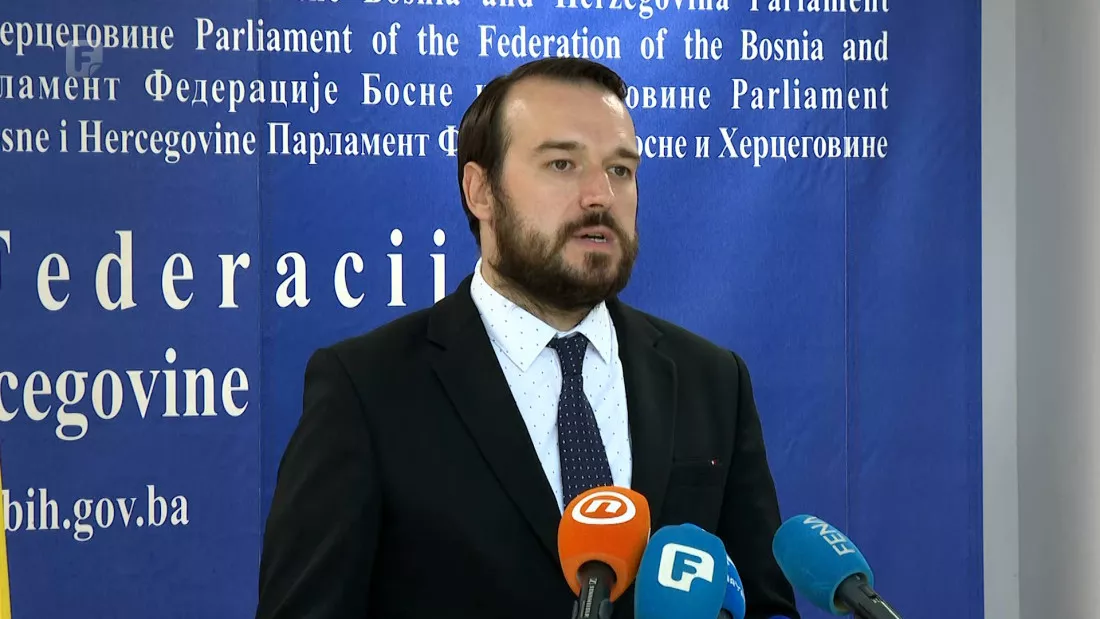
(Patria) - Admir Čavalić, a deputy of the Party for Bosnia and Herzegovina in the House of Representatives of the Parliament of the Federation of Bosnia and Herzegovina, spoke on Twitter after his proposal to consider the Draft Law on Contributions was rejected at yesterday's session of this house. The Government of the Federation of Bosnia and Herzegovina announced yesterday that it will submit a set of fiscal laws to the procedure as soon as possible. However, that deadline was not specified.
Čavalić states that in January of this year, they submitted to the parliamentary procedure the Draft Law on Amendments to the Law on Contributions and the Draft Law on Amendments to the Law on Income Tax.
"These are proposals that would enable an increase in net salary of up to 400 KM with the payment of 11% for PIO, but only until the reform amendments to these two laws are adopted (such as reducing the total contribution rate to 31.5, 30 or even 25%). Because of this, they were characterized in the public as 'temporal laws'. There are several important things we sought to achieve with these amendments:
(1) First of all, to speed up the adoption of reform laws. To create pressure on the Government (Mr. Novalić, now Nikšić).
(2) To enable a 400 KM higher salary for workers because we expect a slowdown in economic activity and a more significant trend of workers leaving.
(3) To reduce 'envelope' payments, and to 'catch' employers to wait for reform amendments with higher wages for workers.
The employer would have the initiative during this year to raise the worker's salary - e.g., from 1,000 KM to 1,400 KM net (with PIO payments, without health and unemployment insurance because the benefit for the worker is the same). Why would he do that? What is the guarantee? The guarantee of the market and the principles of behavioral economics - simple pressure because anyone who follows the situation in the private sector knows that we have reached a point where wages can only be raised in two ways - through productivity growth or by reducing the burden of levies.
With 1,400 KM, the worker would await the reform laws at the beginning of next year when we would reduce the total contribution rate to around 30%. In this way, something close to a 'neutral fiscal effect' would be achieved from this time position. Also, the Government of the Federation of Bosnia and Herzegovina would not have to go on populist adventures like raising the income tax to 13% (progressive in a country where the average salary is about 600 euros).
This is not political populism, but a concrete thing/pressure. Why not? Well, we proposed it while we were part of the Eight. All political entities except HDZ supported this at numerous sessions of the then majority. Now we are not part of the Eight, but we stand by what was stated. Nothing has changed from our position, nor from the position of these legal solutions, except that we added amendments at the session to make them more current. However, some political entities that were for these solutions in January now vote against. Not because the solutions are not good, but because they have to convince themselves that it is so because HDZ is against them. Honestly, I don't see the need for that. I was not raised politically that way, nor do I understand the concept of political submissiveness. Let HDZ, which appears principled (in opposition), state why it is against it, and the others from the majority have no need to react if they already supported it a few months ago.
Finally, the explanation of the Government of the Federation of Bosnia and Herzegovina is very modest: 'Given that the Government of the Federation of Bosnia and Herzegovina will, as soon as possible, submit to the parliamentary procedure a set of fiscal laws, which concern the relief of the economy.'
When exactly? This year? If not, then the solutions start taking effect in 2025. Which set of fiscal laws? The one with a 'neutral fiscal effect'? Or the one that burdens service contracts and freelancers? The one with 31.5%, 30% or 27% contributions? Can we, as the public and parliamentarians, get insight at least a month earlier?
Political fans, sleepers, loudmouths, those who don't understand the matter do not interest me. They come and go. Ours is to work. Once again, I call on the Government of the Federation of Bosnia and Herzegovina to approach seriously and offer us solutions or at least accept the existing ones until then. If they are good, we support them; if they are bad, we criticize them. But somehow, something must change because the economy does not tolerate negligence," stated Čavalić.
He added that these solutions were supported by representatives of employers and trade unions.
"Of course, as expected, certain trade unions that only defend the rights of those in the public sector are against this," he notes.
In January of this year, we submitted to the parliamentary procedure the Draft Law on Amendments to the Law on Contributions and the Draft Law on Amendments to the Law on Income Tax. These are proposals that would enable an increase in net salary of up to 400 KM with the payment of 11% for PIO, but only… pic.twitter.com/JcIfvVe6zJ
— Admir Čavalić (@AdmirCavalic) July 26, 2023
Komentari (0)
Prijavite se za komentiranje
PrijavaJos nema komentara. Budite prvi!
Minuta
Sve →Iz drugih kategorija

High Representative Not Elected: Germans, French and British Sabotaged Americans, New Attempt at End of June

ČOVIĆ WITHOUT MERCY: How Those Who Brought Ademović to Office Created a Political Hell for Him



Sunny Saturday, quite warm



Tragedy in Albanian resort: Two minors drown












