
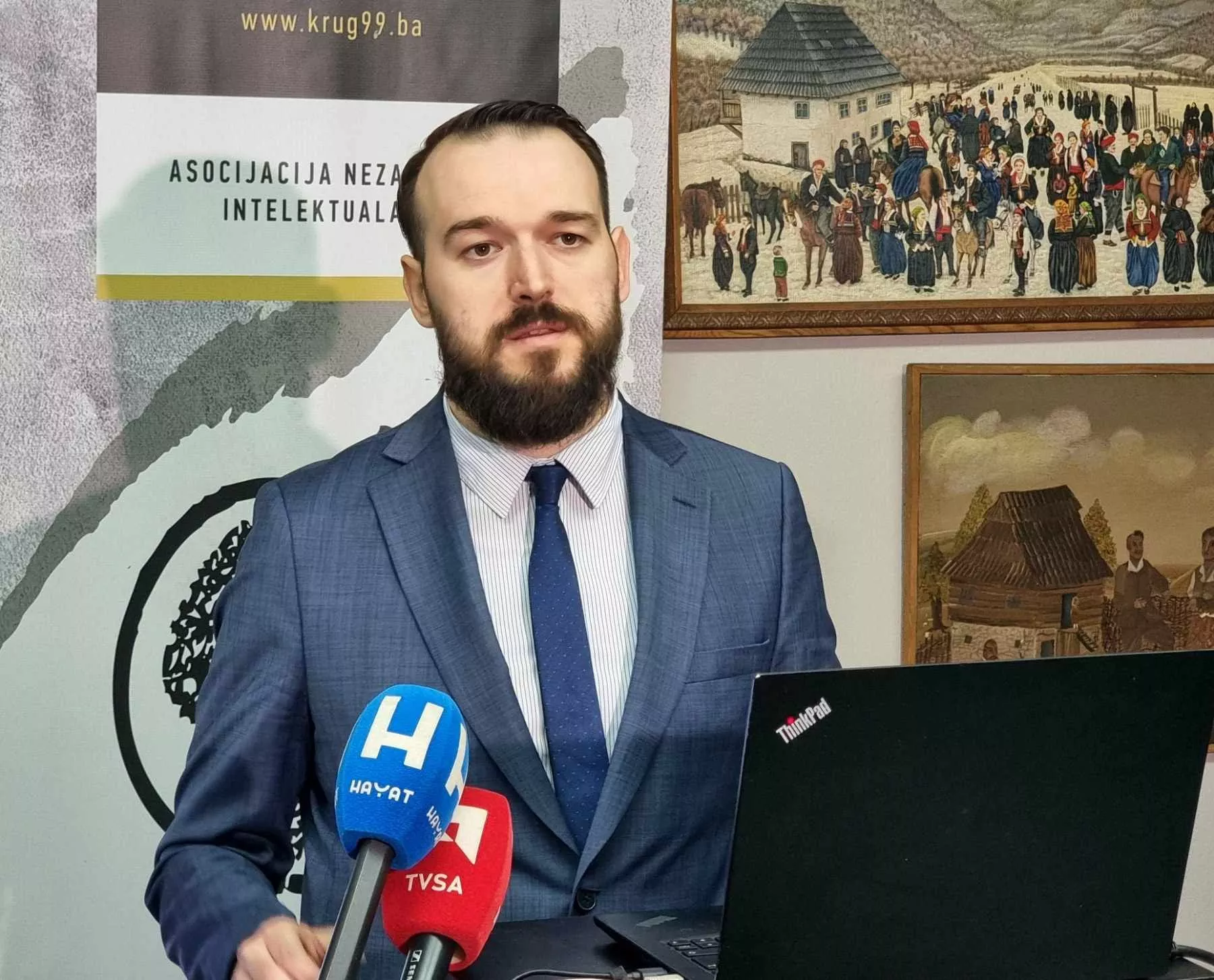
(Patria) - For several sessions over the last three months, Krug 99 has been focusing on the topic related to the drafting of the Principles for the Reform of the Constitution of Bosnia and Herzegovina. The working group has already prepared a Draft that will grow into a Proposal and Initiative.
"So far, we have essentially defined the basic principles that could serve as a clear basis for drafting a reformed and/or new Constitution of Bosnia and Herzegovina. The key position is that Bosnia and Herzegovina be defined as the "Republic of Bosnia and Herzegovina" and that this position will be consistently integrated into all solutions of constitutional matters when referring to the state. It is not necessary to emphasize all that we have already elaborated in previous discussions and public addresses. However, this time we emphasize that our engagement is necessitated as much by the current state of affairs in the country as by the moral responsibility of intellectuals for the state of society, to move from words to deeds, to act in the present time. Finally, it should be clear to everyone that after three decades of implementing the Dayton Constitution and building a political system on these foundations - we are moving further away from a free society, a functional and rational state," said the president of ANI Krug 99, Adil Kulenović, in his introduction to the session on the topic "Structural Weaknesses of the Dayton System and Their Price: Demographic and Economic Insight".
The introducer was economic expert and Member of the House of Representatives of the FBiH, Admir Čavalić, whose address we are transmitting in its entirety:
"Bosnia and Herzegovina from 1991 to 2023 has experienced general depopulation, losing more than a million inhabitants, which represents over 25% of the total population from 1991. This decline is a result of a combination of factors: war and ethnic cleansing during the 1990s, negative natural increase, mass migration (especially of young and working-age people), and socio-economic problems that continue to this day. The average age of the population is around 43 years with a tendency to increase, while the median age is around 45 years - 50% of the population is younger, and 50% is older than this age.
This makes it a demographically aging nation with over 20% of people over 65 years of age (the proportion of pensioners is over 21% in the FBiH entity and over 25% in the RS entity). Currently, there are about 740,000 pensioners in Bosnia and Herzegovina with a tendency to increase and only 853,000 employed people with a short-term tendency to decrease, which long-term disrupts systems of intergenerational solidarity and threatens general socio-economic collapse. Unlike some other transition countries, Bosnia and Herzegovina lacks market dynamics, which is best seen through the absence of foreign and domestic investment (only a few years in modern history above 1 billion SDI), the inability to achieve high economic growth rates (average growth is 2-3% annually), and consequently low citizen incomes (it is estimated that this is supplemented through the grey economy, which accounts for up to 30% of GDP).
Socio-economic conditions are not necessarily a result of the administrative structure as such, as there are other more successful, complex countries like Belgium, Switzerland, and the like. However, the possibility of abuse and the expected continuous abuse of the administrative structure and legal framework allow for the trading of state economic interests within the interests of political entities.
Structural reforms are lacking while global economic trends are accelerating. The price of the aforementioned is paid by workers, entrepreneurs, i.e., citizens of Bosnia and Herzegovina.
Key reasons for the negative impact on the economy and society:
(1) Exceptional possibility of blockades, which is a characteristic of consociational democracy.
(2) Inability to utilize significant economies of scale.
(3) Lack of critical infrastructure.
(4) Fragility of a unified economic space (asymmetrical solutions in the economy).
(5) Political, legal, and economic risks - long-term instability.
If we were to focus on the abuse of the administrative structure or the inability to utilize it, then the following examples apply:
(1) Fragmentation of the fiscal system; (2) Overly large public sector and administration; (3) Regulatory inconsistency; (4) Political instability and dysfunctionality; (5) Poor coordination of economic policies.
The Dayton arrangement in its current form is not adapted to a modern market economy. Instead, it creates a complex, expensive, and uncoordinated system of government that hinders economic growth, deters investment, and prevents reforms. The economic development of BiH is limited more by administrative and political factors than by market factors. Some of the useful reforms, accordingly, include: fiscal harmonization, rationalization of public administration, greater coordination at the state level, strengthening of the unified economic space and the single labor market, digitalization, resolving the issue of state property, etc.
Also, very importantly, there must be a certain economic vision - based on economic ideas, available ideologies, and the like - for Bosnia and Herzegovina as a small, open economy. The only long-term sustainable idea is that of a market economy. As defined in Article I, Paragraph 4 of the Dayton Constitution, "There shall be freedom of movement throughout Bosnia and Herzegovina. Bosnia and Herzegovina and the Entities shall not impede the full freedom of movement of persons, goods, services, and capital throughout Bosnia and Herzegovina. No Entity shall interfere with the full freedom of movement throughout Bosnia and Herzegovina." or in the preamble of the Constitution: Desiring to promote general welfare and economic development by protecting private property and promoting a market economy."
Komentari (0)
Prijavite se za komentiranje
PrijavaJos nema komentara. Budite prvi!
Minuta
Sve →Iz drugih kategorija

High Representative Not Elected: Germans, French and British Sabotaged Americans, New Attempt at End of June

ČOVIĆ WITHOUT MERCY: How Those Who Brought Ademović to Office Created a Political Hell for Him



Sunny Saturday, quite warm



Tragedy in Albanian resort: Two minors drown












