
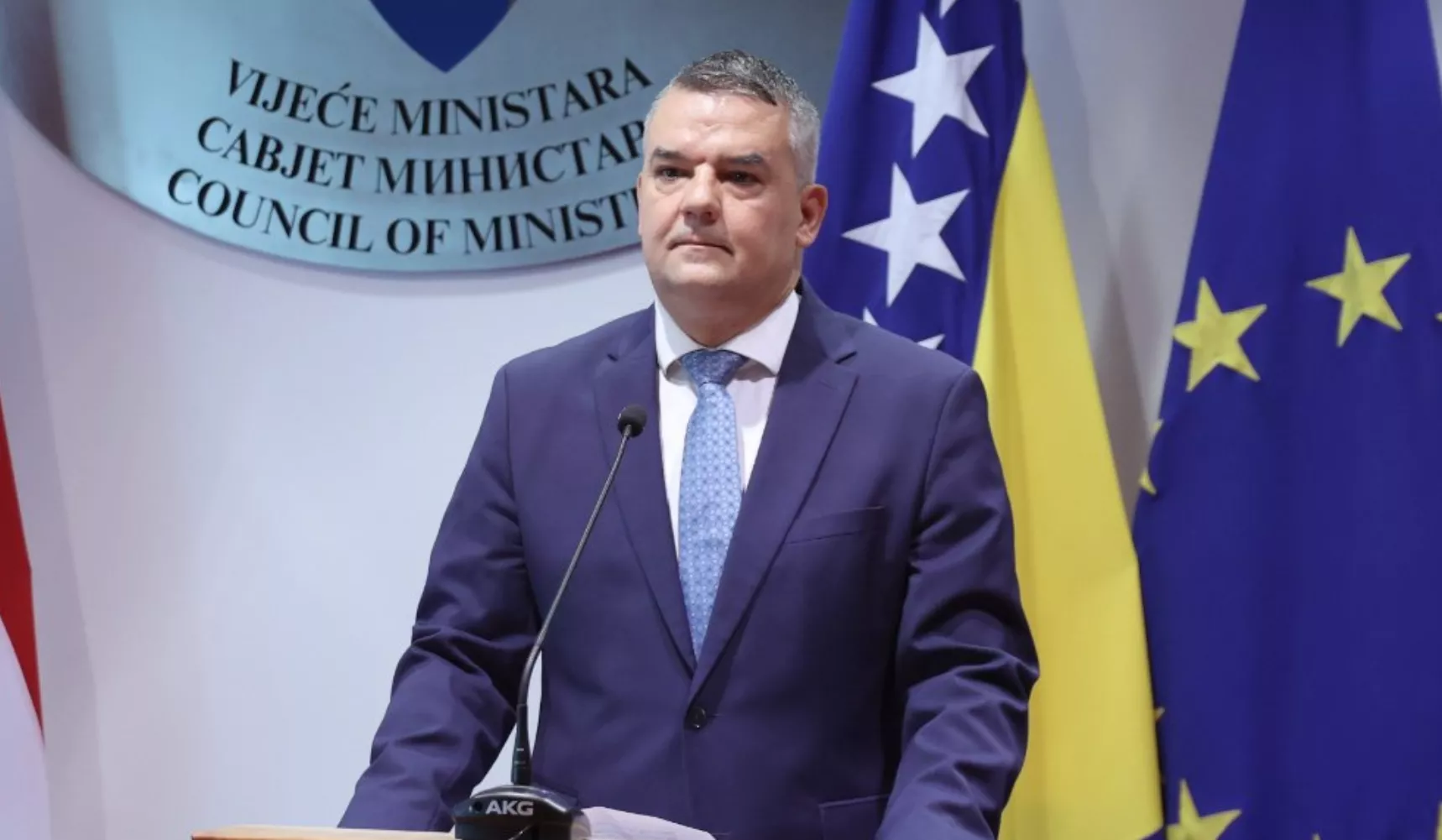
(Patria) - Minister of Justice of Bosnia and Herzegovina Davor Bunoza did not receive authorisation from both houses of the Parliamentary Assembly of Bosnia and Herzegovina to participate in drafting the statement in the 'Kovačević' case, which is being heard before the European Court of Human Rights.
As confirmed for the portal Istraga.ba, the alleged conclusion of the House of Representatives and the House of Peoples of the BiH Parliamentary Assembly, which he cited when requesting the Central Election Commission (CEC) of BiH to submit data on 'all declarations of affiliation with a constituent people or Others when participating in elections in BiH' of the appellant Slaven Kovačević, is actually a conclusion of the Collegium of the House of Representatives and the Collegium of the House of Peoples of BiH, not the Parliamentary Assembly of BiH.
"Given that this ministry has been tasked by the conclusion of the House of Representatives and the House of Peoples of the BiH Parliamentary Assembly to participate in drafting the statement in this case, we hereby address you with a request to urgently provide the requested information," Bunoza wrote in the letter, which, as it turns out, is incorrect.
Members of the Collegium of the House of Peoples and the Collegium of the House of Representatives of the BiH Parliamentary Assembly adopted such a conclusion despite the fact that the Ministry of Human Rights and Refugees of BiH is responsible for communication with the agents.
The Collegium of both houses makes decisions by consensus. Members of the Collegium of the House of Representatives of the BiH Parliamentary Assembly are Nebojša Radmanović, Marinko Čavara, and Denis Zvizdić, and of the Collegium of the House of Peoples are Dragan Čović, Nikola Špirić, and Kemal Ademović.
Nevertheless, despite this, Bunoza emphasised that every institution in BiH has an obligation to cooperate with the agents of BiH before the Court in Strasbourg.
- We received a letter from the agents stating that the CEC of BiH refuses to provide them with data, and they said we should request it. I quoted their question.
For the first time in history, an institution refused to provide information to agents defending BiH in Strasbourg. The fact is that they are defending the Constitution as it is. Why the agents are asking for this does not concern me as a minister at all - Bunoza said for Istraga.
The CEC refused to provide the agents of BiH with data on Kovačević's ethnic declaration, citing the provisions of Article 9, paragraph 2 of the Law on Personal Data Protection, which states that processing of special categories of personal data is permitted if the data subject has given explicit consent.
On the other hand, Bunoza in his letter cited the provisions of Article 9, paragraphs f) and g) of the Law on Personal Data Protection.
"Which provisions prescribe an exception to the prohibition of data processing, and that in cases where the information is already publicly published or the same information is necessary for the defence of legal claims or if it is in the public interest," Bunoza wrote.
DF representative in the House of Representatives of the BiH Parliamentary Assembly Milan Dunović told Istraga that the CEC acted absolutely correctly.
- The only one who can provide personal data is the person to whom that data belongs, in this case, Mr. Slaven Kovačević. He did not provide that data, that is one issue.
The second, much larger and more important matter is the essence of Mr. Kovačević's appeal, where his personal ethnic declaration absolutely does not derogate the Kovačević judgment.
No matter how Mr. Kovačević declared himself, the fact remains that a large number of people in BiH do not have the right to vote in a way that allows them to elect political representatives because their choice of political representatives is tied to their ethnic affiliation - said Dunović.
We remind you that Kovačević complained in his appeal that due to the combination of territorial and ethnic conditions applied to the House of Peoples of the BiH Parliament, he could not vote for candidates of his choice in the last General Elections, held in 2022.
Similarly, he could not vote for candidates of his choice in the last presidential elections at the state level in the same year.
The Court then assessed that Bosnia and Herzegovina violated the European Convention on Human Rights. The Court found that the constituent peoples clearly enjoy a privileged position in the current system.
After that, the Grand Chamber of the European Court of Human Rights in December 2023 accepted the request of the Council of Ministers of BiH, with lobbying from Croatia, to review the judgment in the 'Kovačević' case.
The appeal was then submitted by the acting agents of BiH before the Court, Monika Mijić and Jelena Cvijetić, whose mandate was questionable.
Additionally, High Representative Christian Schmidt decided to participate in the judicial process on his own initiative, allegedly from a position of impartiality.
Nevertheless, his earlier views went in the direction of discrediting the 'Kovačević' judgment, so it seems that his intentions are to weaken the position of the appellant.
Komentari (0)
Prijavite se za komentiranje
PrijavaJos nema komentara. Budite prvi!
Minuta
Sve →Iz drugih kategorija

High Representative Not Elected: Germans, French and British Sabotaged Americans, New Attempt at End of June

ČOVIĆ WITHOUT MERCY: How Those Who Brought Ademović to Office Created a Political Hell for Him



Sunny Saturday, quite warm



Tragedy in Albanian resort: Two minors drown












