
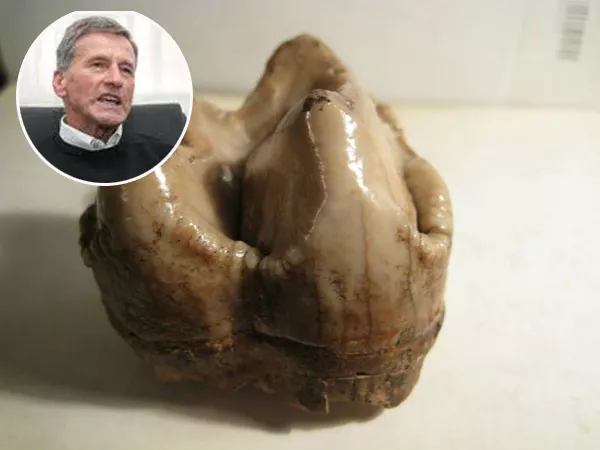
Enver Imamović, a Bosnian-Herzegovinian archaeologist and historian, has posted photos of some valuable exhibits from the National Museum in Sarajevo on social media, which the wider public in Bosnia and Herzegovina does not even know exist. In a statement to the Patria News Agency, Imamović said that a dinosaur tooth was found in Bugojno six years ago.
- We came across this discovery completely by accident. Namely, a man was digging and came across a larger skeleton of bones, removed a tooth, and gave it to his son who was studying history. My student brought this valuable discovery, and we have had it in the National Museum ever since. Unfortunately, our wider public knows little about what BiH and the National Museum possess in terms of world treasures – said Imamović.
He added that dinosaur remains were also found somewhere around Duvno in a quarry. Imamović told NAP that the National Museum, which has been closed since 2012, possesses extremely valuable exhibits.
- We have remains of fossils of animals and creatures in the museum that lived a hundred million years ago. This is an example of a snake fossil, which is the oldest in the world, and lived 200 million years ago. We also have a shark tooth found near Bosanska Gradiška, and also the remains of a whale – Imamović noted.
The professor explains that these are all fossils from a time when the entire Balkan region was under the sea, which science has named the Pannonian Sea.
- There are many exhibits in the National Museum that the wider public is unaware of, including about five percent of all the world's meteorites that have fallen to Earth. And these are the largest quantities kept in the National Museum – Imamović added.
Furthermore, Imamović reveals that the National Museum can also boast of fish fossils found in the Sarajevo neighborhood of Ciglane during the Austro-Hungarian rule.
- When Braun began construction in the eight hundreds during Austria's rule and started digging for clay for bricks, they came across fish fossils. They are very well preserved and are located in the National Museum – Imamović added.
Given that the National Museum has not been operational for some time, Imamović claims that wet preparations such as snakes, mice, and insects, which are preserved in liquid paraffin to prevent decay, are endangered at the museum.
- From time to time, this liquid needs to be changed because it evaporates, and as soon as a part is left without liquid, it disintegrates. Leather and textiles are also endangered because they require a specific temperature, as they decay from moisture. That is the only danger – Imamović explained.
Komentari (0)
Prijavite se za komentiranje
PrijavaJos nema komentara. Budite prvi!
Minuta
Sve →Iz drugih kategorija

High Representative Not Elected: Germans, French and British Sabotaged Americans, New Attempt at End of June

ČOVIĆ WITHOUT MERCY: How Those Who Brought Ademović to Office Created a Political Hell for Him



Sunny Saturday, quite warm



Tragedy in Albanian resort: Two minors drown












